Gaza Humanitarian Crisis Intensifies Amid US Israel Dynamics
Source:The Hindu ↗
Why It Matters
The conflict is a critical issue in contemporary global geopolitics, affecting stability in West Asia and testing the efficacy of international humanitarian law and institutions like the ICC. Understanding the US-Israel dynamic is essential for analysing how major power leverage influences regional conflicts and global security architecture.
Summary
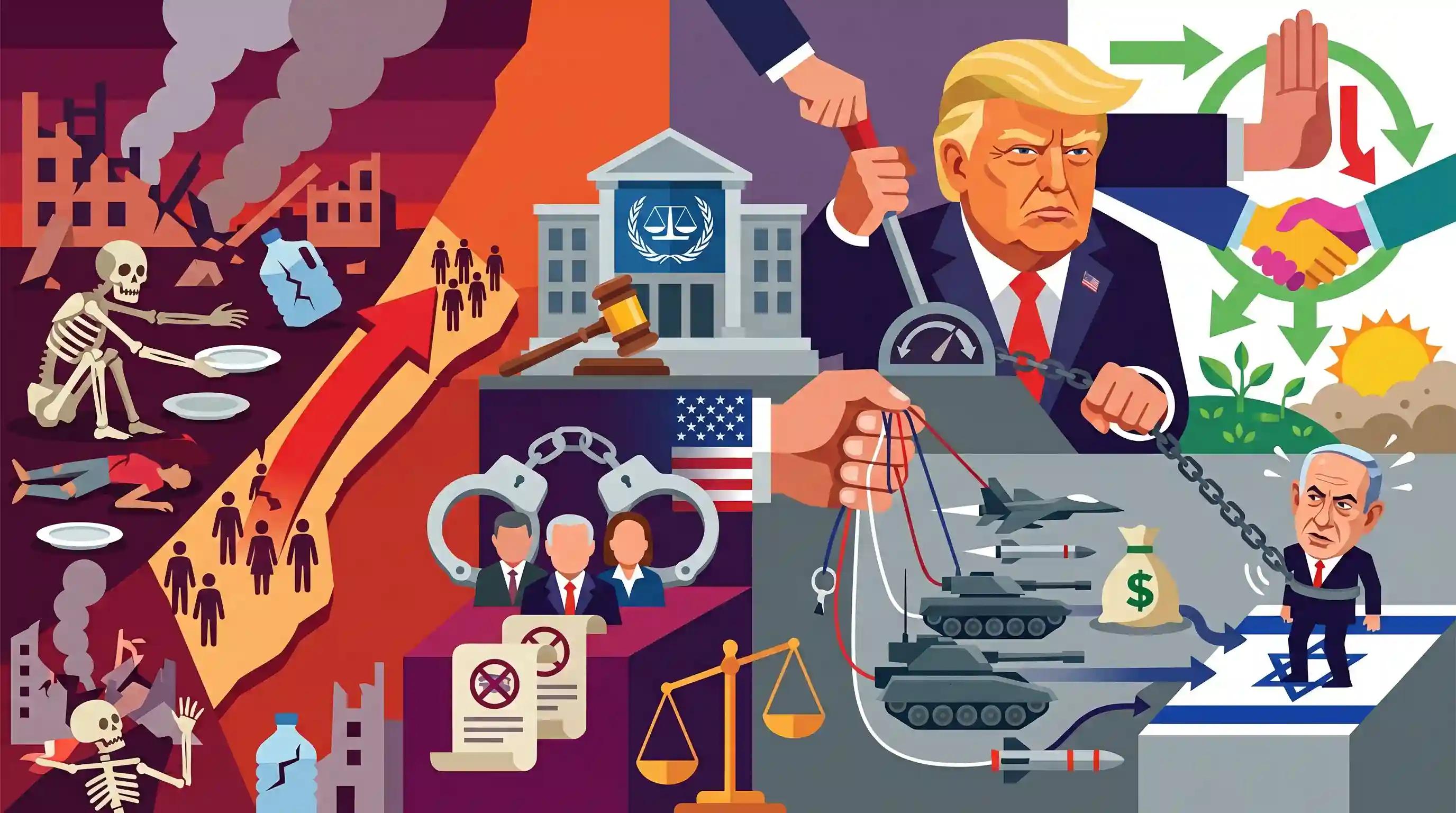
The editorial strongly condemns the ongoing humanitarian catastrophe in the Gaza Strip, highlighting mass starvation, civilian casualties, and a purported Israeli plan for the forced mass transfer of 2.3 million Palestinians. Noting the International Criminal Court's arrest warrants against Israeli leadership for alleged war crimes, it underscores the severe moral and legal implications of the conflict. The article argues that because Israel is fundamentally dependent on American military and diplomatic backing, US President Donald Trump possesses significant leverage. It urges the US administration to actively employ this influence to compel Israeli Prime Minister Benjamin Netanyahu to accept an immediate ceasefire and halt the violence.
Key Points
- Israeli Prime Minister Benjamin Netanyahu met with US President Donald Trump to reportedly seek a way to avoid agreeing to a ceasefire in Gaza.
- The IDF is allegedly planning a mass forced transfer of 2.3 million Palestinians, confining them to tightly controlled zones like Al-Mawasi and parts of Rafah.
- The humanitarian crisis in Gaza has reached catastrophic levels, characterized by mass starvation and severe civilian casualties, including children.
- The International Criminal Court (ICC) has issued arrest warrants for Israeli leaders over alleged war crimes committed during the conflict.
- Given Israel's heavy reliance on American military, diplomatic, and economic support, the editorial urges President Trump to use US leverage to enforce an immediate ceasefire.
Important Terms
International Criminal Court (ICC)

A permanent international tribunal headquartered in The Hague that prosecutes individuals for genocide, war crimes, and crimes against humanity. It recently issued arrest warrants for Israeli and Hamas leadership.
UPSC context
GS Paper II (International Institutions). Tests understanding of global justice, jurisdictional challenges, and India's position as a non-signatory.
Hamas
A Palestinian Sunni-Islamic militant and political organization that has governed the Gaza Strip since 2007. It is designated as a terrorist group by many Western nations.
UPSC context
GS Paper II (International Relations). Central to West Asian security dynamics and India's "de-hyphenated" foreign policy.
Rome Statute
The 1998 treaty that established the International Criminal Court. It defines the court's jurisdiction and core crimes, emphasizing the principle of complementarity with national courts.
UPSC context
GS Paper II. Important for analyzing state sovereignty and why India, the US, and Israel have not ratified the treaty.
International Humanitarian Law (IHL)
A set of rules seeking to limit the effects of armed conflict by protecting non-combatants and restricting methods of warfare. Key treaties include the Geneva Conventions.
UPSC context
GS Paper II (Human Rights). Tests knowledge of wartime ethics, civilian protection, and legal accountability in global conflicts.
Two-State Solution
A proposed diplomatic framework envisioning an independent State of Palestine alongside the State of Israel, based on pre-1967 borders, to resolve the long-standing conflict.
UPSC context
GS Paper II. India’s official stance on the conflict; essential for discussing regional peace and stability.
West Asia Geopolitics
The complex interplay of power, energy interests, and religious-political alliances in the region. Shifts in US policy significantly impact Indian energy security and the diaspora.
UPSC context
GS Paper II (Effect of Policies of Developed Countries). Analyzes how regional instability affects India's "Link West" policy.
Israel Defense Forces (IDF)
The unified military forces of the State of Israel, responsible for ground, air, and naval operations. They are the primary actors in the current Gaza military offensive.
UPSC context
GS Paper II. Relevant for studying regional defense dynamics and India-Israel strategic cooperation.
Prelims Trap
The International Criminal Court has universal jurisdiction and automatically applies to all UN member states.
The ICC is an independent body created by the Rome Statute, not a UN organ. India, the US, and Israel are not signatories.
Static Concepts Connected
What are the key differences between the ICC and the ICJ?
- Jurisdiction: The ICC prosecutes individuals for international crimes (war crimes, genocide). The ICJ settles legal disputes submitted by member states.
- UN Affiliation: The ICJ is the primary judicial organ of the UN. The ICC is independent, established by the Rome Statute.
- Membership: All UN members are automatically parties to the ICJ statute. ICC requires explicit ratification of the Rome Statute.
What are the key geographic boundaries and crossings of the Gaza Strip?
- Borders: Bordered by the Mediterranean Sea (West), Israel (North/East), and Egypt (Southwest).
- Rafah Crossing: Located on the Gaza-Egypt border in the south, it is the sole crossing point not directly controlled by Israel.
- Kerem Shalom: A key commercial crossing situated near the junction of Gaza, Israel, and Egypt.
Cross-Topic Patterns
Israel ties vs. Global South leadership
India's deep defense and technology ties with Israel often complicate its stance as the "Voice of the Global South," requiring a delicate diplomatic balancing act during UN votes on Palestinian human rights.
Geneva Conventions & Demographic Engineering
The forced relocation of Gazans to zones like Al-Mawasi invokes Article 49 of the Fourth Geneva Convention, linking directly to UPSC themes on human rights law and refugee definitions.

Expect a multi-statement question contrasting ICC and ICJ jurisdictions, or mapping West Asian border crossings like Rafah, in Prelims 2026.
Linked PYQs · 2
Linked PYQs · 2
- 2019MainsGS2
‘Too little cash, too much politics, leaves UNESCO fighting for life.’ Discuss the statement in the light of US' withdrawal and its accusation of the cultural body as being 'anti-Israel bias'.
- 2018MainsGS2
“India’s relations with Israel have, of late, acquired a depth and diversity, which cannot be rolled back.” Discuss.
