US President Warns Allies Against Russian Oil and Imposes Tariffs
Source:Indian Express ↗
Why It Matters
Highlights the direct economic and diplomatic pressures India faces under shifting US foreign policies, specifically regarding energy security and trade protectionism. Understanding this complex web of sanctions and tariffs is critical for analyzing India's strategic autonomy and its balancing act in a increasingly polarized global order.
Summary
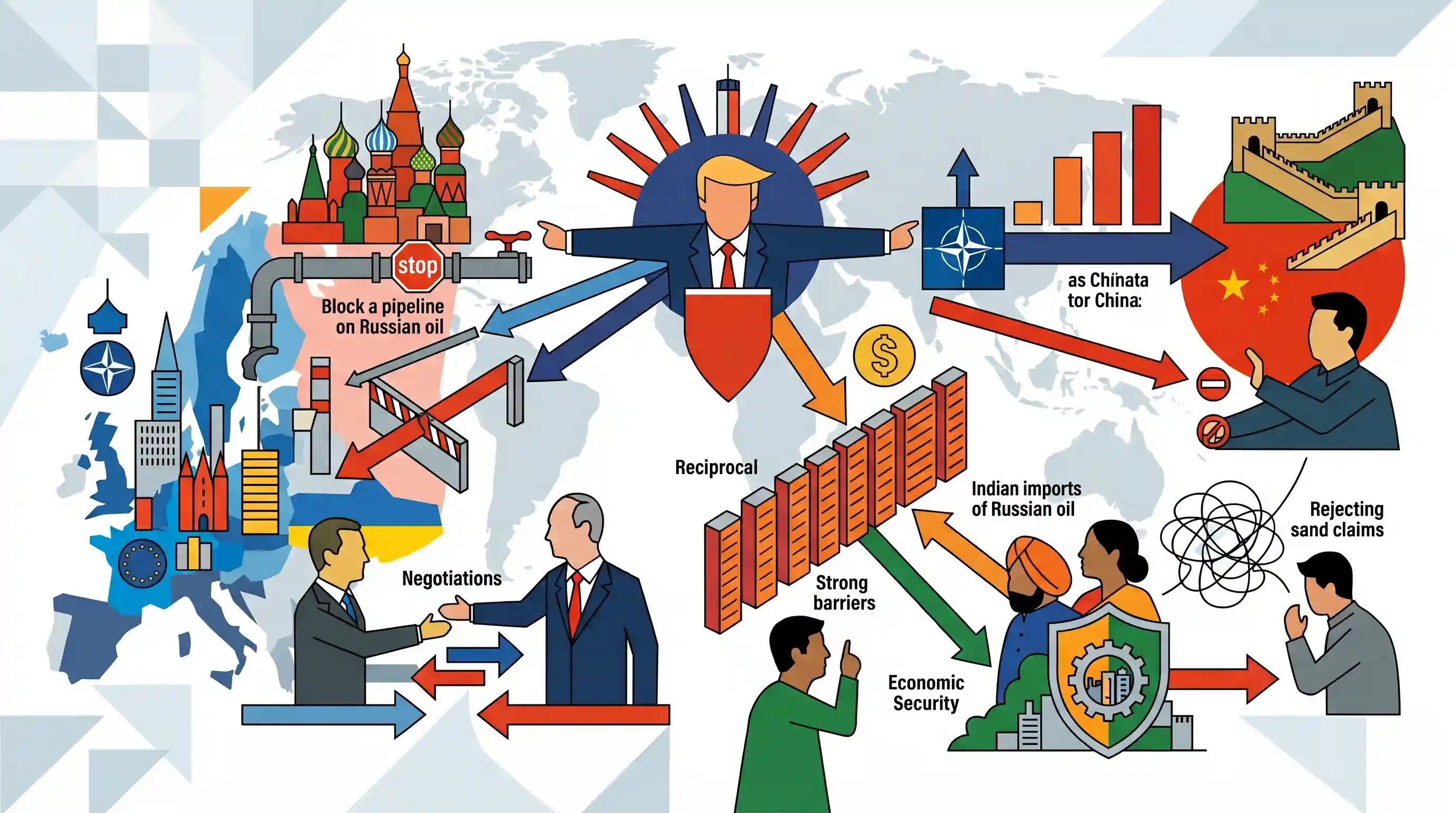
US President Donald Trump has issued a series of ultimatums regarding the ongoing Russia-Ukraine war, urging the EU and NATO to stop buying Russian oil and pressing Ukrainian President Volodymyr Zelenskyy to negotiate with Vladimir Putin. He also criticized existing European sanctions as insufficient. In a broader push involving trade and geopolitics, Trump imposed 25% reciprocal tariffs on India, supplemented by an additional 25% tariff on Indian imports of Russian oil. India swiftly condemned the action as unjustified, reiterating its commitment to safeguarding its economic security. Furthermore, Trump demanded that NATO allies enforce steep 50-100% sanctions on China for allegedly supporting Russia's military—a claim firmly denied by Chinese Foreign Minister Wang Yi, who cautioned that such sanctions would only complicate global conflicts.
Key Points
- US President Donald Trump urged the European Union and NATO to stop purchasing Russian oil, and advised Ukrainian President Volodymyr Zelenskyy to negotiate directly with Russian President Vladimir Putin.
- Trump imposed a 25% reciprocal tariff on India along with an additional 25% tariff specifically targeting India's Russian oil imports, prompting India to condemn the move as unjustified.
- Trump called on NATO allies to impose 50-100% sanctions on China, alleging Beijing is propping up Russia's military capacity.
- China's Foreign Minister Wang Yi denied the allegations, stating that Beijing does not participate in wars and that sanctions complicate conflicts.
Important Terms
NATO (North Atlantic Treaty Organization)

An intergovernmental military alliance between North American and European countries. It operates on the principle of collective defense, where an attack on one member is considered an attack on all.
UPSC context
GS Paper II: International Relations. Tests understanding of global security architectures, multilateral alliances, and India's relationship with Western-led blocs.
European Union (EU)
A political and economic union of 27 European member states. It functions as a single market and is a major global trading bloc and strategic partner for India.
UPSC context
GS Paper II: International Relations. Relevant for bilateral trade agreements (BTAs), global governance, and Indian diaspora/economic interests in Europe.
Reciprocal Tariffs
A trade policy where a country matches the tariff rates imposed by a trading partner. It aims to achieve tariff parity and address perceived trade imbalances.
UPSC context
GS Paper III: Economy (Trade). Tests concepts of protectionism, trade wars, and the impact of US trade policies on Indian exports.
Strategic Autonomy
India’s foreign policy framework of maintaining independent decision-making and avoiding military alliances. It allows India to engage with multiple global powers based on national interest.
UPSC context
GS Paper II: International Relations. Core theme in Indian diplomacy regarding its "multi-alignment" and neutral stance in global conflicts.
Secondary Sanctions
Economic penalties applied by one country against third-party entities that conduct business with a primary sanctioned target (e.g., Russia). It forces third parties to choose between markets.
UPSC context
GS Paper II: International Relations. Critical for understanding the extraterritorial reach of US law and its impact on India's energy imports.
Energy Security
The uninterrupted availability of energy sources at an affordable price. It involves diversifying energy sources and routes to minimize economic vulnerability to supply disruptions.
UPSC context
GS Paper III: Economy/Infrastructure. Tests India’s strategies to secure oil/gas amidst global sanctions and geopolitical volatility.
Prelims Trap
"The US tariff on India's Russian oil imports functions as a UN-mandated multilateral sanction."
Aspirants confuse US unilateral extraterritorial measures (like secondary sanctions/tariffs) with UN-backed multilateral sanctions. India legally only recognizes UN-mandated sanctions, not unilateral ones.
Static Concepts Connected
Primary vs. Secondary Sanctions: What is the difference?
- Primary Sanctions: Prohibits citizens and firms of the sanctioning country from engaging in trade or financial relations with the target nation.
- Secondary Sanctions: Extraterritorial coercive measures targeting third-party nations or foreign entities to prevent them from doing business with the sanctioned state.
How do unilateral tariffs conflict with WTO rules?
- MFN Principle: Under the WTO, a country cannot normally discriminate between its trading partners, ensuring equal treatment for all members.
- Unilateral Actions: Reciprocal or punitive tariffs applied unilaterally outside the WTO dispute settlement mechanism violate this core non-discrimination pillar.
Cross-Topic Patterns
Energy Security & Strategic Autonomy
India's defiance of US tariffs to buy Russian crude illustrates how securing affordable energy dictates India's independent foreign policy choices and non-alignment.
Weaponization of Trade & Tariffs
The use of tariffs as a de facto secondary sanction marks a shift from diplomacy to geoeconomic coercion, undermining the WTO-led multilateral trading system.

Expect a 2026 question pairing 'Secondary Sanctions' with 'WTO MFN exceptions' or 'National Security exemptions' (GATT Article XXI).
Linked PYQs · 4
Linked PYQs · 4
- 2025MainsGS3
What are the challenges before the Indian economy when the world is moving away from free trade and multilateralism to protectionism and bilateralism? How can these challenges be met?
- 2025MainsGS2
"Energy security constitutes the dominant kingpin of India's foreign policy, and is linked with India's overarching influence in Middle Eastern countries.” How would you integrate energy security with India's foreign policy trajectories in the coming years?
- 2021MainsGS2
“The USA is facing an existential threat in the form of a China, that is much more challenging than the erstwhile Soviet Union.” Explain.
- 2023MainsGS2
‘The expansion and strengthening of NATO and a stronger US-Europe strategic partnership works well for India.’ What is your opinion about this statement ? Give reasons and examples to support your answer.
