Cyclone Ditwah Trajectory and Urban Flood Preparedness Gaps
Source:The Hindu ↗
Why It Matters
Urban flooding is a recurrent and highly consequential theme in UPSC GS1 and GS3. This article serves as an excellent case study detailing why heavy capital investment in municipal drainage fails without accompanying structural reforms like desilting natural waterways, enforcing land zoning, and implementing basin-wise expert committee recommendations. It perfectly encapsulates the intersection of extreme weather events (cyclones) and flawed urbanization.
Summary
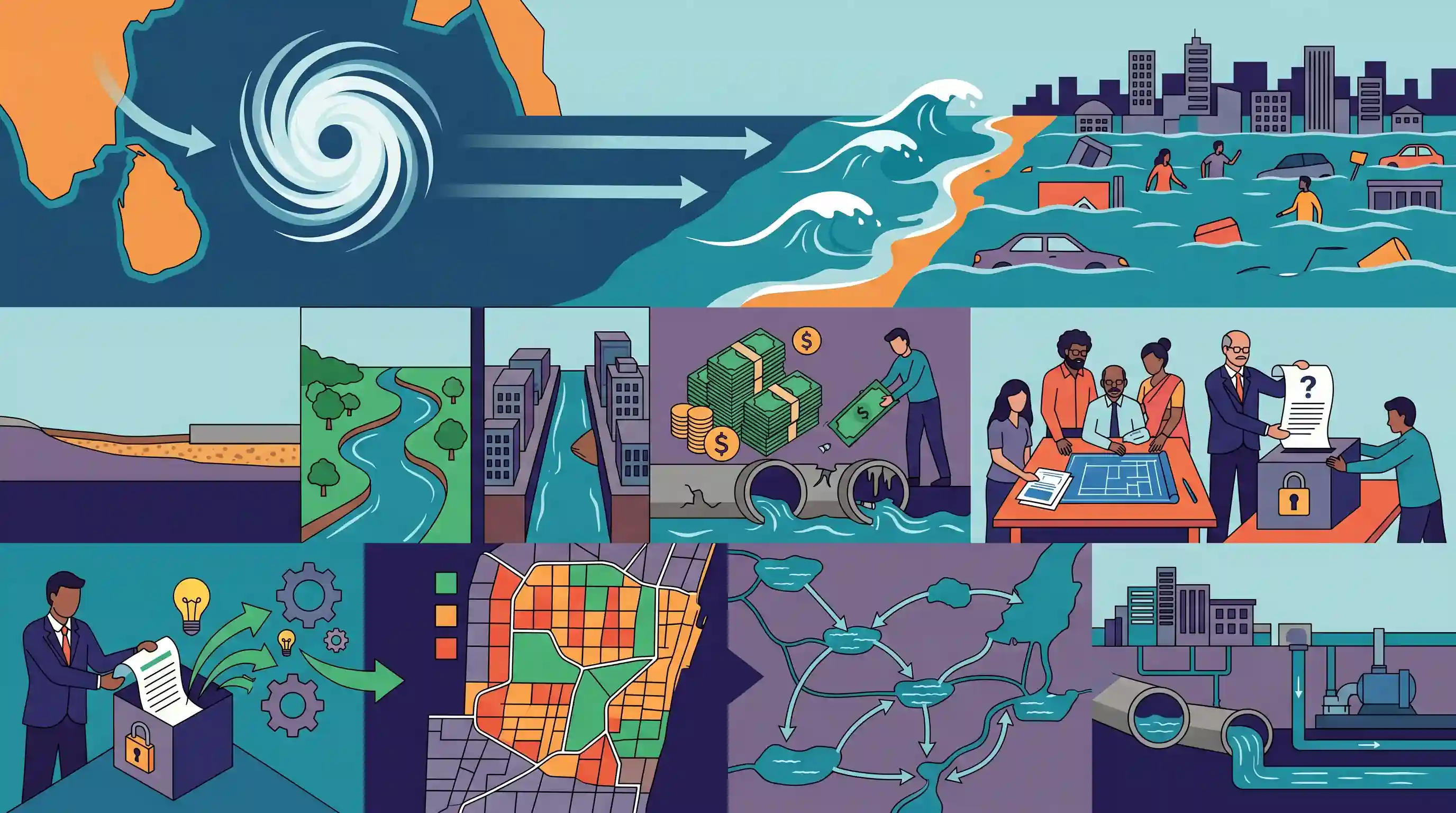
The editorial highlights the destructive trajectory of Cyclone Ditwah, from causing a national disaster in Sri Lanka to bringing severe urban flooding to Chennai. It reveals significant gaps in Chennai's disaster preparedness and infrastructure, arguing that despite vast investments in the stormwater network, the city's flat topography, rapid paving, and encroached rivers render it highly vulnerable. The piece underscores a glaring lack of transparency regarding the Thiruppugazh Committee's flood mitigation recommendations and calls for urgent publication of the report, strict zoning regulations, and basin-wide coordination to handle future climate-induced disasters.
Key Points
- Cyclone Ditwah caused massive devastation in Sri Lanka before re-entering the Bay of Bengal, parking as a deep depression off Chennai and triggering extreme rainfall.
- Despite the Greater Chennai Corporation (GCC) spending ₹5,200 crore to expand the stormwater drain network, intense rain bursts and unlinked drains led to severe urban flooding.
- Chennai's flat layout, expanding paved areas, and inadequate desilting of crucial waterways like the Kosasthalaiyar river significantly worsened the deluge.
- The comprehensive flood management recommendations made by the Thiruppugazh Committee after the 2021 floods remain largely out of public view.
- The editorial calls for holistic basin-wide coordination, transparent sharing of flood maps, strict enforcement of zoning laws, and immediate infrastructure fixes.
Important Terms
Cyclone Ditwah

A catastrophic, slow-moving tropical cyclone (Nov–Dec 2025) that caused devastating floods in Sri Lanka before impacting Chennai. It exemplifies 'rain machine' storms that linger, dumping extreme precipitation.
UPSC context
GS III: Disaster Management. Tests knowledge of cyclone behavior, regional impacts, and emergency response mechanisms in South Asia.
Thiruppugazh Committee
An expert panel appointed after the 2021 floods to develop a flood mitigation strategy for Chennai. It proposed basin-wide planning, regulatory reforms, and over 160 specific infrastructure tasks.
UPSC context
GS II/III: Governance and Disaster Management. Essential for studying policy frameworks and committee-led administrative reforms for urban flooding.
Integrated Urban Flood Management (IUFM) Project
An ADB-funded initiative ($470.5 million) focused on the Kosasthalaiyar basin. It integrates climate-resilient infrastructure, such as drains and pumping stations, with institutional capacity building for the GCC.
UPSC context
GS III: Infrastructure and Disaster Management. Relevant for questions on international funding and integrated planning for climate resilience.
Greater Chennai Corporation (GCC)
The urban local body (ULB) governing Chennai. It is the primary agency for implementing flood mitigation projects, managing stormwater networks, and coordinating on-ground disaster relief.
UPSC context
GS II: Urban Local Bodies. Tests the functional role of ULBs in urban governance and disaster preparedness.
Kosasthalaiyar Basin
A major river basin in North Chennai, identified as a critical flood-prone area. It is the primary site for current large-scale infrastructure and ecosystem restoration projects.
UPSC context
GS I/III: Geography and Disaster Management. Tests understanding of river basin management and localized urban vulnerabilities.
Nature-based Solutions (NbS)
Sustainable planning strategies using natural ecosystems (e.g., lake rejuvenation, sponge parks) to manage climate risks. They provide a cost-effective, ecological alternative to traditional concrete infrastructure.
UPSC context
GS III: Environment and Disaster Management. A key concept in modern climate adaptation and sustainable urban development.
Prelims Trap
Cyclones invariably dissipate entirely after making landfall and cannot cause further coastal damage.
Cyclones can survive crossing narrow landmasses (like Sri Lanka) and re-intensify or park over adjacent warm waters (Bay of Bengal) by drawing fresh moisture.
Static Concepts Connected
What fundamentally differentiates Urban Flooding from rural riverine flooding?
- Impervious surfaces: Concretization severely restricts groundwater infiltration, increasing surface runoff volume by up to six times compared to natural terrain.
- Faster peak discharge: Artificial drains and paved surfaces speed up water flow, leading to rapid, high-volume peak discharges resulting in flash floods.
- Loss of sinks: Encroachment on natural drainage systems, floodplains, and wetlands drastically reduces the city's natural holding capacity during extreme rainfall.
Why do deep depressions cause extreme rainfall even without severe cyclonic winds?
- Stalling systems: When a weather system stalls or 'parks' near the coast, it continuously dumps moisture over a localized area for days.
- Coastal friction: As the system approaches land, increased friction slows wind speeds but forces moisture-laden air to rise rapidly, causing intense precipitation.
Cross-Topic Patterns
Urban flooding + Wetland encroachment
The destruction of urban sinks (like Pallikaranai in Chennai) shifts disaster focus from purely structural measures (stormwater drains) to ecological preservation and wetland conservation.
Disaster management + Governance transparency
The non-publication of the Thiruppugazh Committee report highlights a major governance gap in the NDMA/SDMA framework regarding citizen access to hazard zonation maps.

Urban flooding Mains questions in 2026 will shift from generic causes to evaluating ecosystem-based vs hard-infrastructure mitigation.
Linked PYQs · 4
Linked PYQs · 4
- 2024MainsGS3
Flooding in urban areas is an emerging climate-induced disaster. Discuss the causes of this disaster. Mention the features of two such major floods in the last two decades in India. Describe the policies and frameworks in India that aim at tackling such floods.
- 2020MainsGS1
Account for the huge flooding of million cities in India including the smart ones like Hyderabad and Pune. Suggest lasting remedial measures.
- 2022MainsGS1
Discuss the meaning of colour-coded weather warnings for cyclone prone areas given by India Meteorological Department.
- 2023MainsGS1
Comment on the resource potentials of the long coastline of India and highlight the status of natural hazard preparedness in these areas.
