NASA Axiom ISRO Collaboration for Gaganyaan Human Spaceflight
Source:The Hindu ↗
Why It Matters
The NASA-Axiom-ISRO collaboration is a pivotal milestone for India's highly anticipated Gaganyaan mission. It underscores the importance of international strategic technology partnerships, overcoming regulatory barriers like ITAR, and highlights the technical and logistical preparations required for manned spaceflight.
Summary
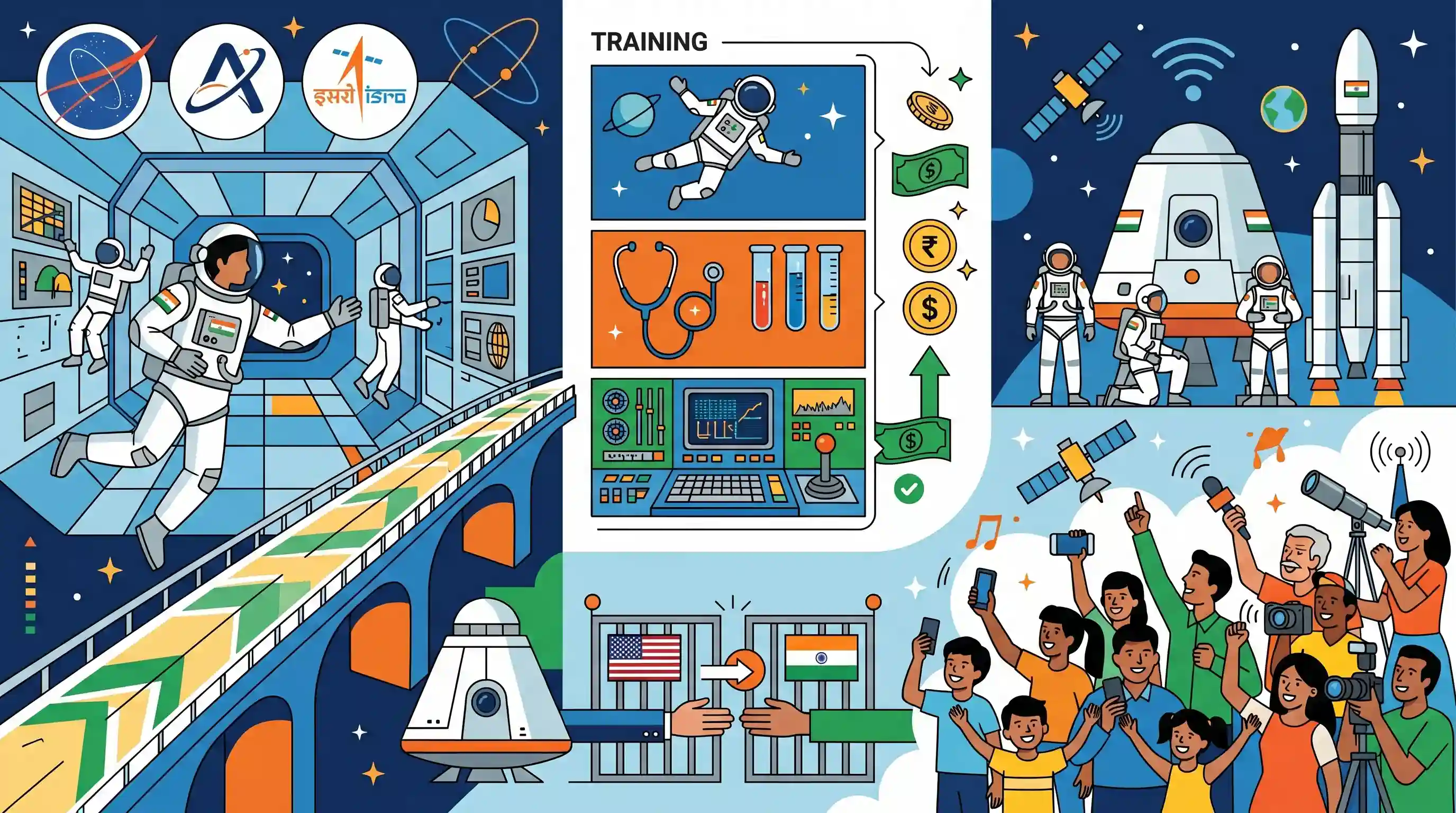
An editorial discussing the successful completion of Indian astronaut Shubhanshu Shukla's mission to the International Space Station under a NASA-Axiom-ISRO collaboration. The mission serves as a vital stepping stone for ISRO's upcoming Gaganyaan human spaceflight programme in 2027. Despite the ₹500 crore cost, the training—which covered microgravity adaptation, space medicine, and spacecraft operations—was cost-effective and successfully navigated US ITAR restrictions. The editorial emphasizes the need for ISRO to enhance its public outreach to build excitement for India's upcoming manned space endeavours.
Key Points
- Indian astronaut Shubhanshu Shukla completed a roughly two-week mission to the ISS, serving as a critical rehearsal for ISRO's Gaganyaan mission expected in 2027.
- The mission was facilitated by a NASA-Axiom-ISRO collaboration, costing ISRO over ₹500 crore, which is considered more cost-effective than independent training.
- Astronauts Shukla and Prasanth Nair received extensive training in advanced spacecraft systems, docking, microgravity adaptation, and space medicine, including exposure to Japanese and European modules.
- The collaboration successfully circumvented strategic technology limitations typically imposed by the U.S. International Traffic in Arms Regulations (ITAR).
- The editorial urges ISRO to improve its public communication and outreach to build excitement and leverage soft power ahead of India's first human spaceflight mission.
Important Terms
Gaganyaan

India's flagship human spaceflight mission aimed at sending a three-member crew to Low Earth Orbit (400 km) for three days and returning them safely to Earth.
UPSC context
GS Paper III (Science & Technology): Tests knowledge of indigenous technological milestones, space exploration capabilities, and self-reliance in high-end technology.
International Traffic in Arms Regulations (ITAR)
A United States regulatory regime that controls the export and import of defense-related articles and services, including sensitive spacecraft and satellite technologies.
UPSC context
GS Paper II & III: Relevant for bilateral strategic partnerships, technology transfer barriers, and India-US space cooperation dynamics.
ISRO
India's national space agency, established in 1969, responsible for the development and application of space technology for national development and planetary exploration.
UPSC context
GS Paper III: Primary body for questions on India's space achievements, indigenization, and institutional framework in science and technology.
Axiom Space
A private American space infrastructure company that facilitates commercial missions to the International Space Station and is building the first commercial space station.
UPSC context
GS Paper III: Highlights the increasing role of the private sector and "New Space" in global and Indian space ecosystems.
Department of Space (DoS)
The nodal Indian government department, directly under the Prime Minister, responsible for the administration and policy framework of the Indian space programme.
UPSC context
GS Paper II (Governance): Essential for understanding the administrative structure and executive oversight of India's scientific institutions.
International Space Station (ISS)
A multi-nation habitable artificial satellite in low Earth orbit that serves as a microgravity and space environment research laboratory for global scientific collaboration.
UPSC context
GS Paper III: A frequent subject regarding international cooperation, microgravity research, and the future of human presence in space.
Prelims Trap
"Axiom-4 was an exclusive government-to-government mission operated solely by NASA and ISRO."
Axiom Space is a private entity. Axiom-4 is a commercial spaceflight, not a purely inter-governmental mission, highlighting the ongoing privatization of Low Earth Orbit (LEO).
Static Concepts Connected
What are the key architectural features of ISRO's Gaganyaan mission?
- Orbit Profile: Targeting Low Earth Orbit (LEO) at ~400 km altitude, carrying a crew of up to 3 members for a 3-day mission.
- Launch Vehicle: Relies on the Human-rated LVM3 (HLVM3), which consists of solid, liquid, and cryogenic stages equipped with a Crew Escape System.
- Orbital Module: Comprises a pressurized habitable Crew Module with an Earth-like environment, and an unpressurized Service Module for propulsion and power.
What are the U.S. International Traffic in Arms Regulations (ITAR)?
- Purpose: A stringent U.S. regulatory regime restricting the export of defense and space-related articles, services, and related technical data to safeguard national security.
- Strategic Shift: Historically blocked US-India tech transfers, but recent bilateral frameworks like the iCET and India's STA-1 status have created pathways to navigate these barriers.
Cross-Topic Patterns
iCET + Commercial Space
Axiom-4 highlights the operationalization of the US-India iCET. Utilizing a private company (Axiom) helps navigate legacy ITAR roadblocks, advancing bilateral space and defense technology sharing.
Microgravity + Human Physiology
Upcoming exams will likely test space medicine concepts like bone density loss and fluid shifts, as India transitions from robotic probes to crewed orbital missions.

Expect a 2026 prelims question blending Gaganyaan's orbital parameters with commercial LEO players (Axiom) and US-India iCET agreements.
Linked PYQs · 2
Linked PYQs · 2
- 2017MainsGS3
India has achieved remarkable successes in unmanned space missions including the Chandrayaan and Mars Orbitter Mission, but has not ventured into manned space missions. What are the main obstacles to launching a manned space mission, both in terms of technology and logistics? Examine critically.
- 2025PrelimsGS1
Consider the following space missions : I. Axiom-4 II. SpaDeX III. Gaganyaan How many of the space missions given above encourage and support micro-gravity research?
