Indian Economy Resilience Amid Global Headwinds and Inflation
Source:The Hindu ↗
Why It Matters
Understanding the interplay between global economic conditions and India's domestic policy responses is crucial for aspirants, as questions frequently cover RBI's monetary tools, inflation dynamics, exchange rate management, and the impact of global trade protectionism on the Indian economy.
Summary
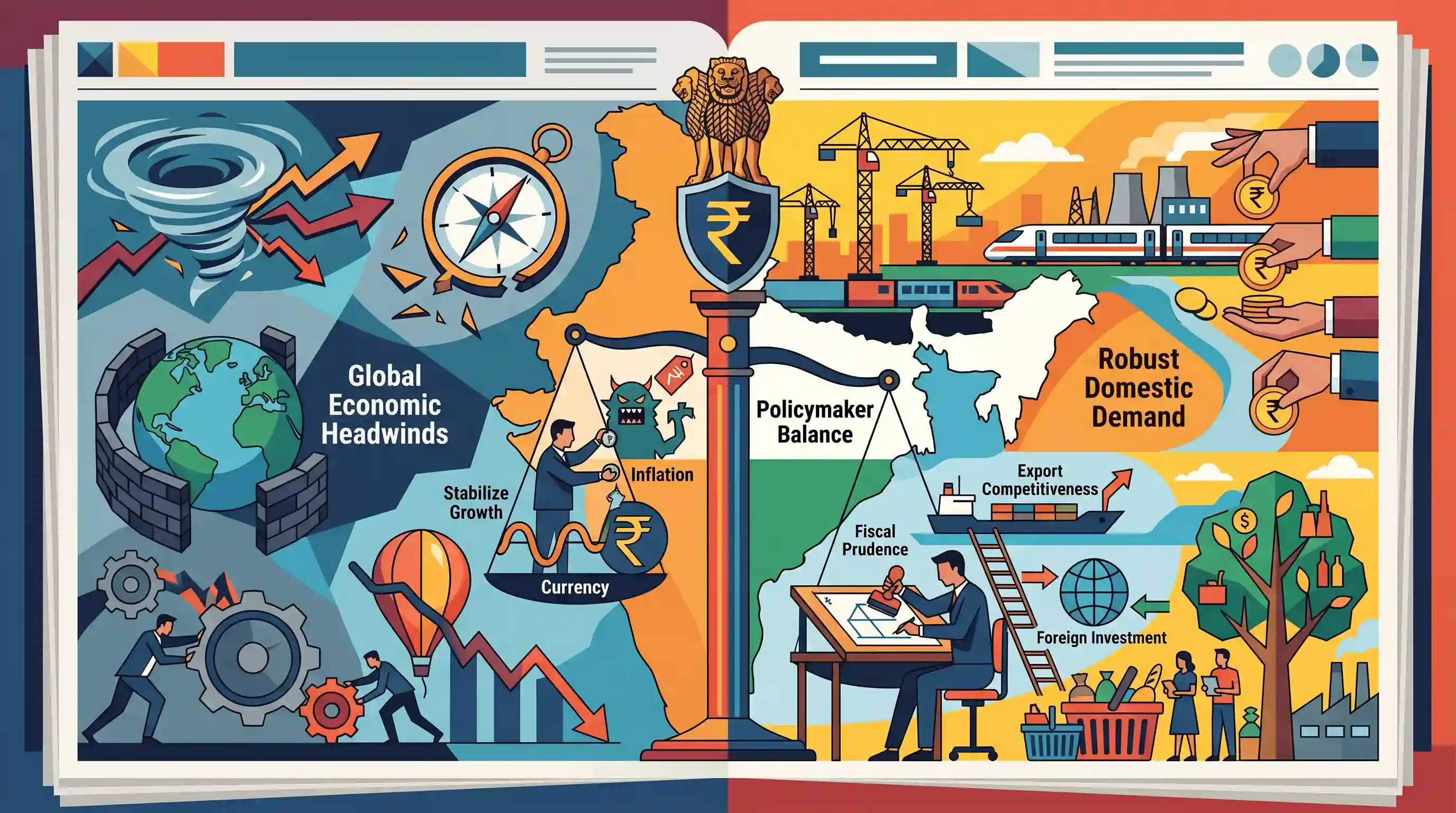
The article analyzes the performance and resilience of the Indian economy in the context of mounting global challenges, including geopolitical uncertainties, protectionist trends, and sluggish global growth. It highlights that while external headwinds pose risks to exports and capital flows, India's robust domestic demand, supported by strong government capital expenditure, continues to drive growth. The piece underscores the critical role of the Reserve Bank of India (RBI) in managing inflation and stabilizing the currency amidst fluctuating global interest rates. Furthermore, it emphasizes that to sustain long-term growth and macroeconomic stability, policymakers must balance fiscal prudence with structural reforms that enhance export competitiveness and attract sustained foreign investments.
Key Points
- The Indian economy has demonstrated significant resilience despite global headwinds such as geopolitical tensions, supply chain disruptions, and tight monetary conditions in advanced economies.
- Domestic demand, bolstered by sustained government capital expenditure and a recovering private sector, remains the primary engine driving India's GDP growth.
- The Reserve Bank of India (RBI) has been instrumental in maintaining macroeconomic stability by carefully managing inflation through monetary policy and utilizing foreign exchange reserves to stabilize the Rupee.
- The external sector faces vulnerabilities, particularly a slowdown in merchandise exports, exacerbated by weak global demand, rising protectionism, and currency fluctuations.
- Long-term economic steering requires strict adherence to fiscal consolidation while implementing structural reforms to boost manufacturing competitiveness and attract foreign investment.
Important Terms
Reserve Bank of India (RBI)

India's central bank and statutory body established under the RBI Act, 1934. It manages the country's monetary policy, regulates the banking system, and maintains price stability through inflation targeting.
UPSC context
GS Paper III (Economy). Core for questions on monetary authority, banking regulation, and inflation management.
US Federal Reserve (US Fed)
The central bank of the United States. Its interest rate decisions, particularly the Federal Funds Rate, profoundly impact global capital flows, the Indian Rupee's value, and external borrowing costs.
UPSC context
GS Paper III (Economy). Tests understanding of global-domestic economic linkages and currency volatility.
Capital Expenditure (Capex)
Government spending on creating long-term physical or financial assets like infrastructure, machinery, and equipment. It is prioritized in India for its high 'multiplier effect' on GDP and job creation.
UPSC context
GS Paper III (Growth & Budgeting). Critical for questions on investment-led growth and fiscal policy.
Fiscal Prudence
Responsible management of public finances by controlling fiscal deficits and maintaining sustainable debt levels. It ensures the government spends efficiently without over-relying on borrowing, as guided by the FRBM Act.
UPSC context
GS Paper III (Government Budgeting). Essential for topics on fiscal consolidation and debt sustainability.
Monetary Policy
The process by which the central bank manages money supply and interest rates to achieve goals like inflation control and price stability, primarily through tools like the Repo Rate.
UPSC context
GS Paper III (Economy). Tests knowledge of the Monetary Policy Committee (MPC) and liquidity management.
Protectionism
The use of trade barriers like tariffs, quotas, and subsidies to shield domestic industries from foreign competition. It often hinders global trade growth and affects India's export competitiveness.
UPSC context
GS Paper III (External Sector). Relevant for trade wars, WTO issues, and export-led growth challenges.
Prelims Trap
The RBI manages foreign exchange reserves to maintain a fixed exchange rate for the Rupee.
India follows a managed floating exchange rate system. The RBI intervenes strictly to curb excessive volatility, not to defend a specific target exchange rate.
Static Concepts Connected
Why does Capital Expenditure (Capex) have a higher economic multiplier effect?
- Asset Creation: Capex generates physical or social assets that increase the economy's future productive capacity, rather than just funding daily operations.
- Multiplier Size: It typically has a multiplier greater than 2.5, spurring long-term job creation and demand, unlike revenue expenditure which usually has a multiplier below 1.
- Crowding In: High public capital spending on foundational infrastructure reduces logistics costs, thereby attracting and crowding-in private sector investment.
How does the RBI sterilize its foreign exchange market interventions?
- Liquidity Impact: Buying dollars injects rupee liquidity into the economy, while selling dollars to defend the currency drains rupee liquidity.
- Sterilization Tools: The RBI uses Open Market Operations (OMOs) or the Market Stabilization Scheme (MSS) to absorb or inject rupees, neutralizing the liquidity mismatch.
- Imported Inflation: By selling dollars to prevent sharp Rupee depreciation, the RBI controls imported inflation, keeping critical imports like crude oil affordable.
Cross-Topic Patterns
Global Protectionism & China Plus One
Rising global tariffs and trade barriers make India's domestic PLI schemes and recent FTAs critical for integrating into shifting global supply chains.
Fiscal Consolidation & Twin Deficits
Balancing high government capex with strict fiscal deficit reduction is essential to avoid twin-deficit shocks if external export revenues continue to fall.

Expect a 2026 prelims statement-based question linking RBI's sterilization via OMOs with managing imported inflation.
Linked PYQs · 3
Linked PYQs · 3
- 2022PrelimsGS1
With reference to the Indian economy, consider the following statements: 1. If the inflation is too high, Reserve Bank of India (RBI) is likely to buy government securities. 2. If the rupee is rapidly depreciating, RBI is likely to sell dollars in the market. 3. If interest rates in the USA or European Union were to fall, that is likely to induce RBI to buy dollars. Which of the statements given above are correct?
- 2018MainsGS3
How would the recent phenomena of protectionism and currency manipulations in world trade affect macroeconomic stability of India?
- 2019MainsGS3
Do you agree with the view that steady GDP growth and low inflation have left the Indian economy in good shape? Give reasons in support of your arguments.
