Decarbonisation and Green Transition in Indian Logistics Sector
Source:The Hindu ↗
Why It Matters
The logistics sector is the backbone of the economy but also one of the fastest-growing emitters. Understanding the decarbonisation of this sector helps UPSC aspirants link infrastructure development (reducing logistics costs to improve competitiveness) with climate action (meeting Net-Zero targets), illustrating a key GS-3 intersection of economy and environment.
Summary
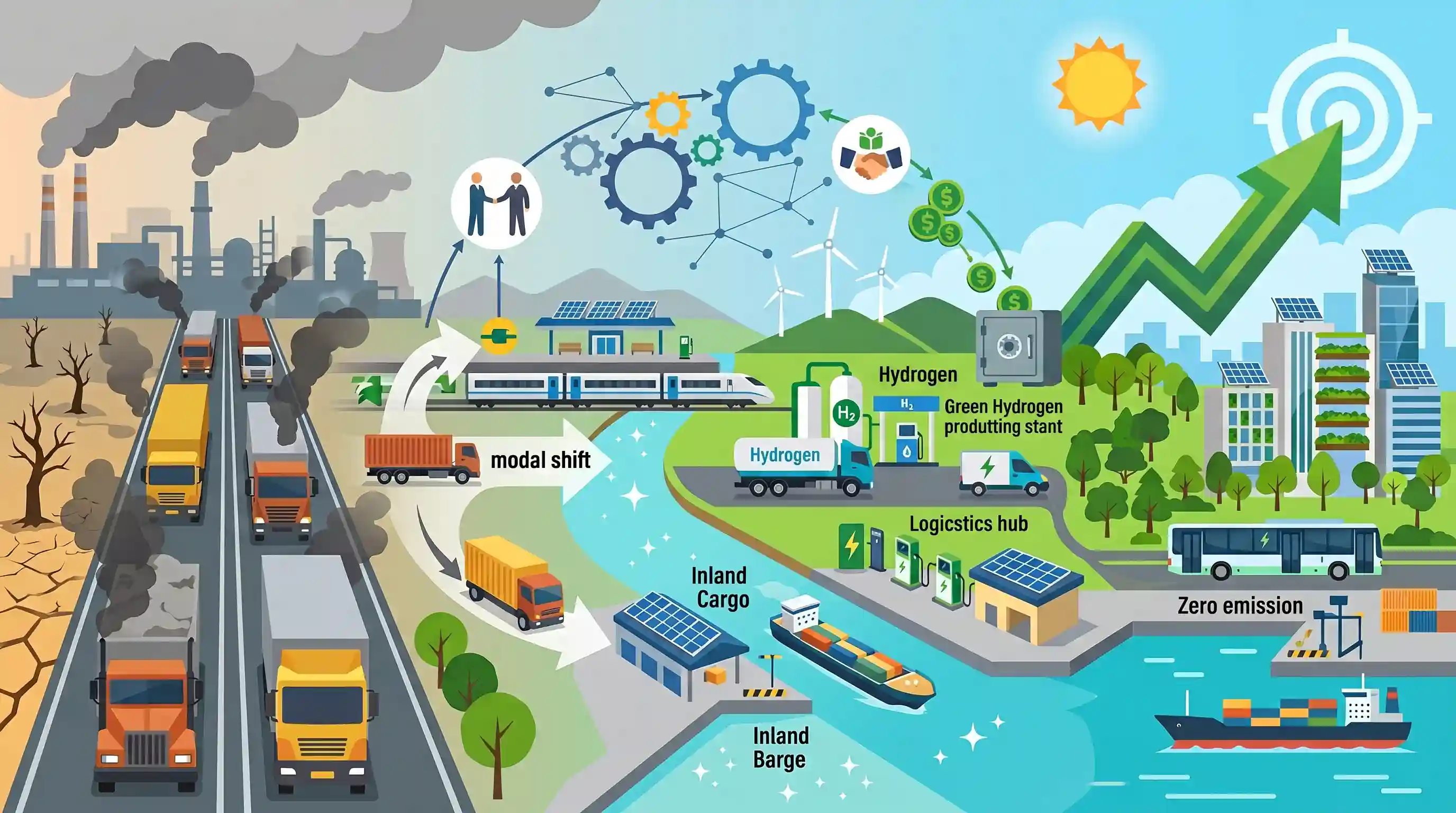
The article underscores the urgent need to decarbonise India's rapidly expanding logistics and freight sector to align with the country's Net-Zero 2070 climate commitments. Highlighting the sector's current carbon-intensive dependence on road transport, it advocates for a systemic transition through a modal shift to rail and waterways. The piece emphasizes the importance of leveraging national frameworks like PM Gati Shakti and the National Logistics Policy to create efficient, multimodal infrastructure. Furthermore, transitioning to sustainable commercial transport requires scaling up zero-emission vehicles (EVs) and alternative fuels like green hydrogen, supported by robust public-private partnerships and green financing to ensure economic competitiveness alongside environmental sustainability.
Key Points
- India's logistics sector contributes significantly to national greenhouse gas emissions due to its heavy reliance on fossil-fuel-powered road freight.
- Decarbonising the sector requires a strategic modal shift from road to more energy-efficient railways and inland waterways.
- Initiatives like the National Logistics Policy and PM Gati Shakti are critical for building integrated, multimodal infrastructure that simultaneously lowers emissions and logistics costs.
- The adoption of clean technologies, including electric vehicles (EVs) for last-mile delivery and green hydrogen or biofuels for heavy commercial vehicles, is essential.
- Achieving a green supply chain necessitates public-private collaboration, targeted green financing, and a supportive policy environment to balance climate goals with economic growth.
Important Terms
National Logistics Policy (NLP)

Launched in 2022, this policy aims to reduce India's logistics costs from 13-14% to single digits and improve the global Logistics Performance Index ranking via digital integration.
UPSC context
GS III (Infrastructure/Economy); tests knowledge of manufacturing competitiveness and trade efficiency.
PM Gati Shakti
A National Master Plan for multi-modal connectivity launched in 2021, using a GIS-based digital platform to coordinate infrastructure projects across 57 ministries to reduce project delays.
UPSC context
GS III (Infrastructure); relevant for questions on integrated planning and logistics streamlining.
Net Zero 2070 target
India's commitment made at COP26 (Glasgow) to achieve a balance between greenhouse gas emissions produced and removed from the atmosphere by the year 2070.
UPSC context
GS III (Environment/Climate Change); central to India's long-term climate strategy and 'Panchamrit' goals.
Green Hydrogen
Hydrogen produced through electrolysis of water using renewable electricity; it is a zero-emission fuel critical for decarbonizing heavy transport and hard-to-abate industries.
UPSC context
GS III (S&T/Environment); crucial for National Green Hydrogen Mission and energy transition.
Paris Agreement
A 2015 legally binding international climate treaty aiming to limit global warming to well below 2°C, with a preference for 1.5°C, compared to pre-industrial levels.
UPSC context
GS III (Environment); fundamental framework for international climate diplomacy and Nationally Determined Contributions (NDCs).
Decarbonisation
The process of reducing or eliminating carbon dioxide emissions from an economy or sector through electrification, energy efficiency, and low-carbon energy sources.
UPSC context
GS III (Environment); tests understanding of technical and policy pathways for climate change mitigation.
Prelims Trap
PM Gati Shakti is a central scheme providing direct financial grants to states for building green multimodal logistics infrastructure.
PM Gati Shakti does not provide direct financial grants. It is a GIS-based digital National Master Plan to integrate and coordinate infrastructure planning across 16 Central Ministries.
Static Concepts Connected
How do PM Gati Shakti and the National Logistics Policy differ in their approach?
- PM Gati Shakti: Focuses on the physical infrastructure network and coordinated multi-ministerial planning using a GIS-based digital platform.
- National Logistics Policy: Focuses on "soft" infrastructure like streamlining processes, standardizing regulatory frameworks, digitalization (ULIP), and reducing overall costs.
- Complementary synergy: Gati Shakti builds the physical backbone, while the NLP ensures its efficient, cost-effective, and digitized utilization.
Why is a 'modal shift' critical for India's 2070 Net-Zero target?
- Road dominance: Road transport currently handles ~70% of India's freight but is highly carbon-intensive, causing over 88% of the logistics sector's emissions.
- Rail & Water efficiency: Shifting freight to electrified railways and inland waterways drastically lowers CO2 emissions per ton-km, a prerequisite for national decarbonization.
Cross-Topic Patterns
Green Hydrogen & Long-Haul Freight
While EVs suit last-mile delivery, the National Green Hydrogen Mission is crucial for decarbonizing long-haul heavy trucks, where massive battery weights would otherwise reduce commercial payload capacity.
Logistics cost & Export competitiveness
India's high logistics costs (14-18% of GDP) act as an implicit tax on domestic manufacturing. Achieving the NLP target of 8% will directly boost 'Make in India' and global supply chain integration.

Expect a multi-statement question interlinking India's 2070 Net-Zero target, ULIP's digital integration, and NLP's logistics cost targets.
Linked PYQs · 4
Linked PYQs · 4
- 2023MainsGS3
The adoption of electric vehicles is rapidly growing worldwide. How do electric vehicles contribute to reducing carbon emissions and what are the key benefits they offer compared to traditional combustion engine vehicles?
- 2023PrelimsGS1
Consider the following heavy industries: 1. Fertilizer plants 2. Oil refineries 3. Steel plants Green hydrogen is expected to play a significant role in decarbonizing how many of the above industries?
- 2014MainsGS3
National Urban Transport Policy emphasises on 'moving people' instead of 'moving vehicles'. Discuss critically the success of the various strategies of the Government in this regard.
- 2022MainsGS3
Why is Public Private Partnership (PPP) required in infrastructural projects ? Examine the role of PPP model in the redevelopment of Railway Stations in India.
