Impact of US Protectionist Tariffs on Indian Handicrafts Sector
Source:Indian Express ↗
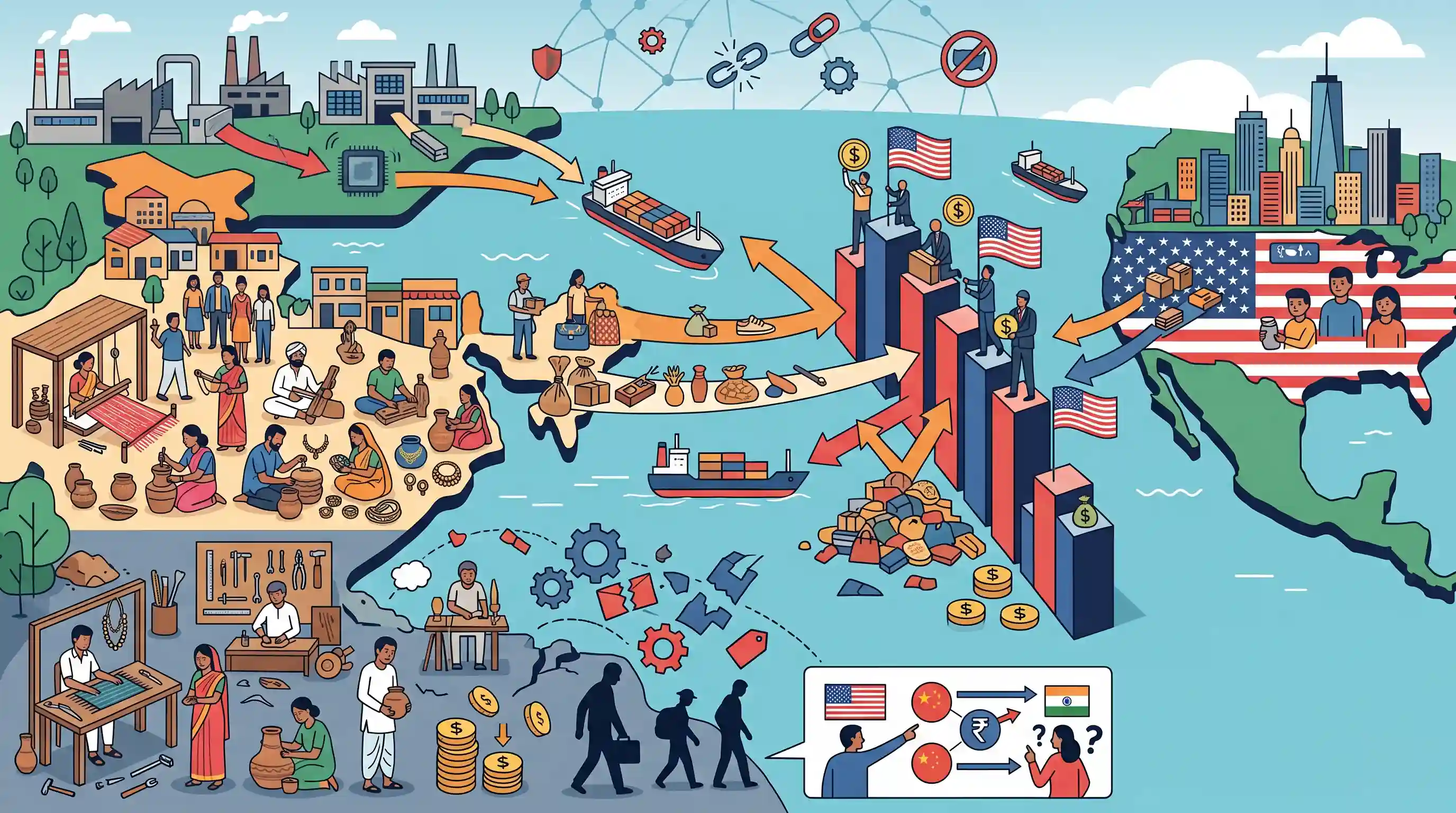
Why It Matters
Demonstrates the real-world socio-economic impact of global protectionism and trade wars on unorganized, labor-intensive sectors in India. It provides a strong case study for answers related to MSMEs, export challenges, and inclusive growth in GS Paper 3.
Summary
The article highlights the potential fallout of proposed US protectionist tariffs on Indian exports, shifting focus from major industries like steel and electronics to the vulnerable handicrafts sector. As a labor-intensive segment of the MSME ecosystem, the handicrafts industry sustains millions of rural artisans. Since the US is a crucial market for these goods, tariff-induced price increases could severely hurt artisan incomes and employment. The situation underscores the broader macroeconomic challenge of global protectionism adversely affecting traditional, employment-generating sectors in developing economies, necessitating strategic export diversification and domestic support.
Key Points
- The proposed protectionist trade policies and tariffs by the US administration pose a significant threat to Indian exports across multiple sectors.
- While policy attention often focuses on the impact on large industries like steel and electronics, India's fragile handicrafts sector is uniquely vulnerable to these trade shocks.
- The handicrafts industry is a critical component of India's MSME ecosystem, being highly labor-intensive and providing livelihoods to millions of rural and marginalized artisans.
- With the US being a major export destination for Indian handicrafts, higher tariffs would erode price competitiveness, directly impacting artisan incomes and threatening traditional crafts.
- The scenario underscores the urgent need for market diversification, domestic policy support, and structural reforms to protect labor-intensive export sectors from global protectionism.
Prelims Trap
Indian handicrafts rely primarily on the domestic market, insulating them from sudden changes in US trade policies.
The US is actually the single largest export destination for Indian handicrafts, absorbing 35-40% of the sector's total exports.
Static Concepts Connected
How are MSMEs defined and what is their economic contribution?
- Revised Definition: Based on composite criteria of investment and turnover (Micro: <₹1Cr/₹5Cr, Small: <₹10Cr/₹50Cr, Medium: <₹50Cr/₹250Cr).
- Export Share: MSMEs account for roughly 40-45% of India's total exports, heavily concentrated in labor-intensive sectors like textiles, leather, and handicrafts.
- Employment Generator: It is the second-largest employer after agriculture, sustaining over 110 million people, largely in unorganized rural clusters.
What mechanisms govern tariff constraints under the WTO?
- Bound Rates: The absolute maximum tariff ceiling a WTO member legally commits not to exceed for a specific product line.
- Applied Rates: The actual tariff currently charged at the border. Sudden tariff hikes exploit the gap between applied and bound rates.
- National Security Exception: Article XXI of GATT allows members to breach tariff commitments for "essential security interests," increasingly used by the US to justify protectionism.
Cross-Topic Patterns
Trade Shocks + Rural Feminization
Over 56% of handicraft artisans are women. Tariff-induced export contractions directly threaten rural gender-inclusion programs, SHG viability, and micro-credit models.
ODOP + Global Supply Chains
Initiatives like One District One Product (ODOP) rely heavily on export markets. Rising US protectionism forces a necessary pivot toward domestic consumption and new FTAs.

Expect a 2026 Mains question linking advanced-economy protectionism directly to the survival of rural MSMEs and female artisan SHGs.
Linked PYQs · 4
Linked PYQs · 4
- 2018MainsGS3
How would the recent phenomena of protectionism and currency manipulations in world trade affect macroeconomic stability of India?
- 2025MainsGS3
What are the challenges before the Indian economy when the world is moving away from free trade and multilateralism to protectionism and bilateralism? How can these challenges be met?
- 2023MainsGS3
Faster economic growth requires increased share of the manufacturing sector in GDP, particularly of MSMEs. Comment on the present policies of the Government in this regard.
- 2017MainsGS3
Account for the failure of manufacturing sector in achieving the goal of labour-intensive exports. Suggest measures for more labour-intensive rather than capital-intensive exports.
