Indo Pacific Strategic Partnerships and Critical Mineral Security
Source:The Hindu ↗
Why It Matters
This article highlights India's diplomatic agility in expanding its regional security footprint through the 'southern arc' of the Indo-Pacific. It showcases how India is operationalizing its maritime doctrines (like SAGAR/MAHASAGAR) and addressing domestic critical mineral and clean-energy supply vulnerabilities through bilateral deals with Quad partners and key ocean-faring democracies, presenting a perfect case study for GS2 foreign policy questions.
Summary
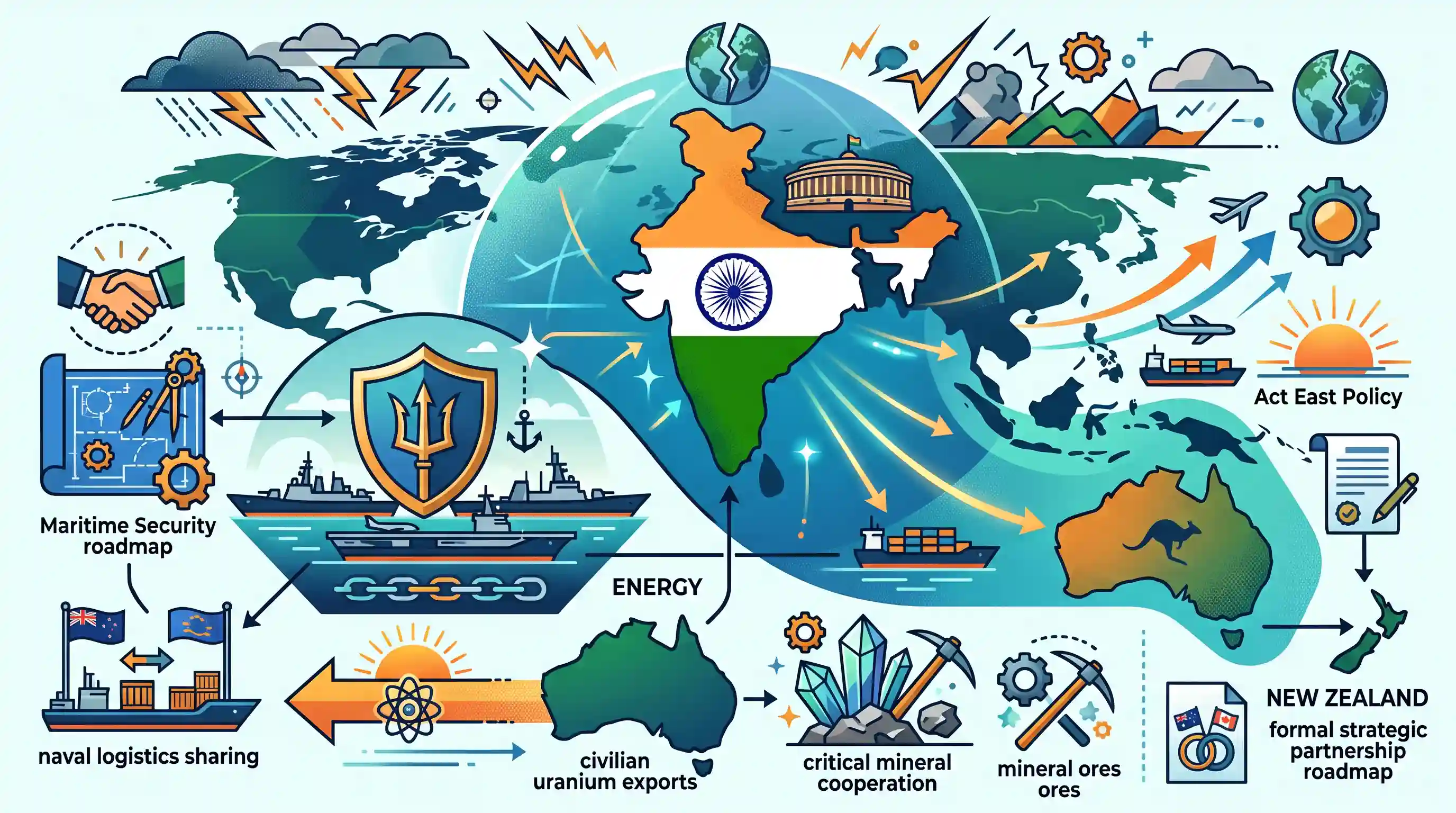
The editorial analyzes India's strategic push to consolidate partnerships in the 'southern arc' of the Indo-Pacific through Prime Minister Narendra Modi's visits to Australia and New Zealand. Historically driven by trade and diaspora ties, these relations have pivoted toward hard-security and strategic domains under India's Act East Policy and MAHASAGAR vision. Key outcomes include the India-Australia Maritime Security Collaboration Roadmap, Australian clearance for civilian uranium exports, critical mineral cooperation, and a formal strategic partnership roadmap with New Zealand including naval logistics sharing. Together, these moves represent India's broader efforts to insulate itself from global turbulence, secure crucial supply chains, and preserve strategic autonomy.
Key Points
- Prime Minister Narendra Modi’s visits to Australia and New Zealand mark a strategic pivot, shifting traditionally economic and people-centric ties into deeper strategic and defence partnerships in the southern arc of the Indo-Pacific.
- The engagements actively advance India's 'Act East Policy', 'MAHASAGAR' (Mutual and Holistic Advancement for Security and Growth Across Regions) vision, and commitments to keeping the Indo-Pacific free, open, and inclusive.
- With Australia, India signed a upgraded Joint Declaration on Defence and Security Cooperation, augmenting military interoperability, establishing an Annual Defence Ministers' Dialogue, and strengthening cybersecurity. They also launched the India-Australia Maritime Security Collaboration Roadmap.
- In a major breakthrough, Australia cleared uranium exports for India's civilian nuclear program, while both countries committed to deepening cooperation in critical minerals and emerging tech.
- With New Zealand, India established a formal Strategic Partnership with a 4-year roadmap, featuring maritime cooperation, mutual logistics support between the Indian Navy and New Zealand Defence Force, and trade expansion targets for 2030 building on their FTA.
- Through these bilateral networks, India aims to safeguard its 'strategic autonomy', diversify key supply chains, and secure energy resources in an era of intense geopolitical turbulence.
Important Terms
Act East Policy

A major foreign policy initiative launched in 2014 to proactively deepen economic, strategic, connectivity, and cultural relations with Southeast Asia, East Asia, and the broader Indo-Pacific, upgrading the older Look East Policy.
UPSC context
GS Paper II (Bilateral & Regional Groupings). Tests understanding of India's strategic shift and neighborhood diplomacy in the Indo-Pacific.
MAHASAGAR (Mutual and Holistic Advancement for Security and Growth Across Regions)
India's upgraded maritime vision launched in March 2025, succeeding the 2015 SAGAR initiative, integrating economic diplomacy, technological connectivity, and environmental sustainability to bolster security and cooperation across the Western Indian Ocean and global littorals.
UPSC context
GS Paper II & III (Maritime Security & IR). Tests India's proactive Indian Ocean strategies and regional security leadership.
India-Australia Maritime Security Collaboration Roadmap
A strategic roadmap adopted in July 2026 during the third India-Australia Annual Summit, aimed at deepening maritime cooperation through enhanced information-sharing, capacity building, capability development, and operational coordination in the Indo-Pacific.
UPSC context
GS Paper II (Bilateral Relations). Tests understanding of India's bilateral defense agreements with key Indo-Pacific partners.
Joint Declaration on Defence and Security Cooperation (India-Australia)
A bilateral security declaration adopted in July 2026, replacing the 2009 framework, to accelerate military exercises, defense interoperability, information sharing, and joint research in advanced defense technology between India and Australia.
UPSC context
GS Paper II (Bilateral Relations). Tests knowledge of India's evolving strategic and defense partnerships.
India-New Zealand Strategic Partnership (Roadmap to 2030)
A four-year framework adopted in July 2026 to elevate India-New Zealand ties, targeting double the bilateral trade, mutual logistics support, a new maritime security dialogue, and cooperation in agriculture, education, and climate action.
UPSC context
GS Paper II (Bilateral Relations). Tests understanding of India's strategic expansion in Oceania and the Indo-Pacific.
Prelims Trap
Australia is legally barred from exporting civilian uranium to India because India is a non-signatory to the Non-Proliferation Treaty (NPT).
India received a unique Nuclear Suppliers Group (NSG) waiver in 2008, permitting civilian nuclear commerce under strict IAEA safeguards despite not signing the NPT.
Static Concepts Connected
How does India engage in civilian nuclear trade despite being a non-signatory to the NPT?
- NSG Waiver: The Nuclear Suppliers Group granted India a unique clean waiver in 2008, permitting international civilian nuclear commerce.
- IAEA Safeguards: India separated its civilian and military nuclear facilities, placing civilian reactors under strict IAEA safeguards and the Additional Protocol.
- Bilateral Accords: India leverages bilateral agreements (e.g., USA, France, Australia) to import uranium, bypassing NPT membership restrictions.
What are Mutual Logistics Support Arrangements (MLSAs) and their strategic utility for India?
- Reciprocal Access: Bilateral pacts that permit partner militaries to access designated bases for refueling, maintenance, and replenishment during operations.
- Operational Reach: They extend the Indian Navy's blue-water endurance and projection capabilities across the Indo-Pacific without establishing permanent foreign bases.
- Strategic Network: India has signed MLSAs or equivalent pacts with key partners including the US, France, Japan, Australia, Russia, and New Zealand.
Cross-Topic Patterns
Space telemetry & island geopolitics
Placing a Gaganyaan tracking terminal on Australia's Cocos Islands merges India's space program with deep maritime security trust in the Indian Ocean.
Energy security & climate commitments
Australian uranium exports help operationalize India's civil nuclear energy expansion, aligning decarbonization targets with strategic diversification of global supply chains.

Transition from SAGAR to MAHASAGAR and India's expanded MLSA network in Oceania likely to feature in 2026 maritime security questions.
Linked PYQs · 3
Linked PYQs · 3
- 2025PrelimsGS1
Consider the following statements : I. India has joined the Minerals Security Partnership as a member. II. India is a resource-rich country in all the 30 critical minerals that it has identified. III. The Parliament in 2023 has amended the Mines and Minerals (Development and Regulation) Act, 1957 empowering the Central Government to exclusively auction mining lease and composite license for certain critical minerals. Which of the statements given above are correct?
- 2021MainsGS2
The newly tri-nation partnership AUKUS is aimed at countering China's ambitions in the Indo-Pacific region. Is it going to supersede the existing partnerships in the region? Discuss the strength and impact of AUKUS in the present scenario.
- 2020MainsGS2
Quadrilateral Security Dialogue (Quad)' is transforming itself into a trade bloc from a military alliance, in present times - Discuss.
