Scientific Rationale Behind Fixed Dose Combination Drug Ban
Source:The Hindu ↗
Why It Matters
The issue of FDC drugs bridges regulatory governance (GS2) and scientific challenges like antimicrobial resistance (GS3). It is highly relevant for UPSC aspirants evaluating the efficacy of India's healthcare system, drug approval processes, and the measures required to ensure patient safety against pharmaceutical misuse.
Summary
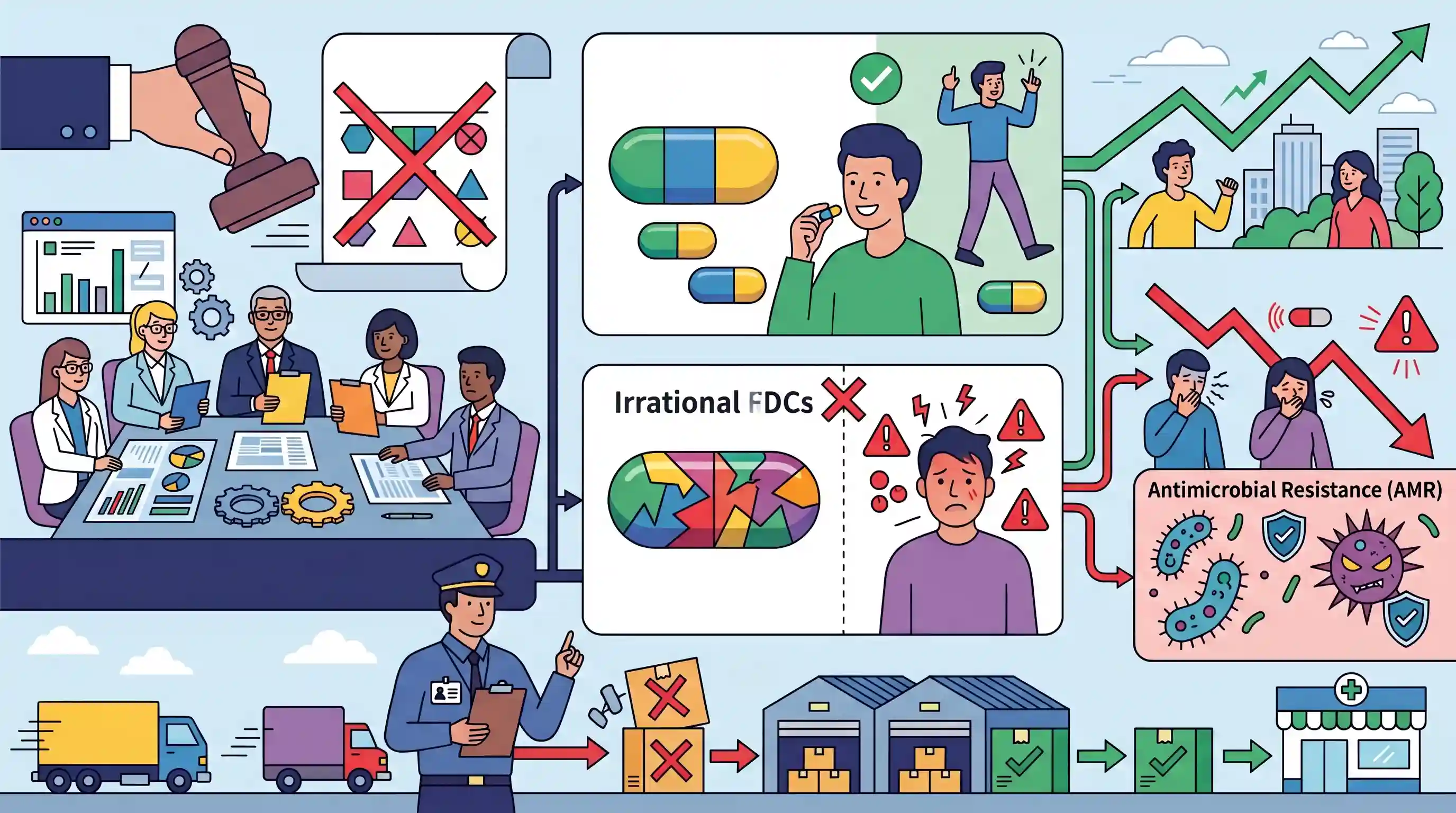
The government's recent ban on 156 Fixed-Dose Combination (FDC) drugs underscores the necessity of evidence-based medicine and stringent pharmaceutical regulation. While FDCs can enhance patient compliance by reducing pill burden, 'irrational' combinations pose significant health risks, including unwarranted side effects and the exacerbation of antimicrobial resistance (AMR) due to inappropriate antibiotic usage. The ban, recommended by an expert panel, highlights the critical role of the Central Drugs Standard Control Organisation (CDSCO) and state-level regulators in monitoring drug supply chains to ensure that banned, unsafe formulations do not reach consumers.
Key Points
- The Union Health Ministry has banned 156 Fixed-Dose Combination (FDC) drugs, citing a lack of therapeutic justification and potential risks to human health.
- FDCs combine two or more active ingredients into a single pill to improve patient compliance (e.g., in tuberculosis treatment), but irrational combinations can lead to unnecessary side effects and complicate allergy tracing.
- The prevalence of antibiotic-based FDCs is a major concern, as their irrational use contributes significantly to the growing crisis of Antimicrobial Resistance (AMR).
- Effective enforcement of the ban requires strict monitoring by the CDSCO and state drug regulators to prevent the continued sale of these deemed unsafe drugs in local pharmacies.
Important Terms
Fixed-Dose Combination (FDC)

A pharmaceutical formulation containing two or more active ingredients in a fixed ratio within a single dosage form, intended to improve patient compliance and therapeutic efficacy.
UPSC context
GS Paper II/III: Public Health & S&T. Tests understanding of 'rational' drug use and regulatory oversight in the pharmaceutical sector.
Central Drugs Standard Control Organisation (CDSCO)
India’s National Regulatory Authority (NRA) for drugs, medical devices, and cosmetics, functioning under the Ministry of Health and Family Welfare to ensure safety, efficacy, and quality.
UPSC context
GS Paper II: Statutory and Regulatory Bodies. Tests knowledge of the central authority responsible for drug approvals and clinical trials.
Drugs Technical Advisory Board (DTAB)
The highest statutory body in India advising the Central and State governments on technical matters arising from the administration of the Drugs and Cosmetics Act.
UPSC context
GS Paper II: Governance. Critical for understanding the technical advisory mechanism behind banning 'irrational' drugs and formulating health policies.
Antimicrobial Resistance (AMR)
A global health threat occurring when bacteria, viruses, and other pathogens evolve to withstand drugs, rendering once-effective treatments like antibiotics ineffective.
UPSC context
GS Paper III: Science and Technology. Essential topic regarding public health challenges and the impact of improper antibiotic use.
Drugs and Cosmetics Act, 1940
The foundational 1940 legislation that regulates the import, manufacture, distribution, and sale of drugs and cosmetics to ensure they meet prescribed quality and safety standards.
UPSC context
GS Paper II: Governance/Legislation. Foundational law for pharmaceutical regulation in India, often cited in the context of drug bans and safety.
Drugs Controller General of India (DCGI)
The executive head of the CDSCO responsible for drug approvals, clinical trials, and ensuring uniform implementation of drug standards across India.
UPSC context
GS Paper II: Regulatory Bodies. Important for understanding the administrative leadership within India’s health regulatory framework.
Prelims Trap
"The CDSCO enforces the FDC ban by cancelling local manufacturing and pharmacy sales licenses."
While CDSCO approves new drugs, issuing or cancelling manufacturing and retail sales licenses is strictly the domain of State Drug Regulatory Authorities (SDRAs), not the Centre.
Static Concepts Connected
How are drugs regulated between the Centre and States in India?
- Central role (CDSCO): Approves new drugs, oversees clinical trials, regulates imports, and lays down standards.
- State role (SDRAs): Issues manufacturing and sales licenses, inspects local pharmacies, and enforces drug bans on the ground.
- DTAB (Advisory): The highest statutory advisory body under the Drugs and Cosmetics Act, 1940, advising government on technical matters.
Why are Fixed-Dose Combinations (FDCs) considered a double-edged sword?
- The benefit: They reduce daily pill burden and drastically improve patient adherence, which is vital for public health programs like DOTS (TB) and ART (HIV).
- The risk: 'Irrational' combinations lack therapeutic justification, complicate dose titration, cause adverse interactions, and accelerate Antimicrobial Resistance (AMR) through unnecessary antibiotic exposure.
Cross-Topic Patterns
AMR + One Health Approach
Irrational FDCs are just one driver of AMR. UPSC frequently links human antibiotic misuse with veterinary residues (poultry) and pharmaceutical effluent under the comprehensive 'One Health' umbrella.
Federalism in Health Enforcement
The Centre invokes Section 26A to ban drugs, but enforcement relies entirely on State drug inspectors. This highlights the systemic capacity constraints within cooperative federalism in health administration.

Expect a Prelims multi-statement question contrasting CDSCO vs State regulator powers, coupled with the utility of FDCs in TB (DOTS).
Linked PYQs · 2
Linked PYQs · 2
- 2014MainsGS3
Can overuse and free availability of antibiotics without Doctor's prescription, be contributors to the emergence of drug-resistant diseases in India? What are the available mechanisms for monitoring and control? Critically discuss the various issues involved.
- 2019PrelimsGS1
Which of the following are the reasons for the occurrence of multi-drug resistance in microbial pathogens in India? 1. Genetic predisposition of some people 2. Taking incorrect doses of antibiotics to cure diseases 3. Using antibiotics in livestock farming 4. Multiple chronic diseases in some people Select the correct answer using the code given below.
