Narmada River Cruise Unveiled at Statue of Unity
Source:lokmattimes ↗
Why It Matters
The development of tourism infrastructure around monumental and geographic landmarks (like the Narmada River and the Statue of Unity) is crucial for regional economic development and cultural promotion. It aligns with India's broader push towards optimizing inland waterways and bolstering domestic tourism.
Summary
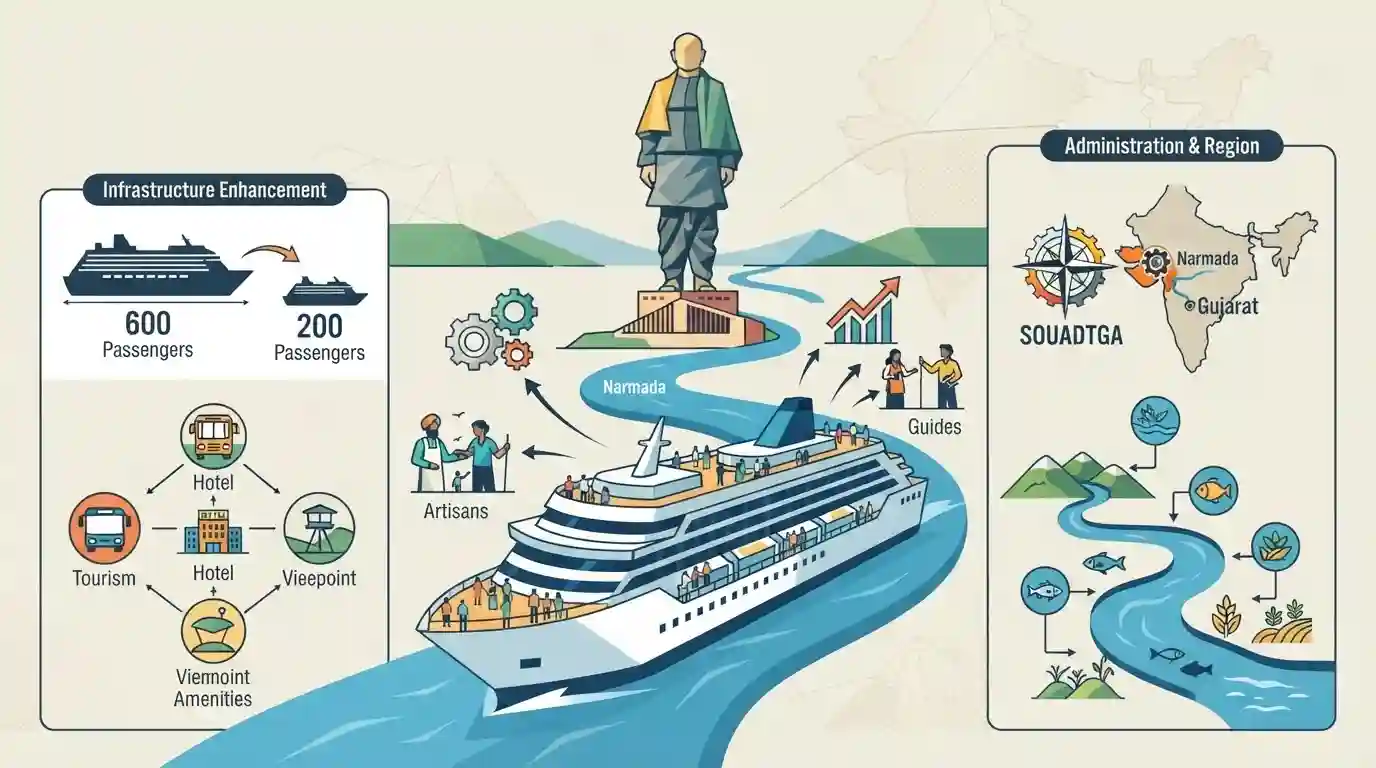
The Statue of Unity at Ekta Nagar, Gujarat, has launched a new 600-passenger luxury cruise on the Narmada River to bolster river tourism. Administered by the Statue of Unity Area Development and Tourism Governance Authority (SOUADTGA), the cruise functions as a multi-purpose floating venue. This initiative supplements the existing tourism infrastructure, which includes a smaller 200-passenger vessel, and aims to stimulate regional economic growth and create local employment.
Key Points
- A new luxury cruise accommodating 600 passengers has been launched at the Statue of Unity in Ekta Nagar, Gujarat.
- The cruise operates on the Narmada River, aiming to enhance the river tourism experience and serve as a multi-functional floating venue.
- The initiative is managed by the Statue of Unity Area Development and Tourism Governance Authority (SOUADTGA).
- This infrastructural addition intends to accelerate tourism growth, create local employment opportunities, and stimulate Gujarat's regional economy.
Important Terms
Statue of Unity Area Development and Tourism Governance Authority (SOUADTGA)

A statutory body established by the Gujarat government in 2019 to manage and govern the planned development, sustainable tourism, and green initiatives in and around Ekta Nagar (formerly Kevadia).
UPSC context
Relevant for GS-2 (Governance) and GS-3 (Infrastructure). Highlights statutory mechanisms for regional development and sustainable tourism governance.
Narmada River
India's largest west-flowing peninsular river, originating from the Amarkantak plateau. It flows through a structural rift valley between the Vindhyan and Satpura ranges, eventually draining into the Arabian Sea.
UPSC context
Crucial for GS-1 (Geography). Frequently tested in Prelims regarding its west-flowing nature, rift valley geography, and drainage basin.
Ekta Nagar
A rapidly developing town in Gujarat's Narmada district, formerly known as Kevadia. It has been transformed into a model eco-friendly tourist city serving as the primary gateway to the Statue of Unity.
UPSC context
Relevant for GS-3 (Infrastructure). Exemplifies tourism-led regional economic growth, smart infrastructure, and sustainable urban development in India.
River Tourism
A sustainable tourism segment utilizing navigable inland waterways for leisure activities like river cruises. India is actively promoting this through the Inland Waterways Authority and initiatives like the Cruise Bharat Mission.
UPSC context
Important for GS-3 (Infrastructure & Economy). Showcases the economic utilization of National Waterways to generate local employment and promote green logistics.
Statue of Unity
The world's tallest statue (182 meters), situated on Sadhu Bet island in the Narmada River. Dedicated to Sardar Vallabhbhai Patel, it commemorates his monumental role in integrating the princely states of India.
UPSC context
Significant for GS-1 (Post-Independence Consolidation). Represents India's political integration and serves as a major driver for regional tourism development.
Prelims Trap
River tourism vessels at the Statue of Unity are managed by the Inland Waterways Authority of India (IWAI).
This specific tourism zone and its vessels at Ekta Nagar are administered by a state-level statutory body (SOUADTGA), not the central IWAI.
Static Concepts Connected
What are the defining geographical characteristics of the Narmada River?
- Origin: Rises from the Amarkantak Plateau in Madhya Pradesh, acting as a traditional boundary between North and South India.
- Rift Valley: Flows westward through a rift valley located between the Vindhya and Satpura mountain ranges.
- Estuary Formation: Drains into the Arabian Sea via the Gulf of Khambhat, forming a large estuary instead of a delta.
What was Sardar Patel's approach to integrating the princely states?
- States Department: Headed the newly formed States Department in 1947 to negotiate the accession of over 560 princely states into the Indian Union.
- Carrot and Stick: Used a mix of diplomacy (Instrument of Accession) and the threat of force (Operation Polo in Hyderabad) to ensure territorial unity.
Cross-Topic Patterns
River Tourism & Inland Waterways
The push for river cruises aligns with Maritime India Vision 2030, transforming inland waterways (like NW-73 on the Narmada) from mere cargo routes into regional economic and employment multipliers.
Monuments as Integrated Economic Hubs
Projects like the Statue of Unity represent a shift towards integrated tourism ecosystems—combining historical tributes with ecological and luxury infrastructure (tent cities, cruises) to anchor state revenue.

Expect map-based questions linking West-flowing peninsular rivers with specific hydro-infrastructure and tourism zones in the 2026 prelims.
Linked PYQs · 2
Linked PYQs · 2
- 2022GPSC_PRELIMSGS1
It was due to the efforts of Sardar Patel, states like were merged into India.
- 2025GPSC_PRELIMSGS1
What are Banni, Rabari and Bavalia in Gujarat?
