Ladakh Analogue Station Begins Simulation Research for Space Missions
Source:The Hindu ↗
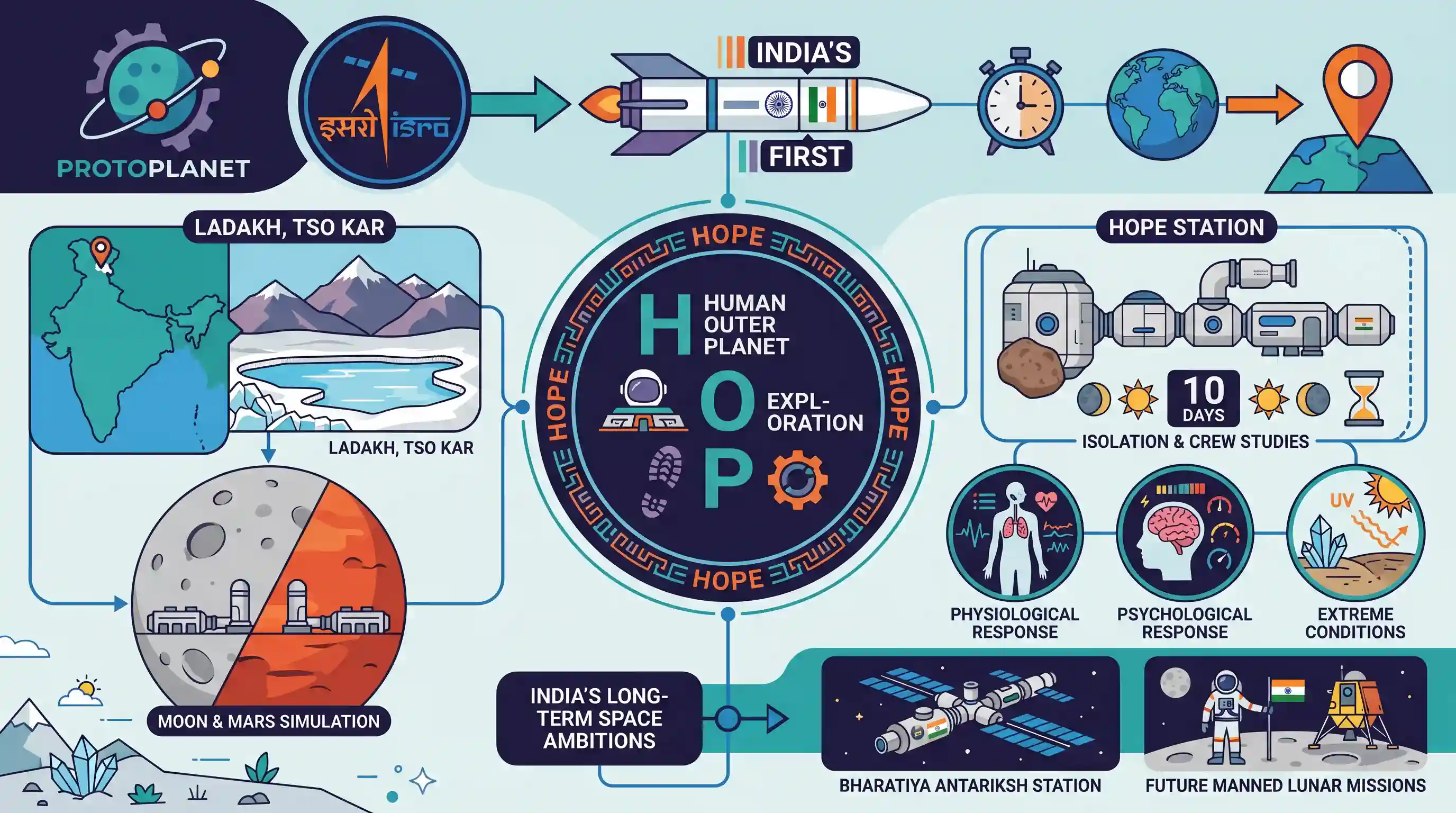
Why It Matters
As India approaches critical milestones in its human spaceflight program (like Gaganyaan) and targets a manned Moon mission by 2040, analogue missions are indispensable for testing life-support systems and understanding human endurance in deep-space environments.
Summary
The educational space organization Protoplanet, in collaboration with ISRO, has launched India's first analogue space mission, the Human Outer Planet Exploration (HOPE), in Ladakh. Set in the cold, arid environment of Tso Kar, the station serves to simulate life on the Moon and Mars. By isolating a small crew for 10 days, researchers aim to study human physiological and psychological responses to extreme, extraterrestrial-like conditions. This initiative significantly bolsters India's long-term space exploration ambitions, acting as a precursor to the planned Bharatiya Antariksh Station and future manned lunar missions.
Key Points
- HOPE (Human Outer Planet Exploration) is India's first analogue space mission, launched in the high-altitude, cold desert region of Tso Kar, Ladakh.
- The station accurately mimics extraterrestrial landscapes, allowing researchers to simulate life on the Moon and Mars without leaving Earth.
- A selected two-person crew will undergo a 10-day isolation mission to assess the physiological, psychological, and epigenetic impacts of a simulated deep space environment.
- Partially funded by ISRO, this mission is a crucial stepping stone for India's ambitious targets to launch the Bharatiya Antariksh Station by 2035 and land humans on the Moon by 2040.
Important Terms
Himalayan Outpost for Planetary Exploration (HOPE)

India's first full-scale analogue space mission in Ladakh. It simulates lunar/Martian conditions to study human physiological, psychological, and technological readiness for deep-space exploration.
UPSC context
GS Paper III (S&T); crucial for topics on indigenization of technology and future interplanetary missions.
Bharatiya Antariksh Station (BAS)
India's planned indigenous space station, targeted for initial launch in 2028 and full operation by 2035. It will support long-term microgravity research and manned lunar missions.
UPSC context
GS Paper III (Space Technology); represents India's strategic autonomy and long-term space infrastructure goals.
Analogue Space Mission
Field tests on Earth that mimic physical and environmental conditions of space (e.g., isolation, terrain, gravity) to validate equipment and human protocols before spaceflight.
UPSC context
GS Paper III (S&T); tests the application of scientific research in extreme environments.
Tso Kar
A high-altitude saline lake in Ladakh (a Ramsar site). Its extreme cold, low oxygen, and arid, rocky terrain serve as a near-perfect terrestrial analogue for Mars.
UPSC context
GS Paper I (Geography); important for environmental significance and its role in scientific research locations.
Protoplanet
The Bengaluru-based private space technology startup that partnered with ISRO's Human Space Flight Centre to develop the HOPE station's habitat and utility modules.
UPSC context
GS Paper III (Economy/S&T); highlights the increasing role of the private sector and public-private synergy in Indian space.
ISRO (Indian Space Research Organisation)
The primary national space agency of India. It oversees the Human Spaceflight Programme, including the Gaganyaan mission and the development of the Bharatiya Antariksh Station.
UPSC context
GS Paper III (S&T); central institution for all space-related developments and competitive exams.
Prelims Trap
"The HOPE mission is India's upcoming interplanetary spacecraft to Mars."
India's HOPE is an Earth-based analogue space mission in Ladakh, not an actual spacecraft. Do not confuse it with the UAE's Mars 'Hope' probe.
Static Concepts Connected
What makes the Tso Kar Wetland Complex geographically unique?
- Connected dual lakes: It uniquely comprises two connected water bodies: the freshwater Startsapuk Tso and the much larger hypersaline Tso Kar.
- White Lake efflorescence: The name translates to "White Lake" due to the distinct white salt efflorescence (crusts) found along its margins.
- Crucial avian habitat: It is a high-altitude Ramsar site and serves as one of the most important breeding areas for the Black-necked Crane in India.
What is the planned timeline for the Bharatiya Antariksh Station (BAS)?
- LEO Positioning: BAS will be a modular space station positioned in Low Earth Orbit (LEO) at an altitude of roughly 400-450 km.
- Phased operational timeline: ISRO targets launching the first module by 2028, with the complete station expected to be fully operational by 2035.
- Lunar mission gateway: The station will serve as a vital technological stepping stone and training ground for India's goal of landing humans on the Moon by 2040.
Cross-Topic Patterns
Analogue space sites & Ramsar conservation
Extreme environments like Tso Kar mimic Martian conditions but are also fragile Ramsar wetlands, requiring space-tech testing activities to balance scientific advancement with strict ecological conservation guidelines.
Private-Public synergy in human spaceflight
Protoplanet partnering with ISRO for analogue missions highlights the expanding role of private startups in India's deep-space and human spaceflight ecosystem, moving beyond just launch vehicle manufacturing.

Tso Kar's dual identity as a Ramsar site and a Mars analogue makes it a prime candidate for a hybrid Geography-Science Prelims MCQ.
Linked PYQs · 5
Linked PYQs · 5
- 2017MainsGS3
India has achieved remarkable successes in unmanned space missions including the Chandrayaan and Mars Orbitter Mission, but has not ventured into manned space missions. What are the main obstacles to launching a manned space mission, both in terms of technology and logistics? Examine critically.
- 2023MainsGS3
What is the main task of India's third moon mission which could not be achieved in its earlier mission? List the countries that have achieved this task. Introduce the subsystems in the spacecraft launched and explain the role of the Virtual Launch Control Centre' at the Vikram Sarabhai Space Centre which contributed to the successful launch from Sriharikota.
- 2025PrelimsGS1
Consider the following space missions : I. Axiom-4 II. SpaDeX III. Gaganyaan How many of the space missions given above encourage and support micro-gravity research?
- 2016PrelimsGS1
Consider the following statements: The Mangalyaan launched by ISRO 1. is also called the Mars Orbiter Mission 2. made India the second country to have a spacecraft orbit the Mars after USA 3. made India the only country to be successful in making its spacecraft orbit the Mars in its very first attempt Which of the statements given above is/are correct?
- 2021PrelimsGS1
With reference to India, Didwana, Kuchaman, Sargol and Khatu are the names of
