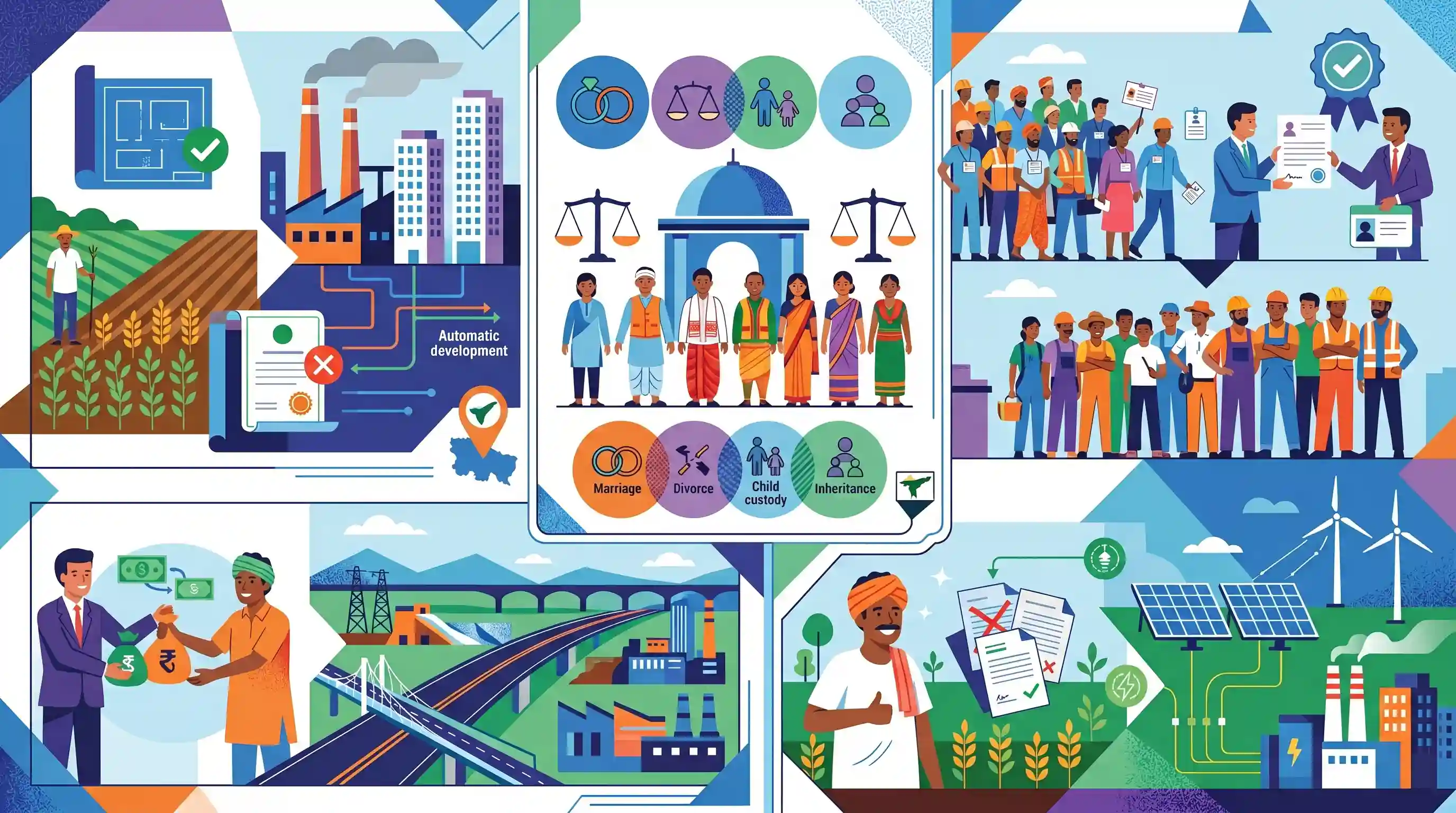
Change of land use certificate requirement eliminated in Uttar Pradesh
Source:csis ↗
Why It Matters
State-level regulatory changes, such as UP's land-use deregulation and Assam's UCC, directly intersect with core constitutional provisions (Article 44, Article 48, Ninth Schedule, and state lists). Understanding these developments is essential for UPPSC aspirants analyzing Indian federalism, ease of doing business, and socio-economic policies.
Summary
The CSIS States Weekly report highlights major policy developments across various Indian states. A major reform in Uttar Pradesh removes the requirement for a Change of Land Use (CLU) certificate to convert agricultural land for industrial or residential use, transitioning to automatic land-use conversion upon building plan approval. Additionally, Assam passed the landmark Uniform Civil Code (UCC) Bill 2026, Punjab moved to formalize 65,000 contractual workers, Bihar introduced incentive-based land acquisition rules, and Tamil Nadu offered farm loan waivers and renewable energy grid guidelines.
Key Points
- Uttar Pradesh has eliminated the need for obtaining a Change of Land Use (CLU) Certificate to convert agricultural land for non-agricultural use; building plans can be approved directly, with land use deemed changed automatically upon plan approval.
- Uttar Pradesh Power Corporation Limited (UPPCL) introduced a fuel adjustment charge raising power tariffs by roughly 10 percent.
- Assam passed the Uniform Civil Code (UCC) Bill 2026, which exempts Scheduled Tribes, criminalizes bigamy and polygamy, establishes minimum marriage ages (18 for women, 21 for men), and mandates the registration of live-in relationships.
- Bihar introduced its Land Acquisition Policy and Land Survey Rules 2026 to acquire land for development projects through fiscal incentives, and mandated local vacations for officials/legislators to boost tourism.
- Punjab passed bills to phase out contractual/outsourced employment and formalize approximately 65,000 workers, alongside introducing a menstrual hygiene curriculum in schools.
- Tamil Nadu waived cooperative bank loans up to ₹50,000 for small and marginal farmers, and issued new wind, solar, and hybrid energy forecasting and deviation settlement guidelines.
- Jharkhand launched the 'Abua Dawakhana' local clinic scheme, Himachal Pradesh introduced mandatory drug tests for new government recruits, and Sikkim withdrew the odd-even traffic rule outside Gangtok.
Important Terms
Assam Uniform Civil Code (UCC) Bill 2026

A state-level legislation passed by the Assam Legislative Assembly in May 2026, establishing a uniform personal law for marriage, divorce, succession, and live-in relationships, while completely exempting Scheduled Tribes.
UPSC context
GS Paper II: Polity & Governance. Evaluates state legislation under Article 44 (DPSP), federalism, and the protection of tribal customary laws.
Punjab State Outsourced Personnel (Transition to Contractual Engagement) Bill 2026
A state bill approved in 2026 transitioning outsourced Group C and D workers into direct government contractual service after five years (three for hazardous jobs), eliminating private middleman contractors.
UPSC context
GS Paper II: Governance & GS Paper III: Economy. Analyzes civil service reforms, labor contract formalization, and worker social security.
Punjab Contractual Personnel (Absorption Against Sanctioned Vacancies) Bill 2026
A legislative bill approved in Punjab in 2026 establishing a clear pathway to regularize contractual employees by absorbing them into permanent, regular government posts after completing ten years of service.
UPSC context
GS Paper II: Welfare & GS Paper III: Economy. Assesses public sector employment regularization, fiscal impacts, and administrative structural reforms.
Bihar Land Acquisition Policy and Land Survey Rules 2026
Comprehensive reforms from 2026, including the Raiyati Land Purchase Policy (boosting urban/rural acquisition compensation) and the Special Survey Rules, extending land-mapping to urban areas to minimize land disputes.
UPSC context
GS Paper III: Land Reforms & Infrastructure. Tests legal mechanisms for land acquisition compensation, land record digitization, and reducing civic litigation.
Abua Dawakhana Scheme
A grassroots primary healthcare initiative approved by the Jharkhand Cabinet in 2026 to open generic medicine pharmacies and integrated clinics practicing multiple medical systems across rural and tribal regions.
UPSC context
GS Paper II: Social Justice. Evaluates primary healthcare decentralization, tribal welfare initiatives, and integration of traditional and modern medical systems.
Tamil Nadu Forecasting, Scheduling and Deviation Settlement and Related Matters for Wind, Solar and Hybrid Generations Regulations, 2026
A regulatory framework issued by TNERC in 2026, establishing updated forecasting, scheduling, and deviation settlement rules for wind, solar, and hybrid energy projects of 1 MW and above.
UPSC context
GS Paper III: Infrastructure & Energy. Analyzes renewable energy grid integration, deviation settlement mechanisms, and utility regulatory frameworks.
Prelims Trap
A state-level Uniform Civil Code (UCC) applies uniformly to all residents, including Scheduled Tribes, to satisfy the mandate of Article 44.
Assam’s UCC 2026 explicitly excludes Scheduled Tribes to preserve customary laws, demonstrating that state-level codes can carve out constitutionally protected exemptions.
Static Concepts Connected
Which list of the Seventh Schedule governs land, and how does Article 300A protect property?
- State List Entry: Land and land tenure fall under Entry 18 of the State List, granting states exclusive legislative authority over local land laws.
- Article 300A: Inserted by the 44th Amendment (1978), it establishes property as a constitutional right, prohibiting deprivation except by authority of law.
- Eminent Domain: Allows the state to acquire private land for public utility, balancing public development needs with fair market compensation.
What constitutional provisions govern the Uniform Civil Code and state legislative powers over personal law?
- Article 44 DPSP: Directs the State to secure a Uniform Civil Code for all citizens throughout India, placed under non-justiciable Directive Principles.
- Concurrent List Entry 5: Places marriage, divorce, and succession in List III, allowing both Parliament and state legislatures to enact personal law reforms.
- Article 254(2) Assent: Requires state personal law bills conflicting with central statutes to receive presidential assent to become legally operative within that state.
Cross-Topic Patterns
Land conversion deregulation + Environmental zoning
Automatic land-use conversions speed up industrial investment but bypass local environmental impact assessment and conservation of fertile agricultural tracts.
Personal laws + Sixth Schedule protections
Exempting Scheduled Tribes from state UCC laws illustrates the constitutional balancing act between Article 44 uniformity and Article 244 tribal customary rights protection.

State-level UCC exemptions for Scheduled Tribes and the legislative route under Entry 5 of Concurrent List will likely be a core 2026 Polity question.
Linked PYQs · 3
Linked PYQs · 3
- 2020UPPSC_PRELIMSGS1
Which of the following is not a correct match?
- 2015UPPSC_PRELIMSGS1
Which one of the following is not a part of land reforms in India?
- 2013UPPSC_PRELIMSGS1
The Uttar Pradesh Government on 24th December 2012 decided to issue cards to Industrialists and Industrial associations for easy access to its offices. The name of this card is
