Himachal Pollution Board Simplifies Environmental Consent Rules
Source:csis.org ↗
Why It Matters
State-specific policies are critical for GS2 (Governance, Welfare) and GS3 (Economy, Environment). The HPSPCB’s environmental consent reform is directly relevant to Himachal Pradesh-specific questions in HPAS Prelims. Policies like Assam's CBG and Gujarat's Shipbuilding highlight decentralized initiatives in clean energy and industrial growth, frequently appearing in current affairs MCQs.
Summary
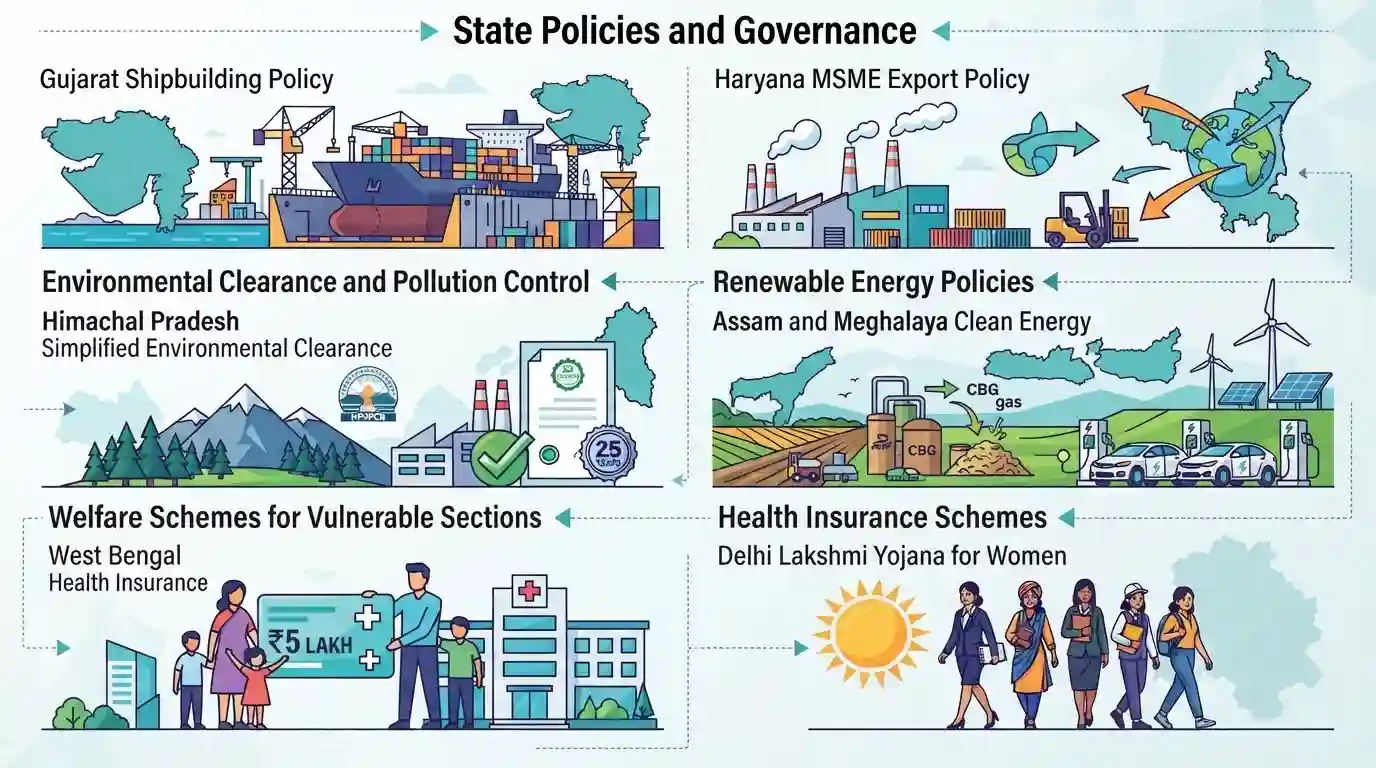
This weekly update highlights major policy decisions by Indian states. Crucial for regional governance, Himachal Pradesh’s pollution board (HPSPCB) simplified environmental compliance by granting a one-time consent valid for 25 years for low-polluting industries. Several states advanced clean energy initiatives, including Assam’s Compressed Biogas (CBG) Policy and Meghalaya’s new EV Policy. On the economic front, Gujarat announced a major Shipbuilding Policy targeting large vessel capacities, while Haryana introduced an MSME Export Policy. Welfare measures included West Bengal’s new health insurance scheme offering ₹5 lakh cashless cover and Delhi’s Lakshmi Yojana for women.
Key Points
- Himachal Pradesh State Pollution Control Board (HPSPCB) introduced a 25-year, one-time consent certificate for non-polluting industries (Green and White categories) to promote ease of doing business.
- Assam launched its Compressed Biogas (CBG) Policy 2026 to encourage renewable energy production and waste management.
- Gujarat unveiled the Shipbuilding and Repair Policy 2026 to develop Mega Shipbuilding Parks and support vessels up to 100,000 DWT.
- West Bengal introduced the 'Mukhya Mantri Swasthya Bima Yojana' offering cashless medical cover up to ₹5 lakh per family annually.
- Delhi announced the 'Lakshmi Yojana' to provide financial independence to women.
Important Terms
Assam Compressed Biogas (CBG) Policy 2026

A policy to convert Assam's organic waste into renewable energy. It offers single-window clearances and a 25% capital subsidy to biofuel developers, establishing a robust biogas ecosystem to reduce fossil fuel dependence.
UPSC context
GS-3 (Environment/Energy). Relevant for waste-to-wealth initiatives, the SATAT scheme, and India's transition to a circular bio-economy.
Gujarat Shipbuilding and Ship Repair Policy 2026
A strategic maritime policy targeting ₹27,000 crore investment to boost Gujarat's shipbuilding capacity to 5 million Deadweight Tonnage by 2047. It offers 50-year investor concessions and establishes two Integrated Mega Shipbuilding Parks.
UPSC context
GS-3 (Infrastructure/Industrial Policy). Crucial for evaluating state-led boosts to maritime manufacturing and the Maritime India Vision 2047.
DWEEPTI Yojana (Chhattisgarh)
The "Decentralised Women Empowerment on Energy and Policy for Transformative Inclusion" integrates rural Self-Help Groups into the rooftop solar sector. It trains women as "Solar Didis" to install, manage, and operate clean-energy enterprises.
UPSC context
GS-2 (Social Justice) & GS-3 (Energy). A prime example of women-led climate action and decentralised renewable energy policy.
Delhi Lakshmi Yojana 2026
A welfare scheme granting ₹2,500 monthly to eligible low-income women. To encourage long-term saving and financial inclusion, the assistance is uniquely split between a recurring/fixed deposit and a Central Bank Digital Currency (CBDC) wallet.
UPSC context
GS-2 (Welfare Schemes). Highlights innovative direct benefit transfer models leveraging digital currency and mandatory savings mechanisms.
Mukhya Mantri Swasthya Bima Yojana (MMSBY)
A state-funded health scheme providing ₹5 lakh annual cashless hospitalisation coverage per family. It acts as a safety net for state residents who do not qualify for the central Ayushman Bharat PM-JAY scheme.
UPSC context
GS-2 (Health). Important for discussions on universal health coverage and the dynamics of Centre-State welfare implementation.
HPSPCB Consent Certificate
A regulatory reform by the Himachal Pradesh State Pollution Control Board granting registered industries a one-time "consent to operate" valid for up to 25 years. It reduces compliance burdens and eliminates repeated renewal hurdles.
UPSC context
GS-3 (Economy/Environment). Illustrates state-level "Ease of Doing Business" reforms balancing industrial acceleration with environmental governance.
Meghalaya Electric Vehicle (EV) Policy 2026
A state mobility policy offering a ₹25,000 purchase incentive, complete vehicle registration fee waivers, and scrappage-linked benefits to buyers. It aims to accelerate the transition to zero-emission vehicles and develop commercial charging infrastructure.
UPSC context
GS-3 (Infrastructure/Environment). Relevant for studying sub-national EV adoption strategies and measures to curb vehicular emissions.
Prelims Trap
White category industries must renew their Consent to Operate (CTO) periodically.
White category industries are practically non-polluting and completely exempt from Consent to Establish (CTE) or Operate (CTO) under Air/Water Acts. They only require prior intimation.
Static Concepts Connected
How does the CPCB categorize industries based on pollution potential?
- Red & Orange: High (PI ≥ 60) and moderate (PI 41-59) polluters requiring stringent environmental clearances, impact assessments, and regular regulatory monitoring.
- Green: Low polluters (PI 21-40) that require standard consent mechanisms but enjoy simplified, longer-duration compliance frameworks in many states.
- White: Practically non-polluting (PI ≤ 20). Exempt from Consent to Establish/Operate; only require intimation to the respective State Pollution Control Board.
What are the core characteristics of Compressed Biogas (CBG)?
- Composition: Produced via anaerobic digestion of biomass. Purified to contain over 90% methane, making it chemically and functionally identical to standard commercial CNG.
- SATAT Initiative: Promoted under the SATAT initiative to provide an alternative green transport fuel, reduce import dependency, and monetize agricultural residue to prevent stubble burning.
Cross-Topic Patterns
State Policies Driving NDCs
State-level EV, CBG, and green-clearance policies act as essential decentralized cogs for achieving India's centralized Panchamrit targets and 2070 net-zero commitments.
Universal Health Coverage via States
State health insurance schemes (like West Bengal's) increasingly fill the missing middle left by PM-JAY's strict SECC-2011 criteria, creating a patchwork but vital path toward Universal Health Coverage.

Expect a multi-statement Prelims question mixing CPCB's White/Green category exemptions with the SATAT scheme's CBG composition facts.
Linked PYQs · 4
Linked PYQs · 4
- 2023HPAS_PRELIMSGS1
Consider the following Acts and Policy : (1) Water (Prevention and Control of Pollution) Act (2) Water Cess Act (3) The National Water Policy (4) Air (Prevention and Control of Pollution) Act With reference to the Acts and Policy mentioned above, in terms of their starting year, which one of the following is the correct ascending order? Choose the correct answer from the options given below :
- 2018HPAS_PRELIMSGS1
In which of the following conditions bio-gas is produced ?
- 2024HPAS_PRELIMSGS1
Economic Growth in country X will necessarily have to occur if :
- 2020HPAS_PRELIMSGS1
SANKALP is launched to provide:
