Gujarat Student Internship Stipend Scheme Strengthens Youth Welfare
Source:csis ↗
Why It Matters
State-specific schemes and legislative milestones often serve as essential fodder for state public service commissions like the GPSC. Developments such as Tamil Nadu's agricultural carbon trading provide unique examples of climate-resilient policies, while constitutional readjustments for STs in Goa offer practical insights into polity and representation.
Summary
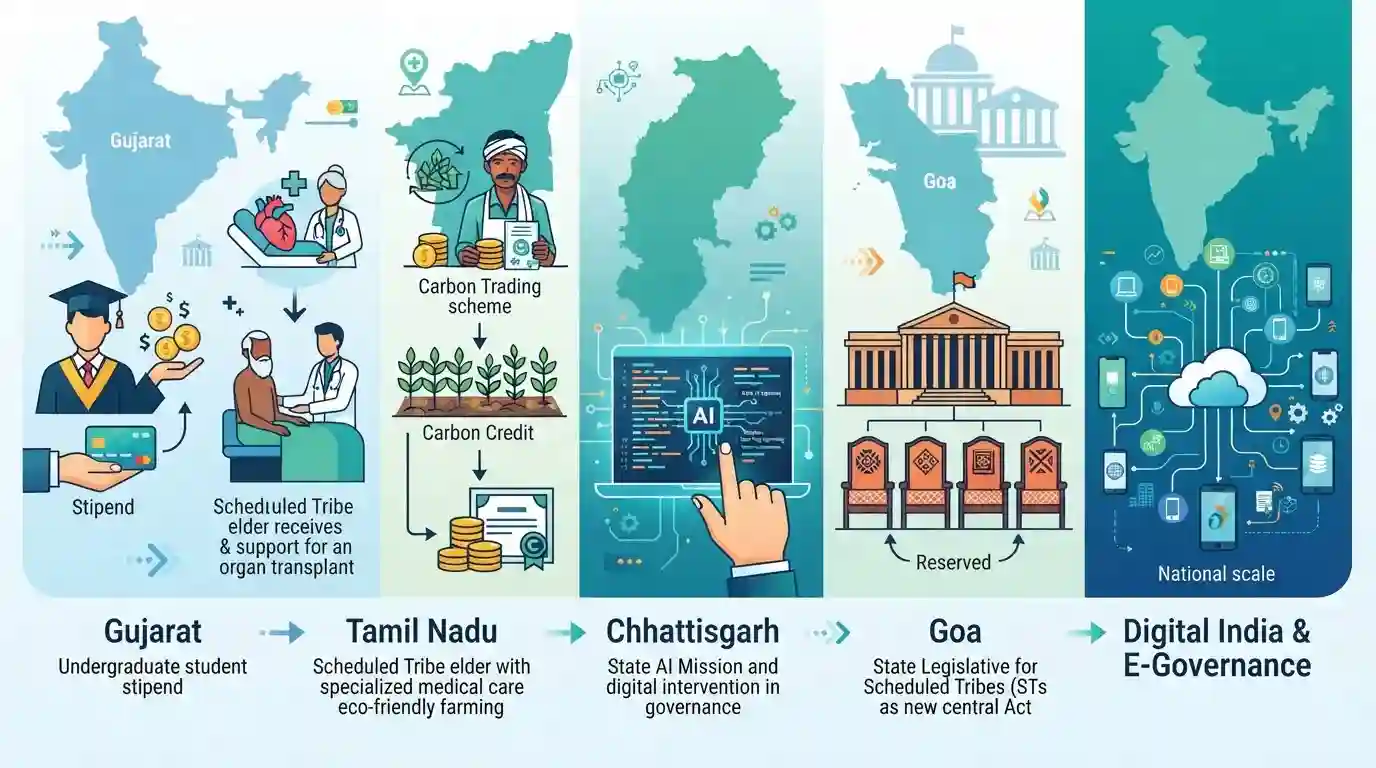
A weekly compilation of significant state-level policy announcements and initiatives across India for the week ending August 12, 2026. Prominent developments include Gujarat's introduction of an internship stipend for undergraduate students and a specialized organ transplant assistance scheme for Scheduled Tribes. Other states also introduced landmark policies, such as Tamil Nadu's integration of a carbon trading scheme into agriculture, Chhattisgarh's launch of a State AI Mission, and a new central Act securing four reserved assembly seats for Scheduled Tribes in Goa.
Key Points
- The Gujarat government introduced a stipend of INR 2,000 for final-year undergraduate students completing a mandatory 20-day internship, alongside a medical assistance scheme (INR 2 crore allocation) for Scheduled Tribe patients requiring organ transplants and robotic surgeries.
- Tamil Nadu launched a pioneering carbon trading scheme in agriculture, incentivizing sustainable irrigation methods like Direct Seeded Rice (DSR) and Alternate Wetting and Drying (AWD) to reduce greenhouse gas emissions.
- Chhattisgarh announced its State Artificial Intelligence (AI) Mission to integrate AI into education and administration, planning 100 AI data labs in schools and 5 Centers of Excellence across universities.
- The Readjustment of Representation of Scheduled Tribes in Assembly Constituencies of the State of Goa Act, 2025, allocates 4 reserved seats for STs in the 40-member Goa Assembly to ensure proportional political representation.
Important Terms
Carbon Trading Scheme

A pilot Tamil Nadu initiative allowing farmers to earn supplementary income through carbon credits by adopting sustainable cultivation methods—like Direct Seeded Rice (DSR)—that reduce greenhouse gas emissions and boost soil carbon sequestration.
UPSC context
GS3 (Agriculture & Environment). Tests knowledge of climate-resilient farming, carbon sequestration, and supplementary farmer income mechanisms.
State Artificial Intelligence (AI) Mission
A ₹500 crore initiative by Chhattisgarh to embed AI in governance. It will establish 100 AI data labs, build Centres of Excellence, upskill public employees, and launch AI-enabled public services over five years.
UPSC context
GS2 & GS3 (Governance & Tech). Highlights state-level digital ecosystems, emerging technology adoption, and modernization of public service delivery.
Pedestrian Safety and Universal Accessibility Policy
Andhra Pradesh's statewide framework shifting urban road planning to a people-centric model. It mandates scientific safety audits, tactile indicators, wheelchair ramps, and obstruction-free footpaths, linking pedestrian safety to the constitutional Right to Life.
UPSC context
GS2 (Polity) & GS3 (Infrastructure). Tests urban planning, road safety jurisprudence, and inclusive infrastructure for vulnerable sections.
Readjustment of Representation of STs in Assembly Constituencies of Goa Act, 2025
A central Act empowering the Census Commissioner to officially estimate Goa’s Scheduled Tribe population, enabling the Delimitation Commission to formally reserve seats for ST communities in the Goa Legislative Assembly for the first time.
UPSC context
GS2 (Polity). Tests political representation, constituency delimitation, and affirmative action mechanisms for tribal populations.
Organ Transplant and Robotic Surgery Assistance Scheme for ST Patients
A specialized Gujarat government initiative providing targeted financial support for high-cost medical treatments—including advanced organ transplants and robotic surgeries—for tribal patients when expenses exceed PM-JAY and Mukhyamantri Amrutam coverage limits.
UPSC context
GS2 (Health & Vulnerable Sections). Illustrates supplementary state welfare schemes aimed at reducing out-of-pocket healthcare expenses for marginalized tribes.
Soil Fertility Mission
A five-year, ₹600 crore agricultural programme by Tamil Nadu to restore soil organic carbon, reclaim alkaline and saline soils, and reduce chemical fertilizer dependence by incentivizing large-scale organic farming and vermicompost production.
UPSC context
GS3 (Agriculture & Environment). Tests knowledge of state interventions for soil conservation, organic farming transition, and agricultural sustainability.
Prelims Trap
Adjusting ST reserved seats in a State Assembly requires a nationwide Delimitation Commission exercise.
Parliament can enact state-specific legislation (like the Goa Act 2025) to readjust ST reservation based on population under Article 332, bypassing the need for a nationwide delimitation freeze.
Static Concepts Connected
How is SC/ST reservation determined in State Legislative Assemblies?
- Article 332: Mandates reservation of seats for SCs and STs in the Legislative Assembly of every State, strictly proportionate to their population.
- Parliamentary Power: Typically handled by a Delimitation Commission, but Parliament can pass standalone Acts to readjust specific state quotas (e.g., Goa ST Act) if demographic anomalies exist.
What are the ecological benefits of DSR and AWD in rice cultivation?
- Methane Reduction: Periodic drying (in AWD) and lack of continuous flooding (in DSR) break the anaerobic conditions required by methanogenic bacteria, drastically lowering emissions.
- Water Conservation: Both methods eliminate the need for continuous field inundation and puddling, saving massive amounts of groundwater.
- Carbon Credits: Carbon mitigation from these methods can be quantified, verified, and traded, providing an alternative revenue stream for farmers.
Cross-Topic Patterns
Climate-Smart Ag + Carbon Markets
Tamil Nadu's scheme connects agricultural emission reductions (DSR/AWD) directly to carbon monetization, bridging GS3 Agriculture with GS3 Climate Finance.
State vs National AI Missions
Chhattisgarh's AI Mission highlights a decentralized state-level push for tech infrastructure, complementing the central 'IndiaAI' Mission's goals for compute capacity.
Delimitation + ST Representation
Goa's ST seat readjustment serves as a micro-study for the impending post-2026 nationwide delimitation and the implementation of women's reservation.

Expect a 2026 Prelims question combining Direct Seeded Rice (DSR), methane reduction, and carbon credit eligibility.
Linked PYQs · 3
Linked PYQs · 3
- 2025GPSC_PRELIMSGS1
Which of the following statements is/are correct regarding the G-SAFAL scheme?
- 2025GPSC_PRELIMSGS1
Which of the following statement(s) is/are true focusing the establishment of an ethanol plant in Haryana for utilizing agricultural residue which is set to revolutionize India's 'waste-to-wealth' efforts? (i) About 2 lakh tonnes of rice straw (parali) will be used to generate 3 crore litres of ethanol annually (ii) Considering the Ethanol Blending Program, this ethanol will reduce greenhouse gases equivalent to about three lakh tonnes of CO₂ equivalent emissions per annum.
- 2021GPSC_PRELIMSGS1
Which of the following statements are correct regarding the reservations in the Lok Sabha? 1. At present there are 84 seats reserved for the Scheduled Castes 2. There are 47 seats reserved for the Scheduled Tribes 3. There are no seats reserved for Scheduled Castes and Scheduled Tribes in Jammu and Kashmir 4. In the total Union territories three seats are reserved for Scheduled Tribes and no seats reserved for the Scheduled Caste
