Utility Led Solar Subsidies and DISCOM Fiscal Deficit Mitigation
Source:The Hindu ↗
આ શા માટે મહત્વનું છે
This article illustrates a creative administrative solution that aligns state-level welfare policies (free power) with national green transition targets (solarisation). It offers a vital case study on how shifting state expenditure from recurring revenue subsidies to productive capital investments can simultaneously reform DISCOM finances, lower the fiscal burden on state budgets, and advance climate change mitigation goals.
સારાંશ
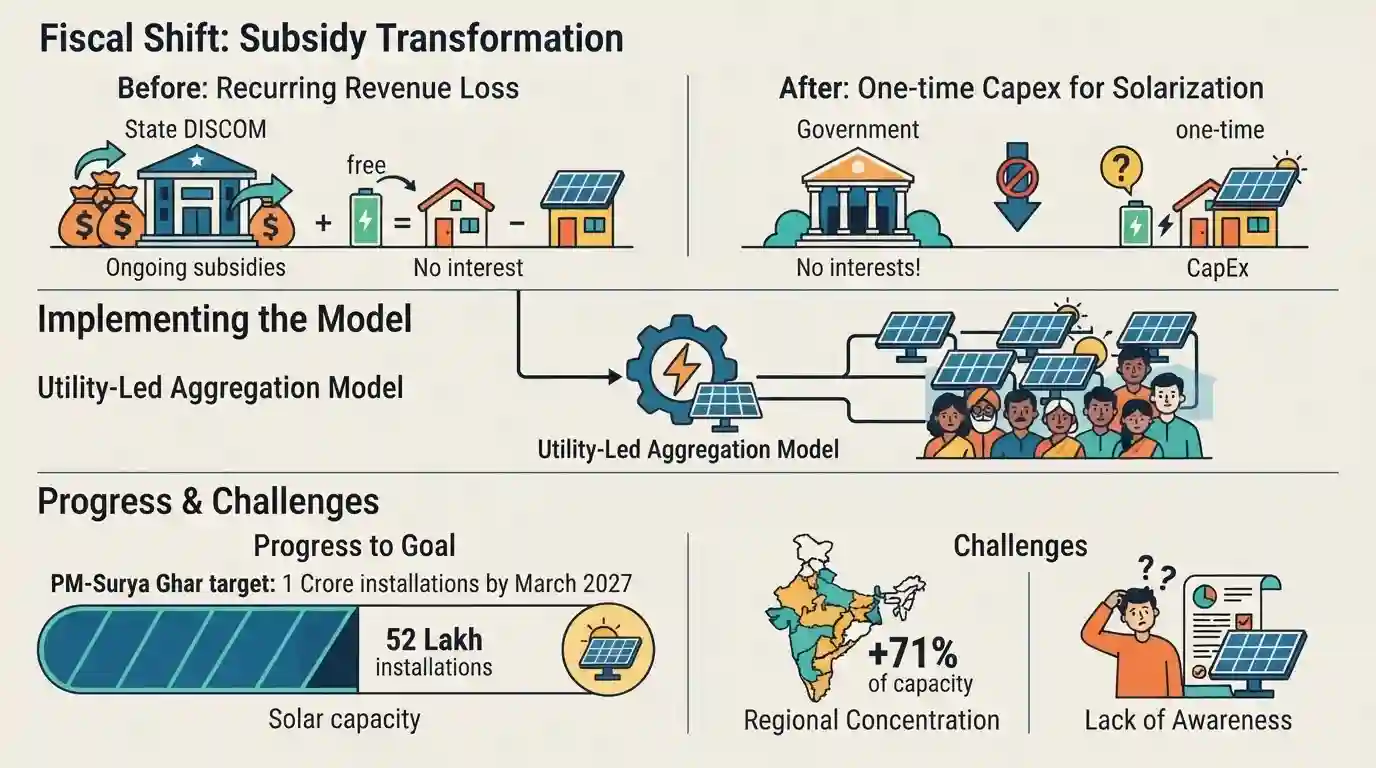
The article details a strategic fiscal shift where Indian states are utilizing solar subsidies under the Utility-Led Aggregation Model (ULA) of the PM-Surya Ghar scheme to offset recurring losses from subsidised electricity. Since households receiving free power have no incentive to install rooftop solar, states are opting to incur a one-time capital expenditure to solarise these households rather than continuing to bear recurring revenue-side subsidies. While India has achieved 52 lakh installations out of a 1 crore target by March 2027, challenges like heavy regional concentration (with five states accounting for over 71% of capacity) and lack of financial awareness among low-consumption households persist.
મુખ્ય મુદ્દા
- States like Uttar Pradesh, Andhra Pradesh, and Bihar are transitioning from providing recurring revenue-side power subsidies (free monthly electricity bills) to a one-time capital expenditure (subsidising rooftop solar installation) under the Utility-Led Aggregation Model (ULA).
- Under free-power state schemes, households have zero financial incentive to adopt rooftop solar (RTS) due to upfront costs. The ULA model resolves this deadlock by having the state/discom bear the initial capital expenditure of RTS for these low-consumption consumers, offsetting long-term discom losses.
- Out of the ₹75,000 crore PM-Surya Ghar: Muft Bijli Yojna target of solarising 1 crore households by March 2027, about 52 lakh (5.2 million) installations have been completed. Under the ULA component specifically, 2 lakh out of a targeted 30 lakh installations are done.
- To reach the 1 crore household target, India needs to maintain a run-rate of solarising 0.6 million households monthly from mid-2026 to March 2027, as per a CEEW survey.
- Rooftop solar adoption is highly concentrated, with just five states (Gujarat, Maharashtra, Rajasthan, Uttar Pradesh, and Kerala) accounting for more than 71% of the national installed capacity, highlighting the need for geographic diversification.
- Consumer awareness is a significant bottleneck: 73% of households that perceive RTS as expensive are unaware of available institutional financing options. Addressing this could unlock 22.7 GW of theoretical demand.
- The scheme remains strictly grid-dependent and restricted to households with suitable rooftops and existing grid connections, as it does not subsidise battery energy storage systems.
મહત્વપૂર્ણ શબ્દો
Pradhan Mantri – Surya Ghar: Muft Bijli Yojna

A ₹75,000 crore central scheme aiming to install rooftop solar systems in 1 crore households by 2027. It offers direct subsidies and collateral-free loans to provide up to 300 units of free electricity monthly.
UPSC context
GS Paper 3 (Renewable Energy). Tests knowledge of India's energy transition schemes, decentralised power generation, and fiscal subsidy reforms.
Utility-Led Aggregation Model (ULA)
An implementation model where power distribution companies (DISCOMs) aggregate demand and install rooftop solar projects on behalf of individual households, eliminating upfront capital costs for consumers and streamlining approvals.
UPSC context
GS Paper 3 (Infrastructure). Crucial for understanding DISCOM viability reforms, energy accessibility, and innovative models for deploying renewable infrastructure.
Union Ministry of New and Renewable Energy (MNRE)
The nodal central ministry responsible for developing and deploying new and renewable energy sources in India, functioning to meet the country's energy security and clean energy transition targets.
UPSC context
GS Paper 2 & 3. Relevant for evaluating government policies, nodal authorities, and administrative frameworks driving India's climate commitments.
Council on Energy, Environment and Water (CEEW)
A prominent independent policy research institution (think tank) based in New Delhi. It advises governments on natural resource management, sustainable energy transitions, power sector reforms, and climate risk mitigation.
UPSC context
GS Paper 2 & 3. Useful to cite in Mains answers regarding climate policy inputs, non-state actors in governance, and evidence-based research.
પ્રિલિમ્સ ટ્રેપ
The PM-Surya Ghar scheme subsidizes off-grid solar installations and battery storage systems to provide electricity to remote households.
The scheme is strictly grid-dependent and does not subsidize Battery Energy Storage Systems (BESS); it requires an active grid connection and net-metering.
સંલગ્ન સ્થિર ખ્યાલો
What is the economic distinction between Revenue and Capital expenditure in state budgets?
- Revenue Expenditure: Recurring consumption spending, like power subsidies, that does not result in the creation of productive physical or financial assets.
- Capital Expenditure: One-time investments, like solarizing households, that create long-term assets and reduce future operational liabilities for the state.
- Fiscal Consolidation: Converting revenue subsidies to one-time capital outlays improves the quality of state expenditure and reduces structural deficits.
How does net metering impact the financial health of state DISCOMs?
- Cross-Subsidization Loss: When high-paying commercial consumers adopt rooftop solar, DISCOMs lose their high-tariff base used to subsidize agricultural and domestic consumers.
- Fixed Cost Recovery: Net metering reduces energy sales but DISCOMs must still maintain grid infrastructure, leading to unrecovered fixed costs.
આંતર-વિષય પેટર્ન
Fiscal Federalism + Green Transition
How states navigate the political economy of 'free power' promises by using central capital subsidies to restructure utility debt and meet state-level renewable purchase obligations (RPOs).
Energy Security + Trade Protectionism
The friction between ambitious rooftop solar deployment targets and the Approved List of Models and Manufacturers (ALMM) mandate which restricts cheap solar module imports.

PM-Surya Ghar's grid-dependence and ULA-driven capital restructuring of DISCOM subsidies will likely feature in GS-3 Energy/Fiscal reforms.
સંલગ્ન PYQ · 4
સંલગ્ન PYQ · 4
- 2025PrelimsGS1
Consider the following statements about 'PM Surya Ghar Muft Bijli Yojana': I. It targets installation of one crore solar rooftop panels in the residential sector. II. The Ministry of New and Renewable Energy aims to impart training on installation, operation, maintenance and repairs of solar rooftop systems at grassroot levels. III. It aims to create more than three lakhs skilled manpower through fresh skilling, and up-skilling, under scheme component of capacity building. Which of the statements given above are correct?
- 2022MainsGS3
Do you think India will meet 50 percent of its energy needs from renewable energy by 2030 ? Justify your answer. How will the shift of subsidies from fossil fuels to renewables help achieve the above objective ? Explain.
- 2016PrelimsGS1
Which one of the following is a purpose of 'UDAY', a scheme of the Government?
- 2020MainsGS3
Describe the benefits of deriving electric energy from sunlight in contrast to the conventional energy generation. What are the initiatives offered by our Government for this purpose?
