Centre State Administrative Friction and State Autonomy Concerns
Source:The Hindu ↗
Why It Matters
This article illustrates the core flashpoints in contemporary Indian federalism, providing practical examples of tensions over fiscal centralization (GST, scheme funding), legislative overreach, and gubernatorial delays. It serves as essential case-study material for GS2 questions on Centre-State relations and cooperative federalism.
Summary
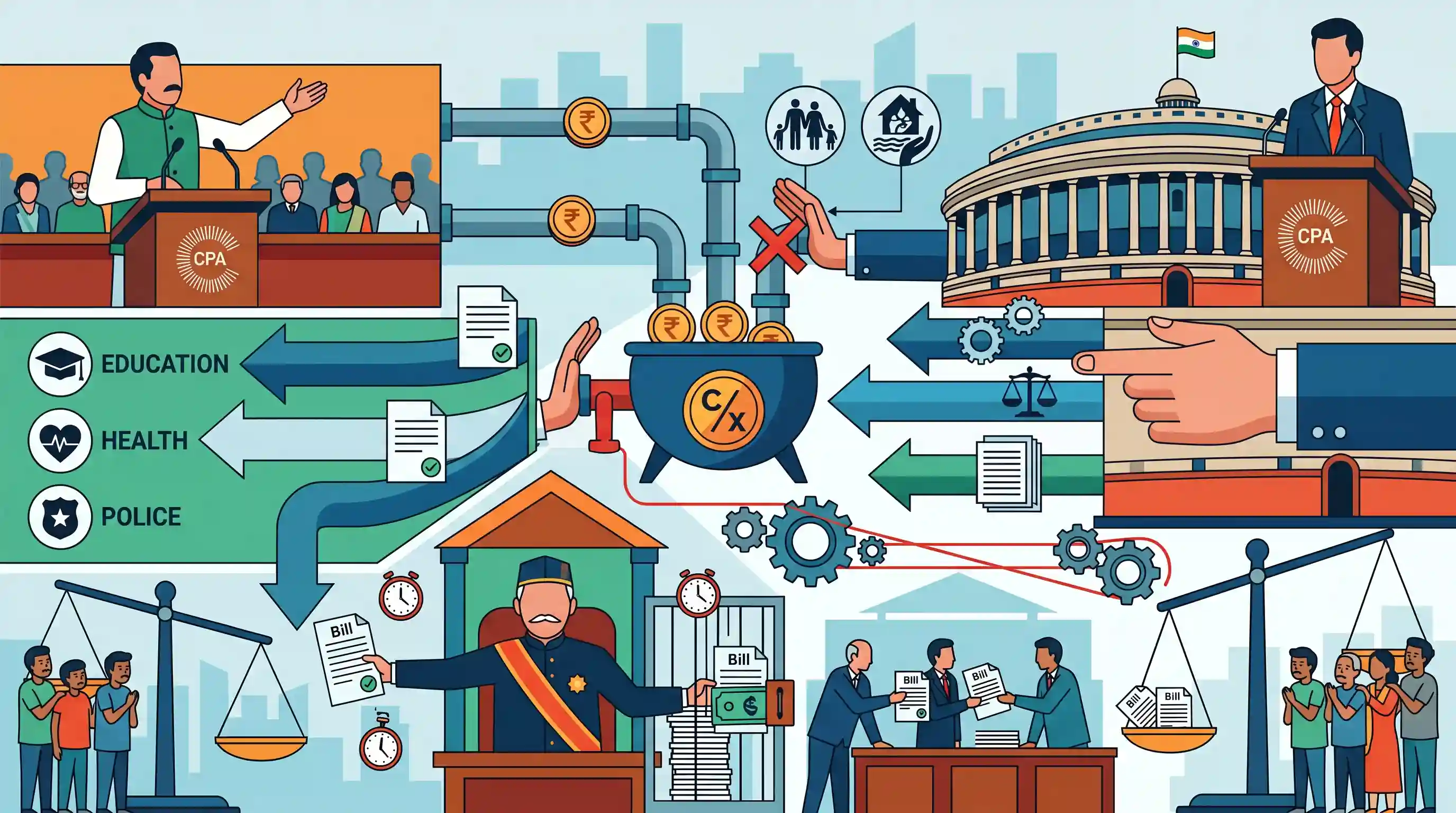
During the 11th Commonwealth Parliamentary Association India Region Conference, Tamil Nadu Speaker M. Appavu sharply criticized the Union government for steadily eroding State autonomy. He highlighted the Centre's encroachment on State subjects via administrative orders, the financial constraints imposed by the GST regime, and the withholding of funds for vital welfare schemes and disaster relief in Opposition-ruled states. Additionally, Appavu flagged the structural bottleneck created by Governors indefinitely delaying assent to State Bills, pointing to the Tamil Nadu Fiscal Responsibility Amendment Bill as a prime example of administrative friction hindering public welfare.
Key Points
- Tamil Nadu Speaker M. Appavu accused the Union government of encroaching on State subjects like minerals, fisheries, and cooperatives through administrative orders, bypassing Constitutional amendments.
- The Speaker criticized the GST regime for diminishing States\' revenue shares and functioning as an enforcer, while the Centre reportedly withholds crucial funds for Samagra Shiksha Abhiyan, RTE Act, and MGNREGA.
- Concerns were raised about the politicization of disaster relief, with allegations that Opposition-ruled states receive meager funds as punitive action, contrasting with massive corporate loan write-offs.
- The delay by Governors in assenting to Bills passed by State legislatures, such as the Tamil Nadu Fiscal Responsibility Amendment Bill returned after 1.5 years, was cited as a major hurdle to public welfare funding.
Important Terms
Commonwealth Parliamentary Association (CPA)

An international network of approximately 180 Commonwealth parliaments and legislatures dedicated to promoting democratic governance, parliamentary privilege, and the rule of law through regional and global conferences.
UPSC context
GS-II: Important International institutions; also relevant for parliamentary proceedings and legislative forums.
Samagra Shiksha Abhiyan (SSA)
An integrated centrally sponsored scheme for school education (pre-primary to Class 12) that subsumes Sarva Shiksha Abhiyan (SSA), Rashtriya Madhyamik Shiksha Abhiyan (RMSA), and Teacher Education (TE).
UPSC context
GS-II: Welfare schemes for vulnerable sections; GS-III: Issues related to inclusive growth and education funding.
Goods and Services Tax (GST)
A comprehensive, multi-stage, destination-based indirect tax levied on the supply of goods and services, aimed at creating a unified national market and governed by the GST Council.
UPSC context
GS-III: Indian Economy and issues relating to planning, mobilization of resources, and fiscal federalism.
Tamil Nadu Fiscal Responsibility Amendment Bill
State legislation enacted to ensure fiscal discipline by setting targets for revenue and fiscal deficits, frequently amended to align with Finance Commission recommendations or emergency needs.
UPSC context
GS-II: Role of Governor (Article 200); GS-III: Fiscal policy and the FRBM framework.
Mahatma Gandhi National Rural Employment Guarantee Act (MGNREGA)
A demand-driven social security measure that guarantees 100 days of unskilled manual work per financial year to every rural household, funded primarily by the Union government.
UPSC context
GS-II: Welfare schemes; GS-III: Rural development and employment; central to fiscal federalism disputes regarding fund disbursement.
Right to Education (RTE) Act
Enacted under Article 21-A, it mandates free and compulsory education for children aged 6–14, establishing minimum norms for schools and teacher qualifications across India.
UPSC context
GS-II: Issues relating to development and management of Social Sector/Services relating to Education.
Supreme Court
India’s highest judicial court, possessing original jurisdiction under Article 131 to resolve legal disputes between the Union and one or more States.
UPSC context
GS-II: Structure, organization and functioning of the Judiciary; arbiter of federal disputes.
Prelims Trap
"The Constitution prescribes a maximum limit of six months for the Governor to decide on a State Bill."
Article 200 says the Governor should act "as soon as possible" but sets no mandatory numerical time limit, enabling indefinite delays.
Static Concepts Connected
What options does a Governor have under Article 200 when presented with a State Bill?
- Assent or Withhold: The Governor can formally grant assent or withhold it entirely, which effectively kills the proposed legislation.
- Return for Reconsideration: Can return non-Money Bills. If the State legislature passes it again (with or without amendments), the Governor is bound to give assent.
- Reserve for President: Must reserve the bill for the President's consideration if it endangers the constitutional position of the State High Court.
How does the Constitution resolve legislative conflicts between the Centre and States?
- Federal Supremacy: Under Article 246, Parliament's power to legislate on the Union List overrides both Concurrent and State Lists in case of overlapping entries.
- Doctrine of Repugnancy: Under Article 254, a central law on a Concurrent subject prevails over a conflicting State law, unless the State law secured Presidential assent.
- Residuary Powers: Article 248 vests the exclusive power to legislate on any matter not enumerated in the Concurrent or State Lists to the Parliament.
Cross-Topic Patterns
CSS conditionalities & Fiscal Federalism
Withholding MGNREGA and education funds highlights the shift from unconditional grants to heavily conditioned transfers, heavily squeezing state fiscal autonomy in the post-GST era.
97th Amendment & Cooperative Autonomy
The Supreme Court struck down parts of the 97th Amendment because 'cooperatives' is a State subject, mirroring the Speaker's concerns over Union encroachment via administrative orders.

Expect a multi-statement question on Article 200, focusing on the absence of a constitutional time limit for Governors to return Bills.
Linked PYQs · 4
Linked PYQs · 4
- 2024MainsGS2
What changes has the Union Government recently introduced in the domain of Centre-State relations ? Suggest measures to be adopted to build the trust between the Centre and the States and for strengthening federalism.
- 2025MainsGS2
Examine the evolving pattern of Centre-State financial relations in the context of planned development in India. How far have the recent reforms impacted the fiscal federalism in India?
- 2022MainsGS2
Discuss the essential conditions for exercise of the legislative powers by the Governor. Discuss the legality of re-promulgation of ordinances by the Governor without placing them before the Legislature.
- 2015MainsGS2
The concept of cooperative federalism has been increasingly emphasized in recent years. Highlight the drawbacks in the existing structure and the extent to which cooperative federalism would answer the shortcomings.
