Kerala State Finances and Fiscal Sustainability Challenges
Source:The Hindu ↗
Why It Matters
The fiscal health of states is a critical element of macroeconomic stability and federal relations. Kerala's high social development is juxtaposed against deep fiscal stress, illustrating the tension between welfare commitments and fiscal prudence. Understanding 'borrowing to consume' vs 'borrowing to invest' is central to the UPSC syllabus on government budgeting and public expenditure.
Summary
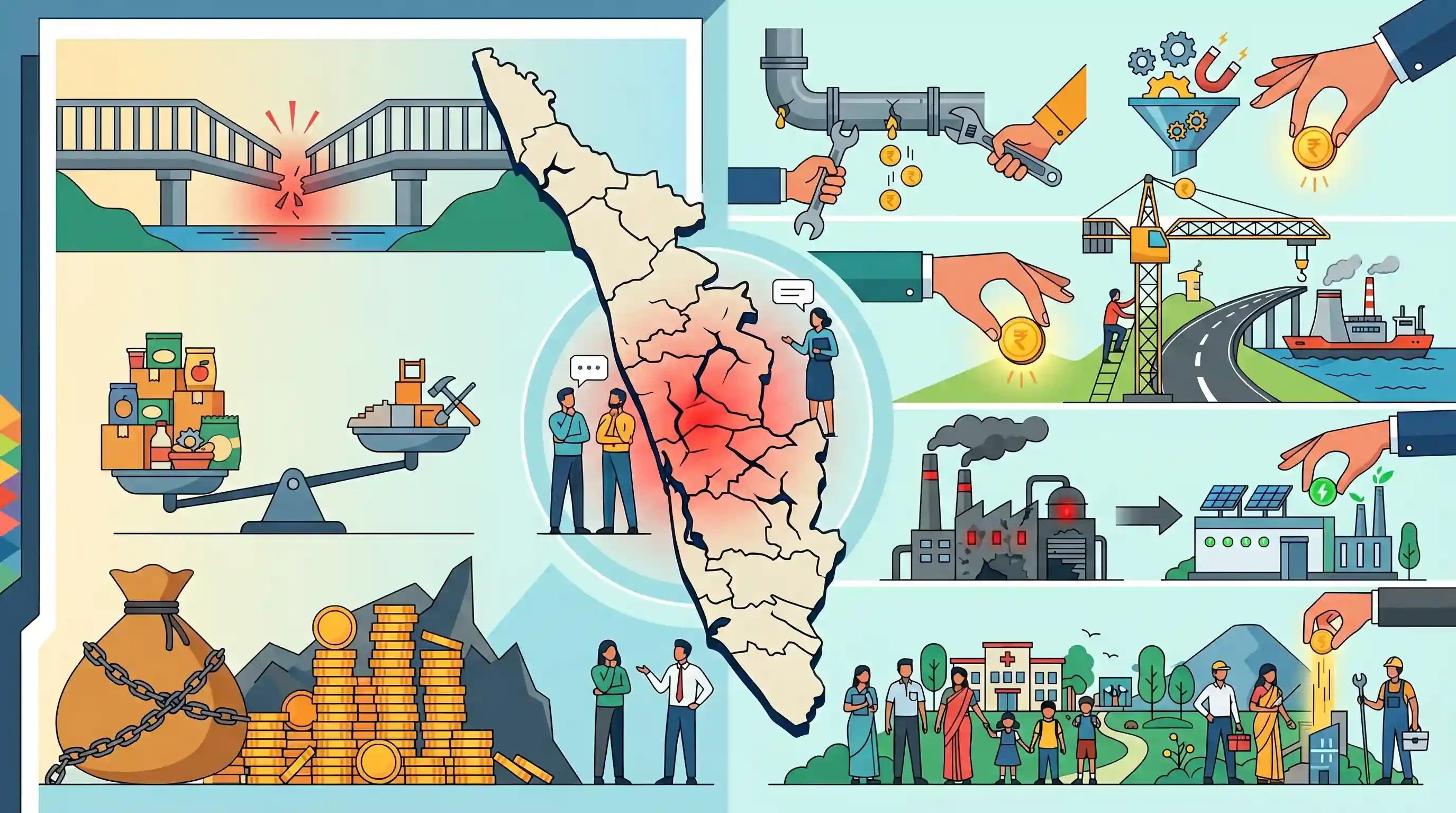
At a colloquium organized by the CAG and ICSSR, experts expressed concerns over deep structural stress in Kerala's finances, warning that it threatens the sustainability of the 'Kerala Model' of development. Speakers advised the state to improve revenue buoyancy by tapping non-tax revenues, recovering arrears, and plugging tax leakages. They criticized the state's tendency to borrow for current consumption rather than capital formation, urging strict adherence to the golden principle of 'borrowing to invest'. To reform its fiscal structure, the state was advised to rationalize committed expenditures, turn around loss-making public enterprises, and leverage the Centre's Special Assistance to States for Capital Investment (SASCI) scheme to boost productive asset creation.
Key Points
- Kerala's finances face severe structural stress characterized by rigid expenditure patterns, low tax buoyancy, high committed expenditures, and loss-making state public enterprises.
- Experts criticized the state's tendency to borrow for current consumption, urging strict adherence to the 'borrow to invest' principle for long-term capital formation.
- To improve fiscal health, the state needs to focus on recovering revenue arrears, tapping non-tax revenue potential, and plugging non-GST tax leakages.
- Kerala has been advised to leverage the Centre's Special Assistance to States for Capital Investment (SASCI) scheme to create productive assets.
- The ongoing fiscal imbalance threatens the long-term sustainability of the socially progressive 'Kerala Model' of development.
Important Terms
Comptroller and Auditor General of India (CAG)

A constitutional authority under Article 148, the CAG is the supreme audit institution responsible for auditing all receipts and expenditures of the Union and State governments.
UPSC context
GS Paper II (Constitutional Bodies). Tests executive accountability, legislative oversight, and the role of the 'guardian of the public purse.'
Special Assistance to States for Capital Investment (SASCI) scheme
A Central scheme providing 50-year interest-free loans to states for capital expenditure to stimulate economic recovery, infrastructure growth, and productive asset creation.
UPSC context
GS Paper III (Economy). Tests knowledge of fiscal federalism, center-state financial relations, and investment-led development strategies.
Kerala Model
A development paradigm prioritizing social welfare (health, education) over industrial growth, resulting in high HDI indicators despite relatively low per-capita income.
UPSC context
GS Paper II/III (Governance/Social Justice). Tests models of inclusive growth and the fiscal sustainability of welfare-driven policies.
Revenue Buoyancy
The responsiveness of tax revenue growth to changes in nominal GDP; a ratio above one indicates tax collections are growing faster than the economy.
UPSC context
GS Paper III (Indian Economy). Tests concepts of resource mobilization, tax efficiency, and long-term fiscal consolidation.
Committed Expenditure
Fixed government spending on interest payments, salaries, and pensions; these obligations are difficult to reduce and often limit fiscal flexibility for capital investment.
UPSC context
GS Paper III (Government Budgeting). Tests understanding of 'quality of expenditure' and the constraints on state-level fiscal management.
Indian Council of Social Science Research (ICSSR)
An autonomous national body under the Ministry of Education established in 1969 to promote, coordinate, and fund social science research in India.
UPSC context
GS Paper II (Institutional Framework). Tests knowledge of autonomous bodies involved in research and socio-economic policy inputs.
Prelims Trap
The SASCI scheme provides central grants-in-aid to States to stimulate capital expenditure.
SASCI provides 50-year interest-free loans, not grants. While highly concessionary, States must eventually repay the principal, impacting their long-term debt profile.
Static Concepts Connected
What is the difference between Tax Buoyancy and Tax Elasticity?
- Tax Buoyancy: Measures total tax revenue growth relative to GDP growth, factoring in the impact of any discretionary changes made to tax rates or the tax base.
- Tax Elasticity: Measures the inherent responsiveness of tax revenue to GDP growth, assuming the underlying tax structure (rates and base) remains completely unchanged.
What is the 'Golden Rule' of public finance?
- Borrow to Invest: Government borrowing should exclusively fund capital formation and asset creation, rather than financing day-to-day revenue expenditures like salaries and pensions.
- Intergenerational Equity: It ensures intergenerational equity, meaning future generations who bear the burden of debt repayment also benefit from the physical or social assets created.
Cross-Topic Patterns
Article 293 and State Borrowing Limits
Kerala's recent Supreme Court suit against the Centre's net borrowing ceilings highlights the ongoing tension between a State's welfare spending autonomy and the Union's macroeconomic stability mandate.
CAG Propriety Audit and Fiscal Prudence
Beyond checking technical legality, the CAG's authority to audit the 'propriety' of expenditure allows it to critique structurally unsound practices like a state systematically borrowing to fund everyday consumption.

Expect a multi-statement Prelims question on State borrowing under Article 293, 'tax buoyancy', and SASCI interest-free capital loans.
Linked PYQs · 5
Linked PYQs · 5
- 2013MainsGS3
What were the reasons for the introduction of Fiscal Responsibility and Budget Management (FRBM) Act, 2003 ? Discuss critically its salient features and their effectiveness.
- 2021MainsGS3
Distinguish between Capital Budget and Revenue Budget. Explain the components of both these Budgets.
- 2025MainsGS3
Explain how the Fiscal Health Index (FHI) can be used as a tool for assessing the fiscal performance of states in India. In what way would it encourage the states to adopt prudent and sustainable fiscal policies?
- 2018MainsGS2
“The Comptroller and Auditor General (CAG) has a very vital role to play.” Explain how this is reflected in the method and terms of his appointment as well as the range of powers he can exercise.
- 2020MainsGS3
Explain the meaning of investment in an economy in terms of capital formation. Discuss the factors to be considered while designing a concession agreement between a public entity and a private entity.
