Kerala IT Department Rebranded and Deep Tech Missions Launched
Source:The Hindu ↗
Why It Matters
The article highlights a state-level policy push towards deep-tech sectors (semiconductors, AI, space tech), serving as a strong case study for GS3 answers on industrial policy, digital transformation, and ease of doing business. It illustrates state governments actively aligning with national tech ambitions.
Summary
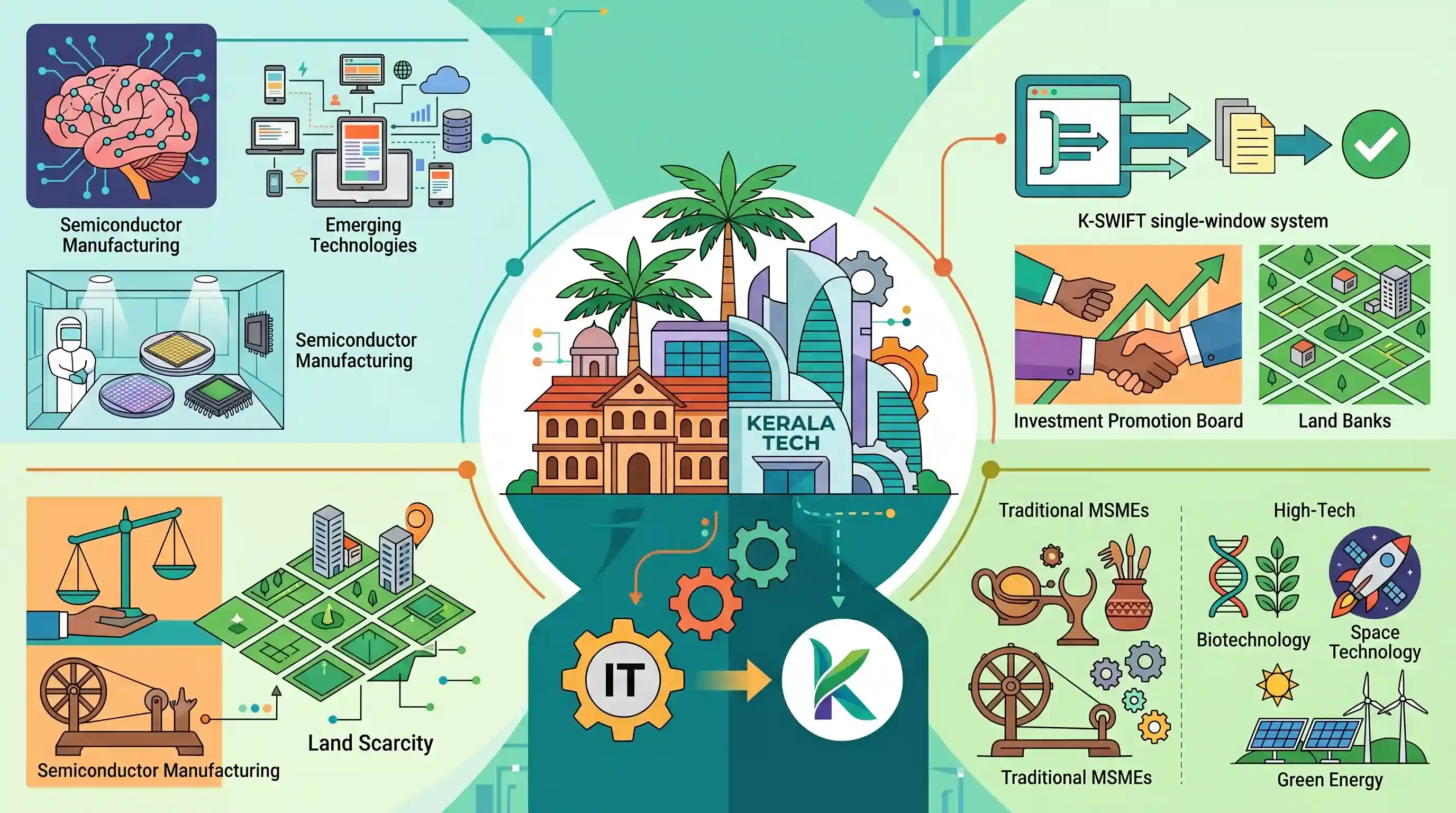
Kerala is initiating a comprehensive revamp of its IT and industrial policies, prominently rebranding its IT department to 'Kerala Tech' to reflect a focus on future technologies and start-ups. Announced in the Governor's Policy Address, the state plans to establish specialized missions for AI, emerging technologies, and semiconductor manufacturing. Simultaneously, it aims to enhance ease of doing business by modernizing the K-SWIFT single-window clearance system, formalizing an Investment Promotion Board, and addressing land scarcity through dedicated land banks. The policy emphasizes equitable growth across both traditional MSMEs and emerging high-tech sectors like biotechnology, space technology, and green energy.
Key Points
- The Kerala government is rebranding its Electronics and IT department as 'Kerala Tech' (IT, Future Technologies and Start-ups department).
- A new Electronics and Semiconductor Mission, along with a Digital Transformation Mission integrating AI and emerging technologies, will be formed.
- A digital government model prioritizing citizen experience using AI and digital technologies will be established.
- To support industrial expansion, land banks will be created using special purpose vehicles and market borrowing.
- The K-SWIFT single-window clearance platform will be modernized to streamline high-value investments and promote emerging sectors like AI, green energy, and space tech.
Important Terms
K-SWIFT

A digital platform providing time-bound statutory clearances and licenses for setting up industrial enterprises, aimed at improving Kerala's Ease of Doing Business through a single-window interface.
UPSC context
GS-III Economy/E-governance; tests industrial policy, administrative reforms, and state-level initiatives for investment facilitation.
Kerala Tech
The new brand identity for Kerala’s rebranded Department of IT, Future Technologies, and Startups, signaling a policy shift toward AI, semiconductors, and deep-tech entrepreneurship.
UPSC context
GS-III Economy; signifies a state's transition toward a knowledge-based economy and high-tech industrialization.
Digital Transformation Mission
The rebranded Kerala State IT Mission (KSITM), restructured to oversee specialized technological verticals including Artificial Intelligence and Emerging Technologies to ensure citizen-centric digital governance.
UPSC context
GS-II/III Governance/S&T; relevant for e-governance, digital public infrastructure, and institutional frameworks for technology management.
Kerala AI Mission
A flagship initiative to position Kerala as a global AI hub by 2030, focusing on ethical AI, skill development, and integrating AI into public service delivery.
UPSC context
GS-III S&T; involves emerging technologies, AI ethics, and the application of disruptive tech in governance.
Electronics and Semiconductor Mission
A strategic framework to attract investments in Electronics System Design and Manufacturing (ESDM) and niche semiconductor research, complementing India's national semiconductor manufacturing goals.
UPSC context
GS-III Economy/S&T; relates to India’s semiconductor ambitions and regional industrial clusters for high-tech manufacturing.
Investment Promotion Board
A proposed statutory high-level body designed to facilitate mega-projects, fast-track high-value investments, and resolve grievances to boost investor confidence in the state.
UPSC context
GS-III Economy; tests institutional mechanisms for investment facilitation and the role of state-level industrial promotion agencies.
Prelims Trap
"Semiconductor policies and missions can only be established by the Union Government under MeitY."
States actively form parallel Semiconductor Missions and IT policies (under their Industries mandate) to attract FDI and augment the national ISM with local incentives.
Static Concepts Connected
What is a Single Window Clearance System and how does it aid Ease of Doing Business?
- Centralized Portal: Integrates multiple state and central departmental approvals into one digital dashboard (like NSWS or Kerala's K-SWIFT).
- Reduced Compliance Burden: Minimizes physical touchpoints with authorities, preventing time overruns, regulatory delays, and bureaucratic rent-seeking.
- Investment Magnet: Provides an efficient, predictable ecosystem essential for boosting FDI and increasing the manufacturing sector's GDP share.
What is the structure and mandate of the India Semiconductor Mission (ISM)?
- Institutional Structure: Operates as a specialized and independent business division within the Digital India Corporation under MeitY.
- Core Mandate: Serves as the nodal agency executing the ₹76,000 crore incentive scheme for sustainable semiconductor and display ecosystems.
- State Synergy: Relies on states to complement national subsidies with local infrastructure like land banks, power, and water tariff concessions.
Cross-Topic Patterns
From IT to AI-driven E-Governance
Restructuring traditional IT departments into 'Tech & Future' ministries marks a shift in e-governance from basic back-end digitization to predictive, AI-driven citizen services.
Land Banks bridging Manufacturing gaps
Creating industrial land banks via Special Purpose Vehicles (SPVs) bypasses historic land acquisition bottlenecks, a crucial prerequisite for space-heavy sectors like semiconductor fabs.

Expect a 2026 Mains GS3 question on how state-level tech policies complement the national India Semiconductor Mission (ISM).
Linked PYQs · 4
Linked PYQs · 4
- 2025MainsGS3
India aims to become a semiconductor manufacturing hub. What are the challenges faced by the semiconductor industry in India? Mention the salient features of the India Semiconductor Mission.
- 2023MainsGS3
Faster economic growth requires increased share of the manufacturing sector in GDP, particularly of MSMEs. Comment on the present policies of the Government in this regard.
- 2024MainsGS2
e-governance is not just about the routine application of digital technology in service delivery process. It is as much about multifarious interactions for ensuring transparency and accountability. In this context evaluate the role of the 'Interactive Service Model' of e-governance.
- 2025MainsGS2
e-governance projects have a built-in bias towards technology and back-end integration than user-centric designs. Examine.
