Rajasthan Government to Relaunch Small Limestone Mining Leases
Source:business-standard ↗
Why It Matters
Mining is a cornerstone of Rajasthan's economy. Policy changes regarding mineral leases, particularly for a critical resource like limestone, directly influence the state's industrial output (especially cement), employment generation, and revenue collection. These topics are highly relevant for the RPSC RAS Prelims, which frequently tests knowledge on the state's economic geography, mineral resources, and governance policies.
Summary
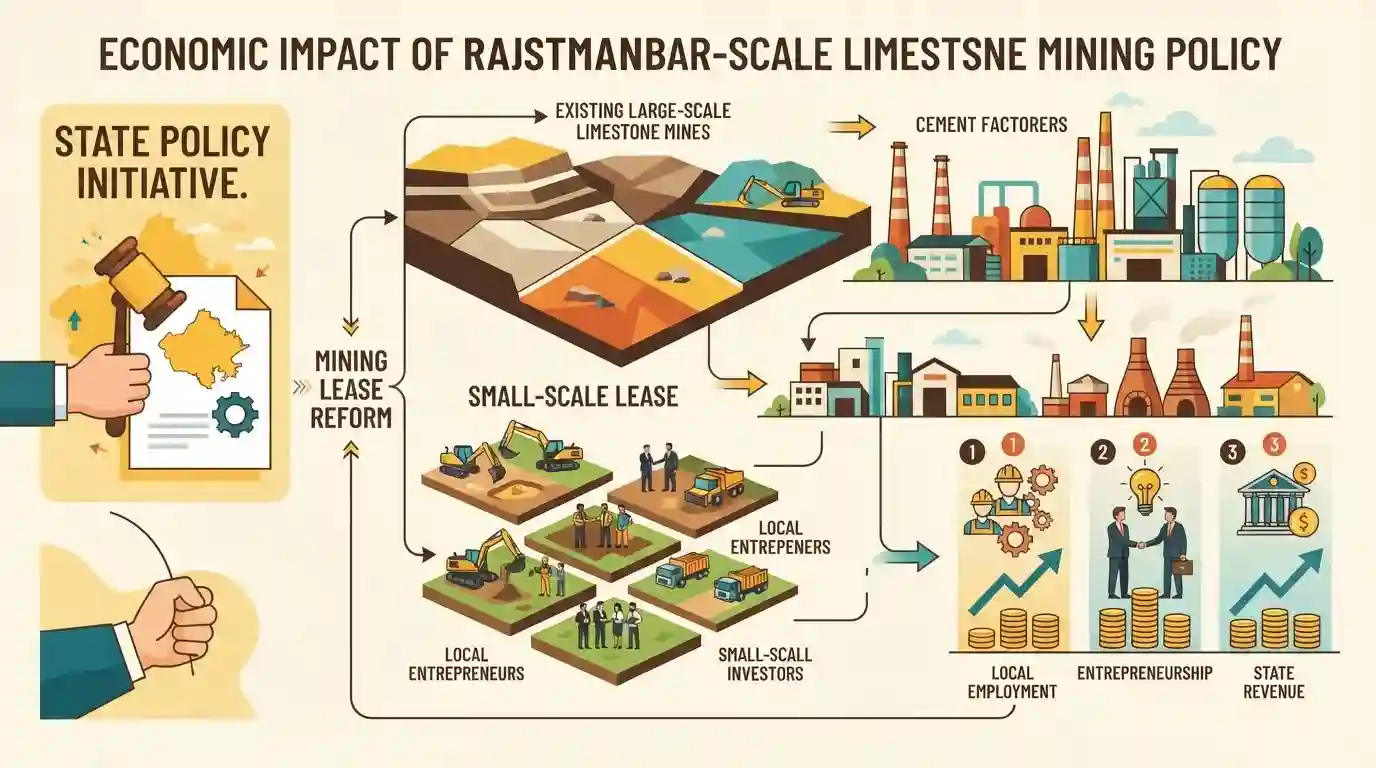
The Rajasthan government plans to relaunch small limestone mining leases to boost the state's mining and industrial sectors. As a leading producer of limestone, Rajasthan relies heavily on this mineral to fuel its robust cement industry. By offering smaller mining leases, the state aims to encourage participation from small-scale investors and local entrepreneurs, thereby generating employment and enhancing state revenue. This strategic move aligns with Rajasthan's ongoing efforts to optimize its mineral wealth, streamline mining regulations, and promote sustainable industrial growth under its state mineral policies.
Key Points
- The Rajasthan government is preparing to relaunch small limestone mining leases to stimulate the local mining sector.
- This initiative aims to attract smaller investors and entrepreneurs, fostering local employment and increasing state revenue.
- Limestone is a vital mineral resource for Rajasthan, serving as the primary raw material for its extensive cement manufacturing industry.
- The relaunch of these leases is expected to streamline mineral concessions and support the industrial development of the state in line with broader mineral policies.
Important Terms
Rajasthan Mineral Policy

A state framework promoting sustainable, zero-waste extraction, investment attraction, and ecological conservation. It aims to balance economic growth from Rajasthan's vast mineral wealth with environmental protection.
UPSC context
GS Paper 3 (Resource Mobilization, Environment). Tests knowledge of state-level sustainable mining initiatives and economic policies.
Rajasthan Minor Mineral Concession Rules
State regulations framed under the MMDR Act 1957 governing the leasing, extraction, and royalty collection for minor minerals, aiming to ensure transparent and scientific mining practices.
UPSC context
GS Paper 2 & 3. Highlights the division of powers, testing knowledge of state jurisdiction over minor minerals.
Limestone
A sedimentary rock essential for the cement industry. In October 2025, the Indian government uniformly reclassified all limestone as a major mineral, removing previous end-use distinctions.
UPSC context
Prelims & GS1 (Economic Geography). Tests factual knowledge of mineral classification and industrial resource distribution in India.
Mines and Minerals (Development and Regulation) Act, 1957
India's primary mining legislation. It classifies minerals into major (centrally regulated) and minor (state-regulated) categories, dictating the legal framework for resource extraction, management, and revenue distribution.
UPSC context
Core for Prelims and GS Paper 3. Frequently tested regarding the regulatory framework and state versus central control over resources.
Prelims Trap
"Limestone used for building purposes or in lime kilns is categorized as a minor mineral."
The Ministry of Mines recently reclassified ALL forms of limestone entirely as a 'major mineral', removing its previous dual-status where building-grade limestone was minor.
Static Concepts Connected
How does the MMDR Act divide regulatory powers for minerals?
- Major Minerals: The Central Government frames rules and policies. However, State governments grant the mineral concessions (leases) and collect the royalty.
- Minor Minerals: State governments have complete administrative, rule-making, and revenue-collection powers for minor minerals (e.g., sand, building stones).
- Notification Power: Under Section 3(e) of the MMDR Act, only the Central Government holds the power to notify a mineral as 'minor'.
Why is Rajasthan referred to as India's 'Museum of Minerals'?
- High Diversity: The state hosts an immense geological diversity, with approximately 79 known varieties of minerals found across its terrain.
- Virtual Monopolies: Rajasthan holds a virtual monopoly in the production of lead, zinc, wollastonite, and selenite in India.
- Limestone & Cement: It is India's largest limestone producer (>20% national output), which directly feeds the massive cement manufacturing clusters in Chittorgarh and Nagaur.
Cross-Topic Patterns
Core Industries & Cement production
Limestone is the primary raw material for cement, one of the eight core industries. Mining lease reforms directly impact cement capacity and the Index of Core Industries (ICI).
Federalism in Resource Governance
This highlights Center-State resource governance: the Center reclassifies minerals (like making all limestone 'major'), while States execute lease allocations and retain the royalty revenue.

2026 Prelims is likely to test major vs. minor mineral classification rules, using limestone's recent uniform 'major' status as a trap.
Linked PYQs · 3
Linked PYQs · 3
- 2018RPSC_PRELIMSGS1
Which of the following are the important mineral-based industries in Rajasthan? (a) Zinc Smelting Industry (b) Cement Industry (c) Electronic Industry (d) Marble Industry Code:
- 2018RPSC_PRELIMSGS1
Which of the following statements are true? (a) Marble Development and Conservation Rules – 2002 (b) Rajasthan Mineral Policy – 2015 (c) District Mineral Foundation Trust Rules – 2016 (d) Rajasthan Minor Mineral Concession Rules (amended up to May 2016) Code:
- 2025RPSC_PRELIMSGS1
The correct order of decreasing contribution of different sectors in Rajasthan’s Gross Fixed Capital Formation is
