Maharashtra plans land allocation for nomadic communities
Source:hindustantimes ↗
Why It Matters
Crucial for understanding state-level welfare policies directed at Nomadic Tribes (NT) and Vimukta Jatis (VJ) in Maharashtra, which frequently feature in MPSC polity and social development questions.
Summary
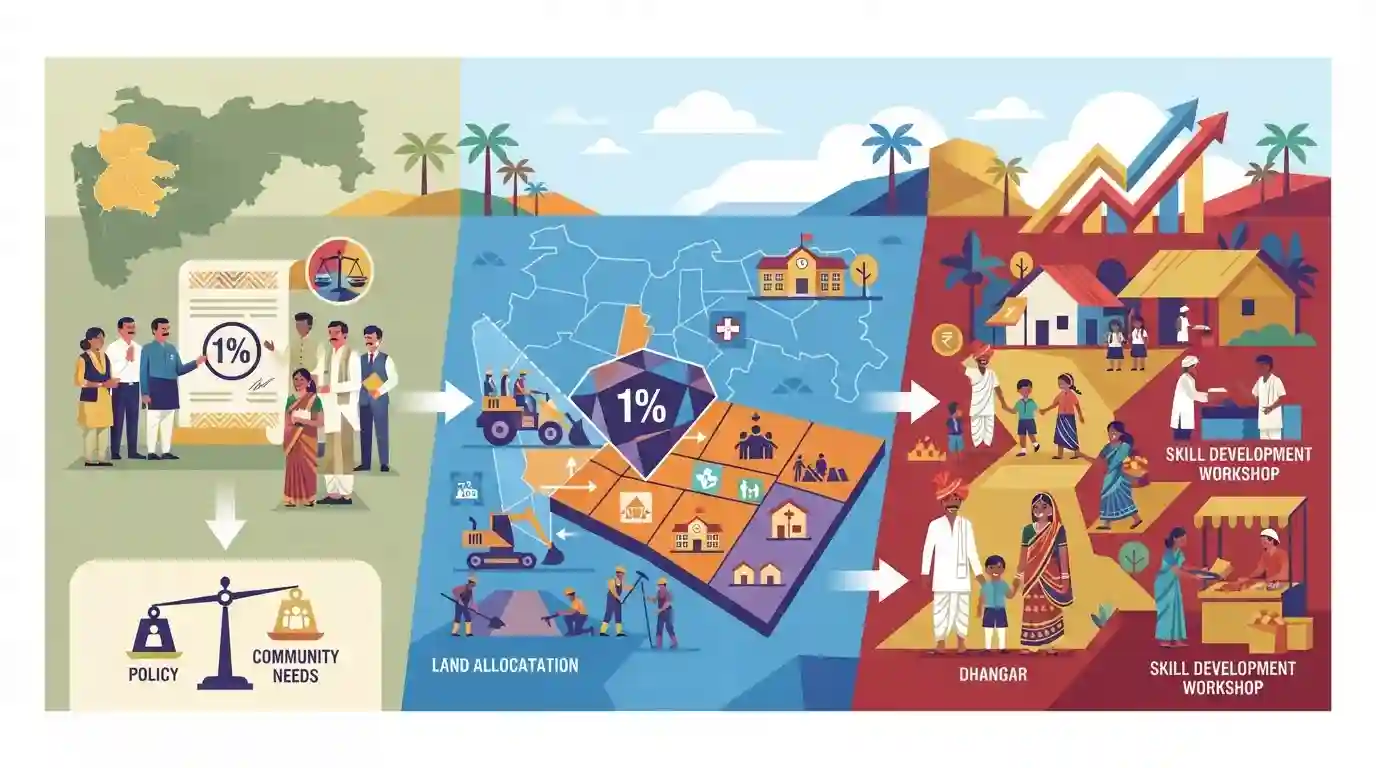
The Maharashtra government has formulated a plan to allocate 1% of land specifically for Dhangar and other Nomadic Tribes (NT) communities to boost their socio-economic development and welfare infrastructure.
Key Points
- The Maharashtra state government has planned to allocate 1% of land for Dhangar and other Nomadic Tribes (NT) communities.
- This initiative is aimed at addressing welfare, settlement, and socio-economic development demands of historically marginalized nomadic groups in the state.
- The policy addresses long-standing social justice and empowerment needs of communities like the Dhangars who have active demands regarding reservation and infrastructure support.
Important Terms
Dhangar Community

A major pastoral and shepherd community in Maharashtra, traditionally semi-nomadic, classified under the Vimukta Jati and Nomadic Tribes (VJNT) category and seeking inclusion in the Scheduled Tribes list.
UPSC context
MPSC Paper II (Governance & Social Justice): Important for studying marginalized social groups, vulnerability, reservation demands, and welfare schemes for Nomadic Tribes.
Nomadic Tribes (NT)
A constitutional and administrative classification encompassing communities that do not have a fixed place of residence and practice traditional wandering or pastoral livelihoods, such as shepherds.
UPSC context
MPSC Paper II (Social Justice / Vulnerable Sections): Tests understanding of state policies, social security measures, and development frameworks for VJNT/OBC communities.
Cabinet Sub-Committee for OBC/VJNT Welfare
A designated state executive committee tasked with formulating, fast-tracking, and executing policy decisions, welfare schemes, and infrastructure projects for backward classes in Maharashtra.
UPSC context
MPSC Paper II (Polity & Governance): Relevant for questions on state-level executive decision-making, administrative committees, and welfare policy implementation.
Prelims Trap
Dhangar community is officially classified under the Scheduled Tribe (ST) category in Maharashtra.
Aspirants often confuse Dhangar (NT-C pastoral community in Maharashtra) with Dhangar of other states or assume they are already classified as Scheduled Tribes (ST).
Static Concepts Connected
What is the categorization and constitutional context of Nomadic Tribes (NT) and Denotified Tribes (DNT) in Maharashtra?
- Categories NT-A to D: Classification split into NT-A, NT-B, NT-C, and NT-D based on traditional occupations and social backwardness within state reservation matrices.
- Renake Commission: Renake Commission (2008) recommended central legislation and welfare boards for DNTs, mirroring state-level panels in Maharashtra.
- NT-C Status: Dhangar community is specifically categorized under NT-C (Nomadic Tribe - C) in Maharashtra, distinct from Scheduled Tribes.
Cross-Topic Patterns
Dhangar Reservation + Constitutional Article 342
The Dhangar demand for inclusion under the Scheduled Tribe (ST) category intersects constitutional provisions under Articles 341 and 342, linking state welfare policies with federal reservation jurisprudence.
Nomadic Rehabilitation + Gairan Land Policy
Pastoral nomadic settlement schemes tie directly into administrative challenges under the Fifth Schedule and land revenue codes concerning common property resources (Gairan lands).

Maharashtra NT/Dhangar land allocation + Mandal/Renake commission recommendations likely to appear as a matching or statement-based question.
Linked PYQs · 1
Linked PYQs · 1
- 2018MPSC_PRELIMSGS1
In Maharashtra, Dr. Abdul Kalam Amrut Ahar Yojana is related with
