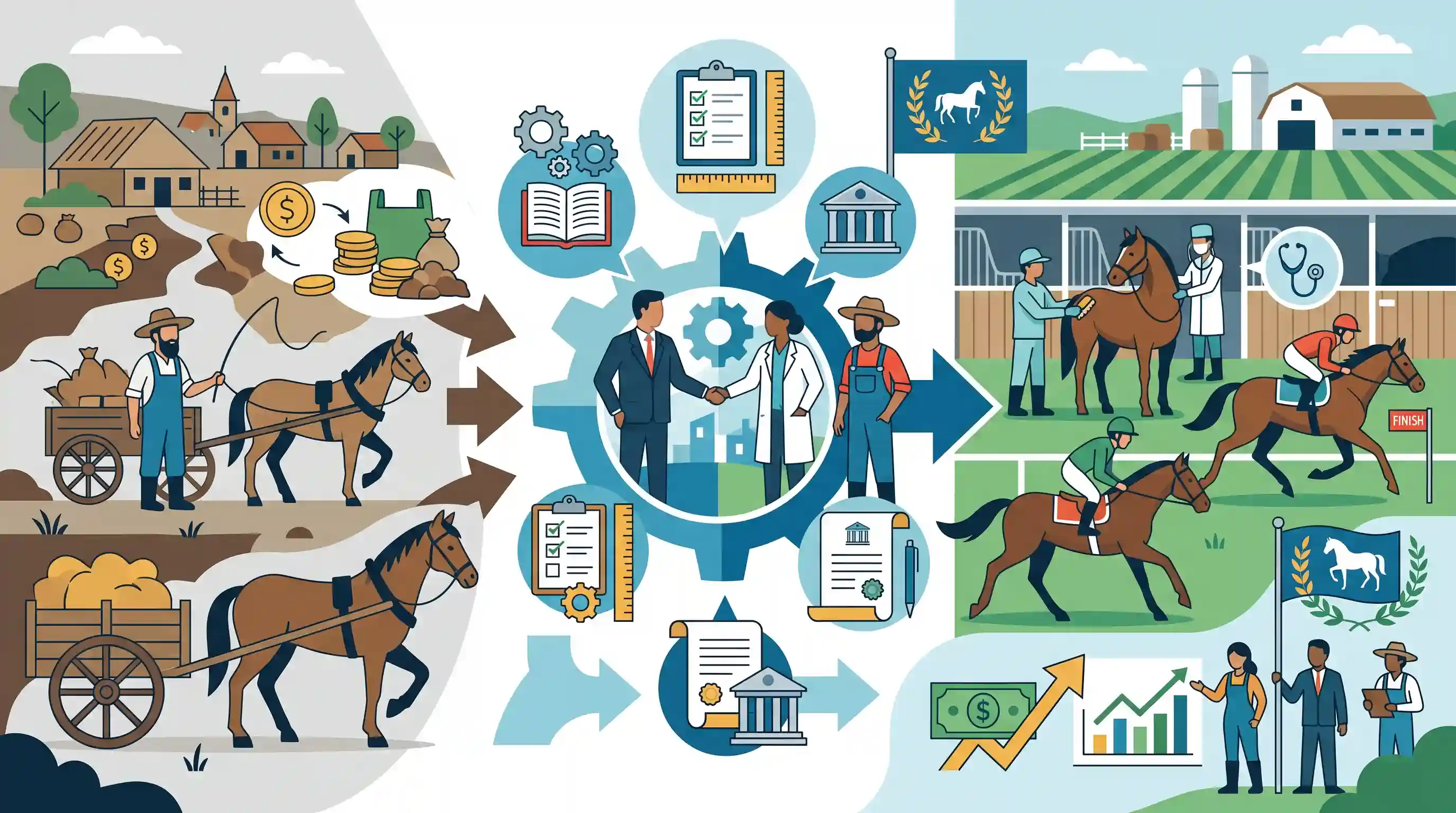
Formalization and skill development initiatives for the equine sector
Source:Indian Express ↗
Why It Matters
The formalization of niche agricultural and allied sectors (like equines) represents an innovative pathway for non-farm rural employment and economic growth, relevant to GS-3 topics on livestock rearing and the rural economy.
Summary
Maharashtra's Minister for Animal Husbandry and Dairy, Pankaja Munde, announced the state's readiness to collaborate with institutions to formalize and boost the Indian equine sector. Speaking at the 'Beyond the Sport' conference organized by The Equine Collective at MIT-WPU, Pune, she highlighted the sector's potential to generate employment and support rural development through skill training, standardisation, and policy reform. The initiative seeks to transition the unstructured domestic industry into a globally competitive, knowledge-driven ecosystem.
Key Points
- A national conference titled 'Beyond the Sport' was organized in Pune to discuss formalizing India's unstructured equine industry.
- Maharashtra's Minister for Animal Husbandry, Pankaja Munde, expressed the state government's willingness to sign MoUs with institutions to standardize training and skill development.
- The initiative aims to unlock the sector's potential in areas like rural development, equine tourism, veterinary care, breeding, and employment generation.
- Experts emphasized the need for collaboration between academia, the government, and the industry to transform India's equine heritage into a competitive part of the multi-billion dollar global market.
Important Terms
The Equine Collective

A collaborative platform founded under MIT-WPU to formalize India's fragmented equine industry through skill development, national forums, and policy advocacy for breeders, veterinarians, and athletes.
UPSC context
GS3: Economics of Animal Rearing. Illustrates private-academic partnerships aimed at formalizing unorganized livestock sub-sectors and boosting rural employment.
National Horse Breeding Society of India (NHBSI)
The apex body representing Indian thoroughbred breeders and stud farm owners; it manages the Indian Stud Book and advocates for the industry in taxation and policy.
UPSC context
GS3: Animal Husbandry. Essential for understanding institutional frameworks that regulate commercial livestock and the economic impact of the racing industry.
Indigenous Horse Society of India (IHSI)
An organization focused on the preservation and promotion of native Indian horse breeds (e.g., Marwari, Kathiawari), working with the government to lift export bans and standardize breeding.
UPSC context
GS3: Animal Husbandry/Biodiversity. Tests knowledge of indigenous breed conservation and the global economic potential of India's native livestock.
Animal Husbandry
The branch of agriculture dealing with the breeding and management of livestock; the equine sector specifically supports rural transport, sports, and socio-cultural traditions.
UPSC context
GS3: Economics of Animal Rearing. A core syllabus topic evaluating livestock’s contribution to rural livelihoods and agricultural GDP.
MIT World Peace University (MIT-WPU)
A private university in Pune acting as a knowledge partner for the equine sector by integrating academia, sports science, and vocational training to professionalize the industry.
UPSC context
GS2/GS3: Education and Skill Development. Highlights the role of academic institutions in sectoral formalization and specialized rural skill-building.
Prelims Trap
"India's equine population has steadily increased over the last decade due to government conservation efforts."
The 20th Livestock Census (2019) actually recorded a steep decline of over 50% in India's equine population compared to the 2012 census.
Static Concepts Connected
What are the key components of the National Livestock Mission (NLM)?
- Breed Development: Focuses on entrepreneurship development and breed improvement for poultry, sheep, goats, pigs, and recently added equines/camels.
- Feed & Fodder: Aims to mitigate the nationwide deficit of animal feed and fodder through certified seed production.
- Innovation & Extension: Supports research institutes, universities, and farmer awareness programs to modernize livestock practices.
How is the Livestock Census conducted in India?
- Frequency: Conducted every 5 years by the Ministry of Fisheries, Animal Husbandry & Dairying since 1919.
- Coverage: Enumerates all domesticated animals and poultry birds across both rural and urban areas.
- Digital Data: The 20th Census (2019) was the first to use tablet computers for direct digital data collection.
Cross-Topic Patterns
Animal traction in unorganized sector
98% of India's equines are utilized by landless/marginal farmers. Formalizing this links directly to GS3 themes of reducing vulnerabilities in the rural unorganized workforce.
Livestock as a climate shock buffer
Niche livestock rearing (equines, camels) provides alternative income during climate-induced crop failures, aligning with the Ashok Dalwai committee's recommendations on income diversification.

The 2024 NLM expansion to equines/camels and the 50% population drop in the 20th Census makes livestock trends a prime target for 2026.
Linked PYQs · 2
Linked PYQs · 2
- 2015MainsGS3
Livestock rearing has a big potential for providing non-farm employment and income in rural areas. Discuss suggesting suitable measures to promote this sector in India.
- 2016MainsGS3
How globalization has led to the reduction of employment in the formal sector of the Indian economy? Is increased informalization detrimental to the development of the country?
