Biochar research facility inaugurated to mitigate forest fires
Source:socialnews.xyz ↗
Why It Matters
The article presents a highly relevant case study for HPAS Prelims on using technological interventions (biochar production) to solve a chronic local disaster issue (pine needle forest fires) while simultaneously addressing global climate goals (carbon sequestration) and agricultural improvement.
Summary
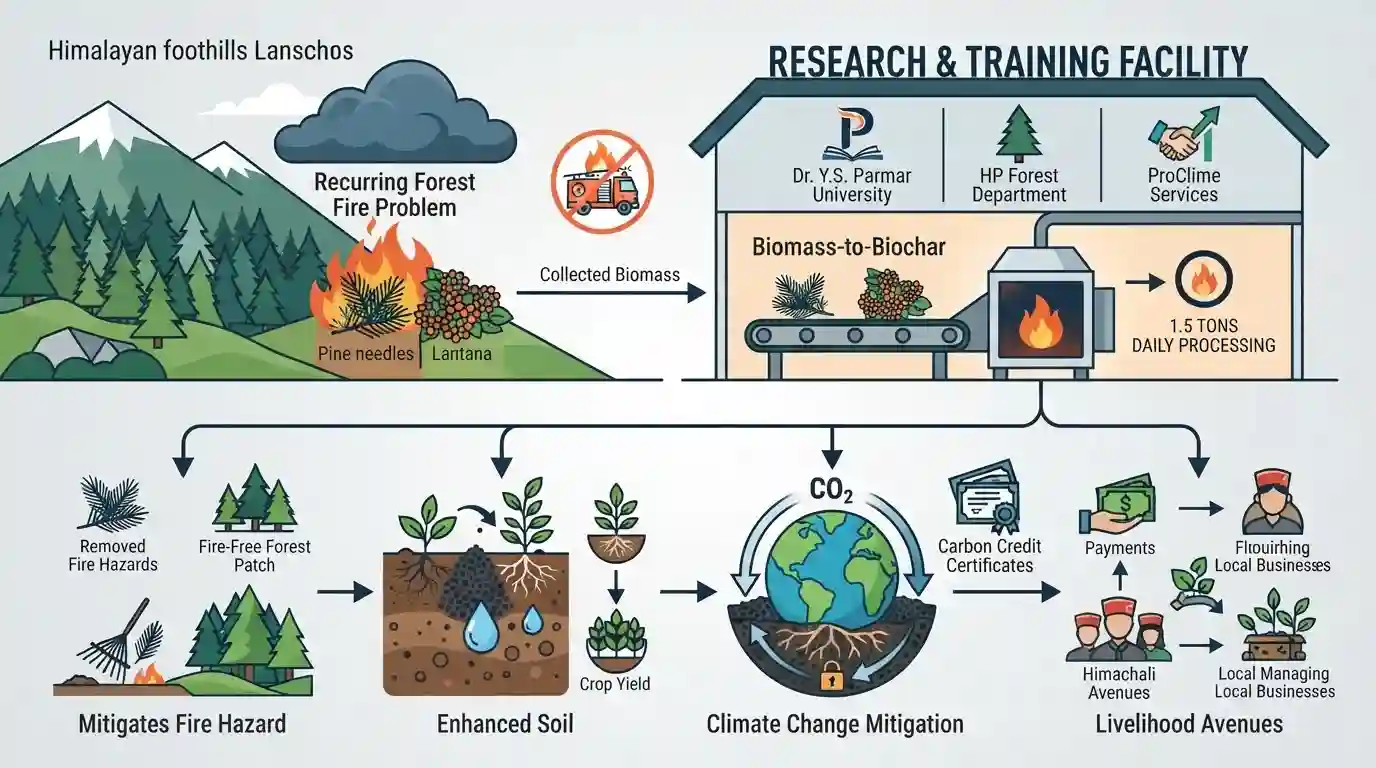
Himachal Pradesh has launched a state-of-the-art Biochar Research and Training Facility at the College of Horticulture and Forestry in Neri to tackle the recurring problem of forest fires. Set up through a tripartite agreement between Dr. Y.S. Parmar University, the HP Forest Department, and ProClime Services, the facility converts combustible forest biomass—such as pine needles and lantana—into biochar. By processing 1.5 tons of biomass daily, the project not only mitigates fire hazards but also produces biochar that enhances soil fertility and water retention. Furthermore, it supports climate change mitigation through carbon sequestration and the generation of carbon credits, offering new livelihood avenues for local communities.
Key Points
- A pioneering Biochar Research and Training Facility has been inaugurated at the College of Horticulture and Forestry in Neri, Himachal Pradesh.
- The facility mitigates forest fire risks by converting highly combustible biomass, particularly pine needles and lantana, into useful biochar.
- With a production capacity of 1.5 tons per day, the biochar produced will be utilized to improve soil fertility, enhance water retention, and support sustainable agriculture.
- The initiative aims to reduce greenhouse gas emissions and generate carbon credits, creating sustainable livelihood opportunities for local communities.
Important Terms
Biochar

A stable, carbon-rich solid produced by heating organic biomass under low-oxygen conditions (pyrolysis), used to enhance soil fertility, improve water retention, and store carbon for centuries.
UPSC context
GS Paper III (Agriculture & Environment); tests understanding of sustainable farming, organic inputs, and technological solutions to crop residue management.
Carbon Sequestration
The long-term capturing and securing of carbon dioxide from the atmosphere to mitigate global warming by storing it in terrestrial reservoirs like soil, biochar, and forests.
UPSC context
GS Paper III (Environment & Climate Change); tests concepts of climate mitigation strategies, greenhouse gas sinks, and international carbon market standards.
Dr. Y.S. Parmar University of Horticulture and Forestry
A premier state agricultural university located in Solan, Himachal Pradesh, specializing in education, research, and extension in horticulture, forestry, and mountain agriculture since 1985.
UPSC context
GS Paper III (Agriculture); tests awareness of key public research institutions driving climate-resilient farming and agro-forestry models in India.
Himachal Pradesh Forest Department
The state agency responsible for forest resource management, implementing wildfire preventive strategies, eradicating invasive species, and involving local communities in sustainable agro-forestry systems.
UPSC context
GS Paper III (Disaster Management); tests administrative models for forest fire mitigation, ecosystem restoration, and public-private-community partnerships.
College of Horticulture and Forestry, Neri
A constituent college of Y.S. Parmar University in Hamirpur, focusing on subtropical horticulture, and the designated location for India’s first indigenous biochar facility.
UPSC context
GS Paper III (Agriculture); tests decentralized institutional frameworks that apply scientific innovations to localized ecological and soil management challenges.
ProClime Services
A Chennai-based climate service provider that designs, implements, and operates high-integrity nature-based solutions, carbon capture, and forestry carbon projects to generate carbon credits.
UPSC context
GS Paper III (Environment & Economy); tests private sector participation in climate finance, public-private partnerships, and market-based conservation models.
Prelims Trap
Biochar is produced by burning biomass at high temperatures in the presence of excess oxygen.
False. Biochar is produced through pyrolysis—thermal decomposition in the absence or limited supply of oxygen. Excess oxygen causes complete combustion, leaving only ash and releasing CO2.
Static Concepts Connected
What is Biochar and what are its primary agricultural applications?
- Pyrolysis process: Produced by heating organic biomass (like pine needles) under oxygen-limited conditions, yielding a highly stable, carbon-rich material.
- Soil amendment: Its highly porous structure improves water retention, reduces soil acidity, and prevents nutrient leaching in degraded soils.
- Carbon sequestration: It locks atmospheric carbon in the soil for hundreds to thousands of years, making it a critical negative-emissions technology.
What constitutes Minor Forest Produce (MFP) and who governs its transit?
- Legal definition: Includes all non-timber forest produce of plant origin, such as bamboo, brush wood, stumps, honey, wax, and notably, pine needles.
- Gram Panchayat authority: Under the Forest Rights Act (FRA) and state rules, local Gram Panchayats are often vested with the authority to issue transit passes for MFP.
Cross-Topic Patterns
Forest Fires + Invasive Alien Species
Linking disaster management (pine needle fires) with biodiversity loss (Lantana camara invasion). Both provide highly combustible, dry biomass fuels that severely escalate Himalayan forest fire intensity.
Biochar Pyrolysis + Carbon Credit Markets
Biomass-to-biochar conversion creates verifiable carbon sequestration, directly linking local forest management to emerging carbon trading mechanisms and carbon credit generation under the Paris Agreement.

Expect a 2026 Prelims multi-statement question combining the biochar pyrolysis process, Lantana's ecological impact, and MFP transit rules.
Linked PYQs · 5
Linked PYQs · 5
- 2018HPAS_PRELIMSGS1
In which of the following conditions bio-gas is produced ?
- 2016HPAS_PRELIMSGS1
The use of carbon tax has been very successful to reduce emissions of greenhouse gases in :
- 2010HPAS_PRELIMSGS1
Carbon dioxide absorbs strongly in infrared region and its presence in atmosphere decreases the loss of heat from earth by radiations. This is called :
- 2014HPAS_PRELIMSGS1
Apart from carbon dioxide, which of the following gases also has a role in climate change ?
- 2025HPAS_PRELIMSGS1
Given below are two statements : Statement I : The withdrawal of USA from Paris Agreement in 2025 will strengthen global climate action momentum. Statement II : India has indicated a shift in its climate change approach by focussing less on adaptation rather than mitigation. In the light of the above statements, choose the most appropriate answer from the options given below :
