UN CERD Report Observations on Marginalized Groups in India
Source:The Hindu ↗
কেন এটি গুরুত্বপূর্ণ
It covers international human rights scrutiny, treaty body reporting, and domestic social justice issues concerning minorities and marginalized communities in India.
সারসংক্ষেপ
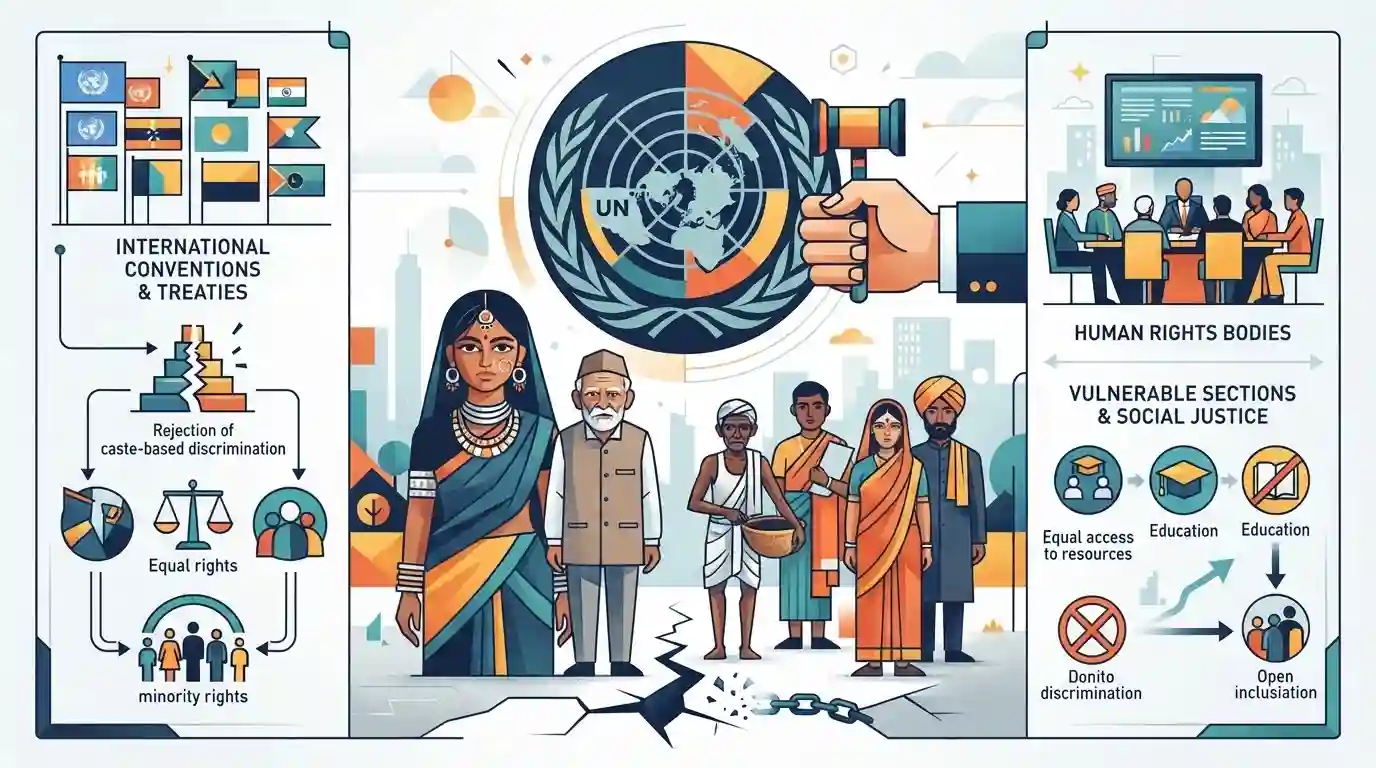
An analysis of the UN CERD report on India, discussing the observations made by the UN Committee on the Elimination of Racial Discrimination regarding marginalized sections, minority rights, and caste-based discrimination.
মূল বিষয়
- The UN Committee on the Elimination of Racial Discrimination (CERD) released a critical report highlighting concerns over the treatment of minorities, marginalized groups, and caste-based discrimination in India.
- The report brings to light issues regarding hate speech, human rights violations, and the effective enforcement of legal protections for vulnerable communities.
- Such international human rights monitoring mechanisms play a key role in reviewing state compliance with global human rights covenants, though India often emphasizes domestic judicial remedies and constitutional guarantees.
গুরুত্বপূর্ণ শব্দ
International Convention on the Elimination of All Forms of Racial Discrimination

A core international human rights treaty adopted by the UN General Assembly in 1965, obligating state parties to eliminate racial discrimination and promote understanding among all races.
UPSC context
Important for GS Paper II (International Conventions, Treaties & Global Groupings, Human Rights).
United Nations Committee on the Elimination of Racial Discrimination
The UN body of independent experts that monitors the implementation of the ICERD by state parties, issuing periodic reviews, observations, and recommendations.
UPSC context
Relevant for GS Paper II (International Bodies, Accountability Mechanisms, and Vulnerable Sections).
সংযুক্ত স্থির ধারণা
What is the UN Committee on the Elimination of Racial Discrimination (CERD) and ICERD mandate?
- Treaty Body:: Body role. Treaty body monitoring state parties' compliance with the International Convention on the Elimination of All Forms of Racial Discrimination (1965).
- Caste Scope:: India's stance. India ratified ICERD in 1968, maintaining that caste-based discrimination falls outside Article 1 (which defines racial discrimination), a point of ongoing debate.
- Legal Weight:: Binding nature. Concluding observations are authoritative recommendations but lack direct judicial enforceability in domestic legal systems unless codified by legislation.
আন্তঃবিষয় প্যাটার্ন
CERD vs Domestic Caste Jurisprudence
CERD's interpretation of racial discrimination to include caste intersects directly with GS-1 Indian Society's study of social stratification, untouchability, and constitutional safeguards under Articles 15, 17, and 46.
NHRC Autonomy and International Treaty Bodies
UN human rights body critiques of domestic institutional autonomy feed directly into GS-2 questions on the statutory powers, pluralism, and Paris Principles compliance of the NHRC.

Expect a statement-based question pairing ICERD's definition of racial discrimination with India's official stance on caste-based inclusion.
সংযুক্ত PYQ · 1
সংযুক্ত PYQ · 1
- 2026PrelimsGS1
Which of the following international conventions have not been ratified by India ? 1. Employment Policy Convention 2. Abolition of Forced Labour Convention 3. International Convention on the Protection of the Rights of All Migrant Workers and Members of Their Families 4. Geneva Convention Relative to the Protection of Civilian Persons in Time of War 5. Convention on Reduction of Statelessness Select the answer using the code given below :
