India China Border Tranquility and Bilateral Relations Posture
Source:The Hindu ↗
Why It Matters
This article highlights India's 'border-first' diplomatic posture towards China, contrasting with Beijing's preference to isolate the boundary dispute from the broader bilateral relationship. Understanding mechanisms like the WMCC, the significance of the 2024 Depsang-Demchok disengagement, and territorial disputes in the Eastern Sector (Arunachal Pradesh) is critical for GS Paper 2 (International Relations) and GS Paper 3 (Internal Security & Border Management).
Summary
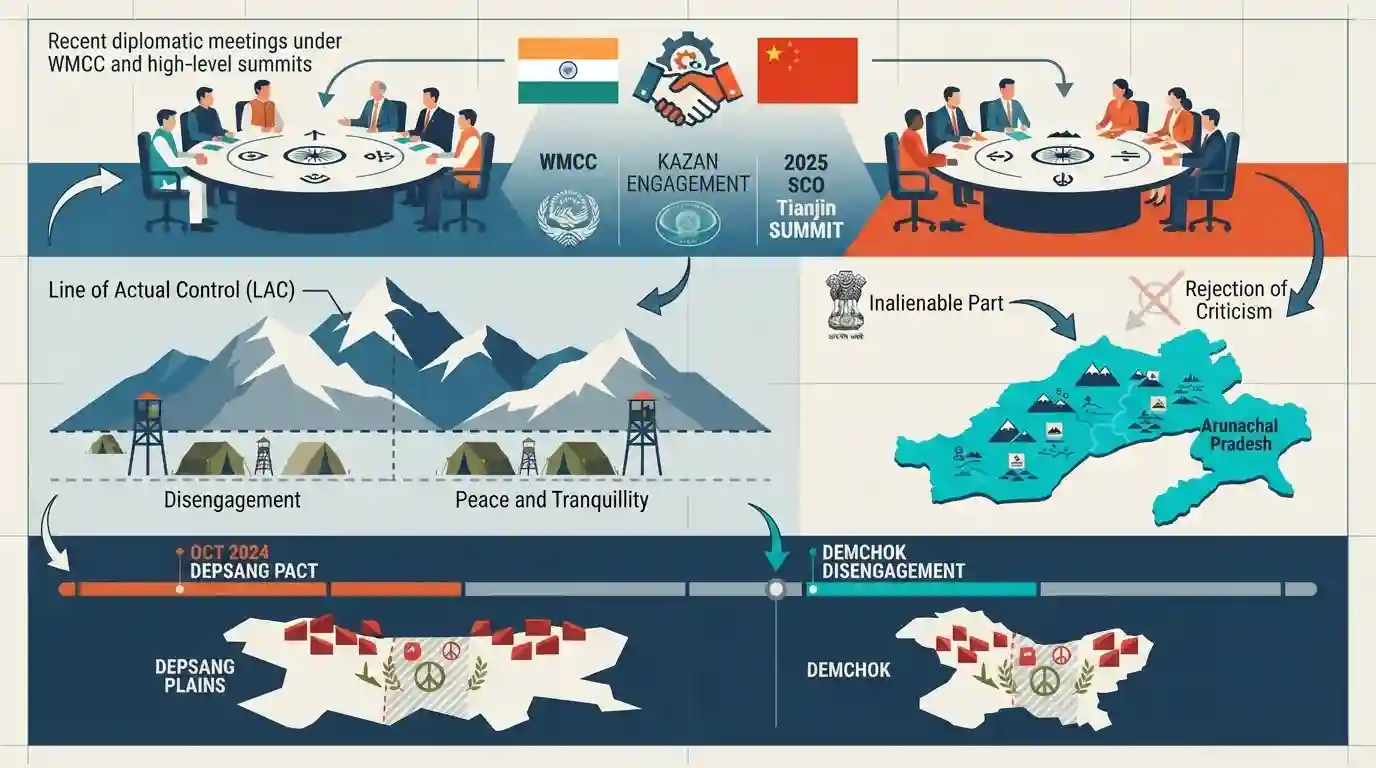
India has reaffirmed its position that normalization of overall bilateral relations with China is contingent upon maintaining peace and tranquillity along the Line of Actual Control (LAC). Speaking after a Working Mechanism for Consultation and Coordination (WMCC) meeting, the MEA also rejected China's criticisms over India naming 27 geographic features in Arunachal Pradesh, declaring the region an inalienable part of India. The diplomatic interactions build upon the momentum of the October 2024 Depsang-Demchok disengagement pact and high-level engagements at Kazan and the 2025 SCO summit in Tianjin.
Key Points
- India asserted that the peace and tranquillity along the Line of Actual Control (LAC) is of 'utmost importance' and that the state of border affairs will directly reflect on the larger bilateral ties.
- The Ministry of External Affairs (MEA) rejected China's opposition to India's formal naming/standardizing of 27 places and features in Arunachal Pradesh, reiterating that Arunachal Pradesh is an 'inalienable and integral' part of India.
- During a recent WMCC meeting, both nations reviewed the LAC situation and agreed to leverage existing diplomatic and military channels (including local commander-level talks) to prevent misunderstandings and miscalculations.
- The statement follows a progressive thawing of ties post the 2020 Galwan Valley clash, aided by the October 2024 disengagement pact at the final friction points of Depsang and Demchok, followed by high-level dialogue at the Kazan Summit (2024) and the Tianjin SCO Summit (2025).
Important Terms
October 2024 Disengagement Pact

An agreement between India and China to resolve the four-year military standoff in Eastern Ladakh, enabling troop disengagement and restored patrolling rights at the Depsang and Demchok friction points.
UPSC context
Vital for GS Paper 2 (India-China Relations) and GS 3 (Security), highlighting diplomatic conflict resolution.
Working Mechanism for Consultation and Coordination (WMCC)
An institutionalized bilateral framework established in 2012 by India and China. It facilitates diplomatic and military communication to maintain peace, handle boundary affairs, and resolve tensions along the border.
UPSC context
Essential for GS Paper 2 (Bilateral Agreements) to understand India-China institutional dialogue mechanisms.
Shanghai Cooperation Organisation (SCO)
A permanent Eurasian intergovernmental organization founded in 2001. Focused on political, economic, and security cooperation—including counter-terrorism—it includes India and China among its full members.
UPSC context
Key for GS Paper 2 (International Organizations), focusing on India's balancing strategy and Eurasian geopolitical interests.
Line of Actual Control (LAC)
The disputed de facto border separating Indian-controlled territory from Chinese-controlled territory. Extending approximately 3,488 kilometers, it is divided into Western, Middle, and Eastern sectors.
UPSC context
Core concept for GS Paper 3 (Border Management) and GS 2 (Neighborhood Relations), testing geographical and strategic awareness.
Depsang and Demchok
Strategically significant friction areas in Eastern Ladakh along the Line of Actual Control. They were key sites of the prolonged military standoff between India and China before the 2024 disengagement.
UPSC context
Relevant for GS Paper 3 (Border Security) and Prelims map-based questions regarding Ladakh's geography.
Prelims Trap
The WMCC was established as an emergency military-command mechanism immediately following the 2020 Galwan Valley clash.
The WMCC was established in 2012, not 2020. It is a diplomat-led (Joint Secretary level) consultative forum, not a purely military command structure.
Static Concepts Connected
What is the Working Mechanism for Consultation and Coordination (WMCC)?
- Origin: Established in 2012 as an institutional framework to exchange views on border management and resolve local LAC frictions.
- Leadership: Co-chaired by Joint Secretary-level diplomats (not defense ministers) from both countries' foreign ministries, aided by military representatives.
- Mandate: Aims to strengthen communication and prevent misunderstandings; it does not replace the higher-level Special Representatives (SR) talks.
Why is the Depsang Plains sector highly sensitive for India's defense?
- DBO Proximity: Lies adjacent to Daulat Beg Oldie (DBO), India's northernmost military outpost near the strategic Karakoram Pass.
- Logistical Threat: Chinese ingress in Depsang can choke the critical Darbuk-Shyok-DBO (DS-DBO) road, cutting off Indian troops in the north.
- Two-Front Link: Acts as a geographical buffer preventing physical collusion between Chinese forces in Aksai Chin and Pakistani forces in Gilgit-Baltistan.
Cross-Topic Patterns
Cartographic warfare & sovereignty
China's renaming of features in Arunachal Pradesh parallels its South China Sea strategy of establishing legal-historical revisionist claims through administrative decrees.
Security-contingent economic policy
India's linkage of border peace to trade normalization marks a strategic shift from 'separate-track' diplomacy to active economic-security statecraft.

WMCC's organizational setup and the strategic geography of Depsang-DBO are highly probable targets for multi-statement Prelims questions.
Linked PYQs · 3
Linked PYQs · 3
- 2024MainsGS3
India has a long and troubled border with China and Pakistan fraught with contentious issues. Examine the conflicting issues and security challenges along the border. Also give out the development being undertaken in these areas under the Border Area Development Programme (BADP) and Border Infrastructure and Management (BIM) Scheme.
- 2014MainsGS2
With respect to the South China sea, maritime territorial disputes and rising tension affirm the need for safeguarding maritime security to ensure freedom of navigation and over flight throughout the region. In this context, discuss the bilateral issues between India and China.
- 2023MainsGS2
‘Virus of Conflict is affecting the functioning of the SCO’ In the light of the above statement point out the role of India in mitigating the problems.
