Restoration of Statehood and Federal Dynamics in Jammu and Kashmir
Source:The Hindu ↗
આ શા માટે મહત્વનું છે
It addresses core constitutional questions regarding federalism, the status of Union Territories, democratic representation, and centre-state relations in the context of Jammu and Kashmir.
સારાંશ
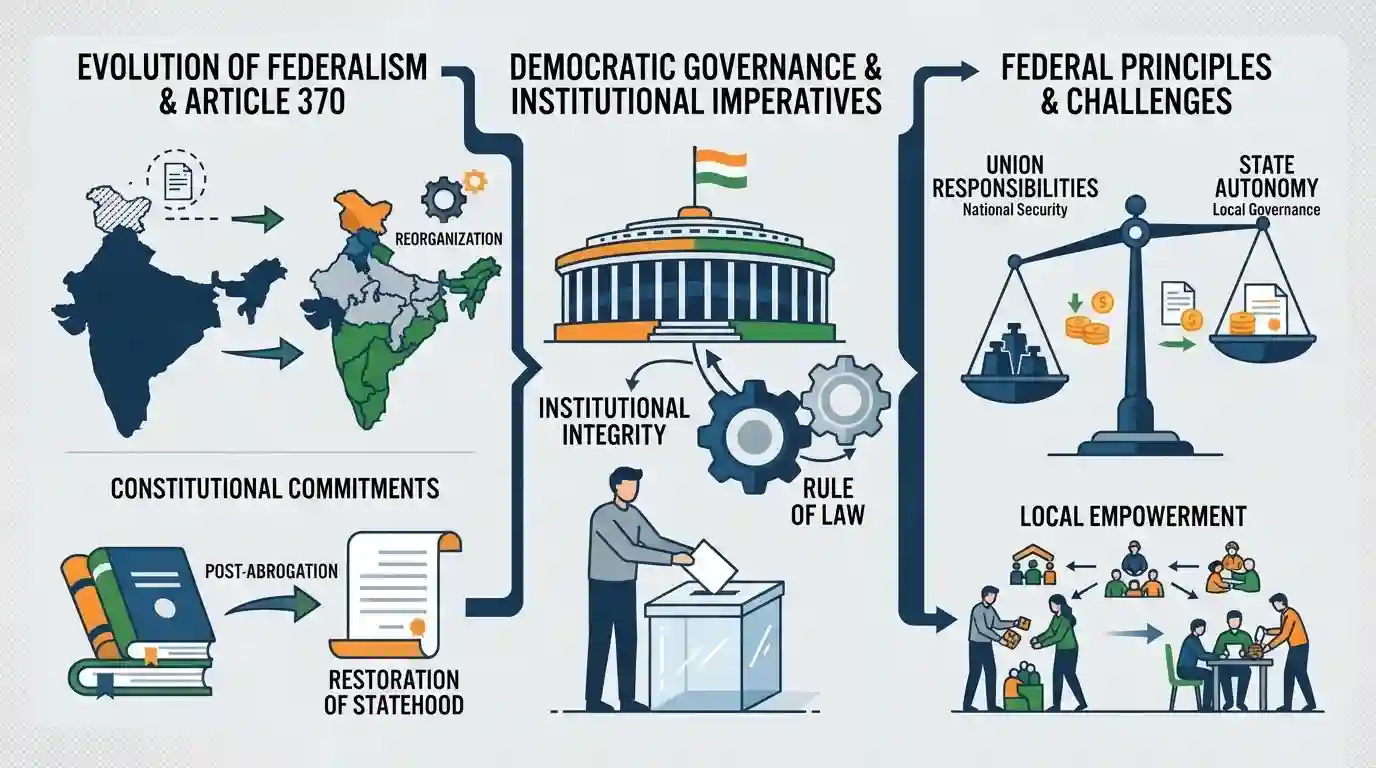
The editorial explores the political expectations and institutional imperatives surrounding the restoration of statehood to Jammu and Kashmir, emphasizing democratic governance, federal principles, and the commitments made post-abrogation of Article 370.
મુખ્ય મુદ્દા
- The editorial discusses the ongoing political anticipation surrounding the restoration of full statehood to Jammu and Kashmir following the Supreme Court's mandate and the recent assembly elections.
- Restoring statehood is viewed as essential for fulfilling democratic aspirations, bridging the trust deficit, and ensuring accountability between elected representatives and governance institutions.
- The transition from a Union Territory back to a full State highlights key dimensions of Indian federalism, centre-state dynamics, and the institutional role of the judiciary in upholding constitutional democracy.
મહત્વપૂર્ણ શબ્દો
Jammu and Kashmir Reorganization Act 2019

A legislation enacted by the Parliament of India in 2019 that bifurcated the erstwhile State of Jammu and Kashmir into two Union Territories: Jammu and Kashmir, and Ladakh.
UPSC context
GS Paper 2 (Indian Constitution, Federal Structure, Governance). Tests understanding of parliament's power to reorganize states/UTs under Article 3.
Article 370
A temporary provision in the Indian Constitution that granted special autonomous status and a separate constitution to the erstwhile State of Jammu and Kashmir, abrogated in August 2019.
UPSC context
GS Paper 2 (Indian Constitution - Significant Provisions and Basic Structure). Tests constitutional history, federalism, and presidential orders.
Supreme Court of India
The highest constitutional court of India, which plays a pivotal role in judicial review, federal disputes, and safeguarding fundamental rights, notably upholding the 2019 abrogation of Article 370.
UPSC context
GS Paper 2 (Judiciary, Constitutional interpretation). Tests the role of the apex court in balancing executive actions with federal principles.
Jammu and Kashmir Legislative Assembly
The unicameral legislative body of the Union Territory of Jammu and Kashmir, empowered to make laws on matters enumerated in the State and Concurrent Lists (except police and public order).
UPSC context
GS Paper 2 (Legislative Organs, Devolution of Powers). Tests the functioning of legislatures in Union Territories with special governance arrangements.
પ્રિલિમ્સ ટ્રેપ
The Supreme Court struck down the abrogation of Article 370 and ordered the immediate reinstatement of the erstwhile state's special status.
Aspirants often assume the Supreme Court struck down the 2019 abrogation of Article 370; in fact, the Court upheld the abrogation while issuing a directive for early restoration of statehood.
સંલગ્ન સ્થિર ખ્યાલો
What are the constitutional provisions governing the creation and alteration of States and Union Territories in India?
- Article 3 Power: Parliamentary power under Article 3 allows Parliament to form new States, alter boundaries, or convert States into Union Territories by a simple majority.
- Prior Recommendation: Presidential recommendation under the proviso to Article 3 is mandatory before a Bill affecting state boundaries is introduced in Parliament.
- Non-Binding Views: State legislature views expressed under Article 3 are recommendatory and not binding on Parliament.
- Indestructible Union: Distinction from US federalism where state existence is indestructible; Indian federation is described as 'an indestructible Union of destructible States'.
આંતર-વિષય પેટર્ન
Article 3 Reorganization & Asymmetrical Federalism
The reorganization of Jammu and Kashmir into a Union Territory utilized Article 3, raising critical questions about parliamentary competence in altering state boundaries without state legislative consent during President's Rule.
Judicial Review & Federal Restructuring
The Supreme Court's directive for restoring statehood highlights the evolving judicial review of executive and legislative actions under federal restructuring and the basic structure doctrine.

Expect a multi-statement question on Article 3 powers, UT creation, and the judicial timelines for restoring statehood to J&K.
સંલગ્ન PYQ · 3
સંલગ્ન PYQ · 3
- 2025MainsGS2
Discuss the nature of Jammu and Kashmir Legislative Assembly after the Jammu and Kashmir Reorganization Act, 2019. Briefly describe the powers and functions of the Assembly of the Union Territory of Jammu and Kashmir.
- 2024MainsGS2
What changes has the Union Government recently introduced in the domain of Centre-State relations ? Suggest measures to be adopted to build the trust between the Centre and the States and for strengthening federalism.
- 2014MainsGS2
Though the federal principle is dominant in our Constitution and that principle is one of its basic features, but it is equally true that federalism under the Indian Constitution leans in favour of a strong Centre, a feature that militates against the concept of strong federalism. Discuss.
