Restoration of Statehood and Federal Dynamics in Jammu and Kashmir
Source:The Hindu ↗
ఇది ఎందుకు ముఖ్యం
It addresses vital questions concerning Indian federalism, Centre-State relations, the constitutional status of Union Territories, and democratic rights in regions undergoing political transition like Jammu and Kashmir.
సారాంశం
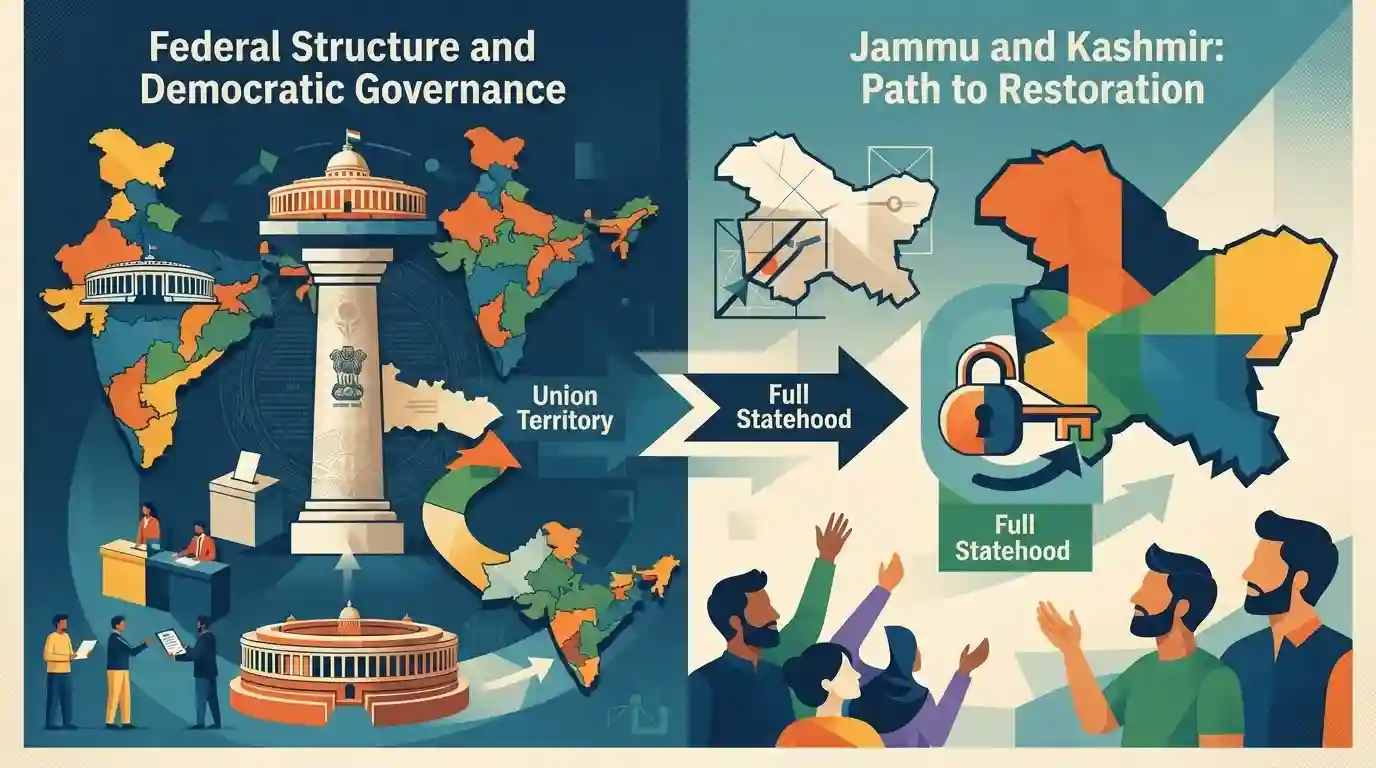
The editorial discusses the ongoing political anticipation surrounding the restoration of full statehood to Jammu and Kashmir, emphasizing its importance for democratic governance, federal principles, and fulfilling political commitments made to its populace.
ముఖ్య అంశాలు
- The editorial highlights the political and democratic expectations surrounding the restoration of statehood to Jammu and Kashmir following the 2024 Assembly elections.
- Reconstruction of full statehood is crucial for restoring federal balance, democratic accountability, and empowering the elected legislative assembly.
- The Supreme Court's earlier directions and commitments made by the central leadership regarding the restoration of statehood add urgency to fulfilling this democratic expectation.
- Delays or ambiguity in granting statehood hamper governance, legislative authority, and trust between the Centre and the Union Territory.
ముఖ్యమైన పదాలు
Jammu and Kashmir Reorganization Act, 2019

Legislation enacted by the Parliament of India in 2019 that bifurcated the former state of Jammu and Kashmir into two Union Territories: Ladakh, and Jammu and Kashmir.
UPSC context
GS Paper II (Indian Constitution - Federal Structure, Union and State Functions). Tests understanding of territorial reorganization and federal dynamics.
Article 370
A former constitutional provision that granted special autonomous status and internal sovereignty to the erstwhile state of Jammu and Kashmir, abrogated in August 2019.
UPSC context
GS Paper II (Indian Constitution - Historical Underpinnings and Significant Provisions). Tests knowledge of asymmetric federalism and constitutional history.
Supreme Court of India
The apex judicial authority in India possessing the power of judicial review to interpret the Constitution and adjudicate center-state disputes and fundamental rights issues.
UPSC context
GS Paper II (Structure, Organization and Functioning of the Judiciary). Tests understanding of constitutional interpretation, judicial review, and federal balance.
Parliament of India
The supreme legislative body of India comprising the President, the Lok Sabha, and the Rajya Sabha, responsible for enacting laws and national policies.
UPSC context
GS Paper II (Parliament and State Legislatures - Structure, Functioning, and Conduct of Business). Tests knowledge of lawmaking powers and legislative procedures.
Jammu and Kashmir Legislative Assembly
The democratically elected lawmaking body of the Union Territory of Jammu and Kashmir, established to ensure representative governance and regional legislative accountability.
UPSC context
GS Paper II (Functions and Responsibilities of the Union and the States). Tests understanding of representative democracy and state/UT governance structures.
ప్రిలిమ్స్ ఉచ్చు
The alteration of state boundaries or creation of UTs requires the explicit concurrence of the concerned State Legislative Assembly.
Aspirants often assume State legislative concurrence is legally binding for altering state boundaries under Article 3. In reality, the views of the State Legislature are purely advisory to Parliament.
అనుసంధానమైన స్థిర భావనలు
What are the constitutional provisions governing the creation of new States and alteration of areas under Article 3?
- Unilateral Authority: Parliamentary Power by law can form new States, alter boundaries, or diminish/increase areas of any State.
- Prior Recommendation: Presidential Recommendation is mandatory before a Bill affecting State boundaries is introduced in Parliament.
- State Views: State View Evaluation requires the President to refer the Bill to the concerned State Legislature for expressing its views within a specified time.
- Advisory Nature: Non-Binding Views of the State legislature are not binding on Parliament, which can proceed even without approval.
అంతర-అంశ నమూనాలు
Statehood Restoration vs. Asymmetric Federalism
The J&K reorganization tests the limits of Article 3 and parliamentary reorganization powers vis-a-vis cooperative federalism and the basic structure doctrine.
Border State Security and UT Conversions
Reorganization of a State into Union Territories sets a major precedent for administrative bifurcation and union control over sensitive border regions.

J&K statehood + Article 3 reorganization powers likely to be tested via statement-based questions on federal balance.
అనుసంధాన PYQలు · 2
అనుసంధాన PYQలు · 2
- 2025MainsGS2
Discuss the nature of Jammu and Kashmir Legislative Assembly after the Jammu and Kashmir Reorganization Act, 2019. Briefly describe the powers and functions of the Assembly of the Union Territory of Jammu and Kashmir.
- 2024MainsGS2
What changes has the Union Government recently introduced in the domain of Centre-State relations ? Suggest measures to be adopted to build the trust between the Centre and the States and for strengthening federalism.
