Judicial scrutiny of secularism and police investigation fairness
Source:The Hindu ↗
Why It Matters
The case brings to the forefront the practical challenges of upholding Indian secularism and ensuring unbiased police investigations in communal riots. It poses a vital governance and ethics question on whether mandating religious representation in investigative teams is necessary to build public trust, or if it undermines institutional neutrality.
Summary
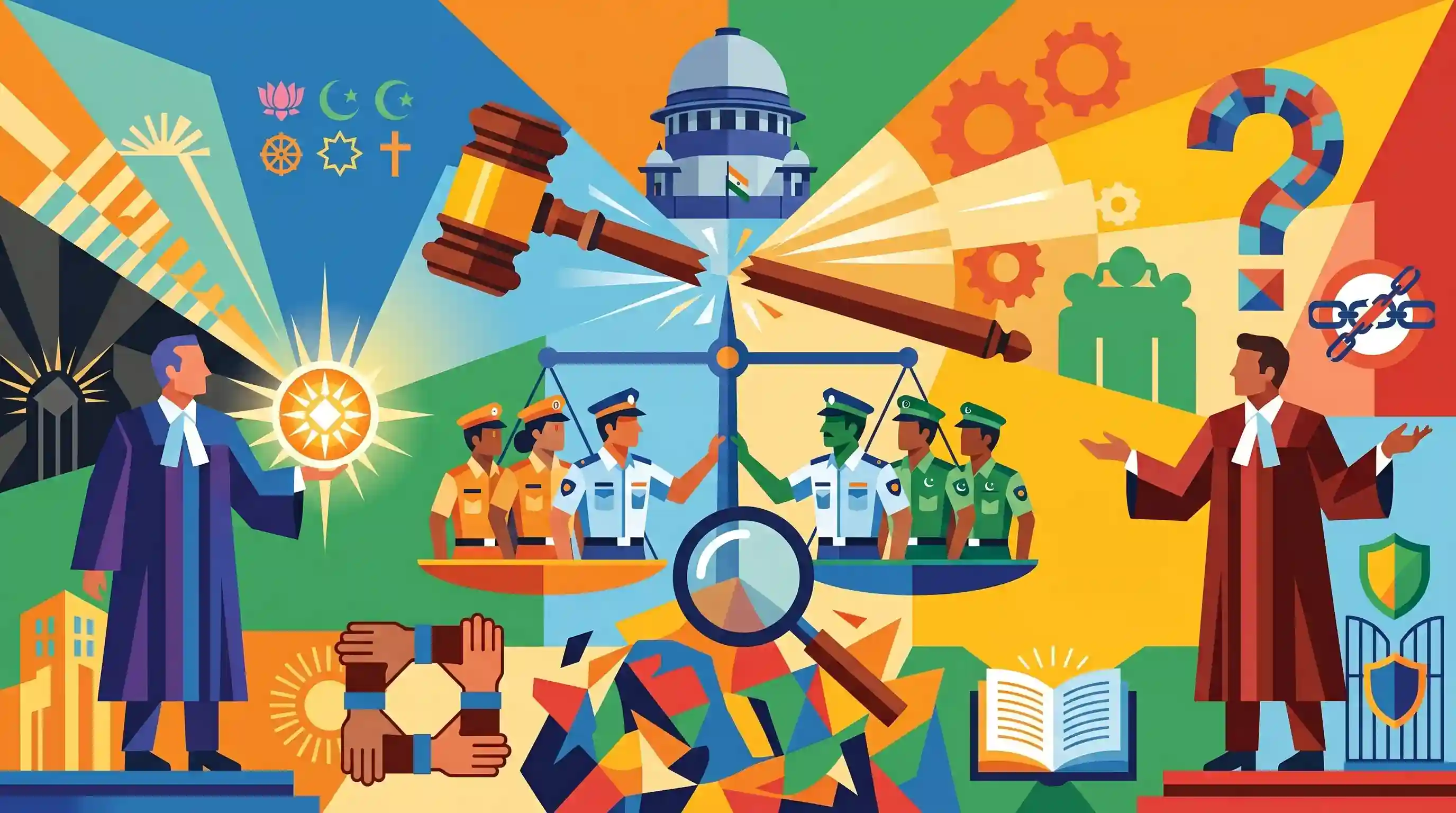
A Supreme Court judge has asserted that the State must demonstrate clear transparency and fairness in cases involving religious oppression, defining the true test of Indian secularism as an unbiased administration. These remarks were part of a split verdict on a review petition filed by the Maharashtra government against a September 2025 order that constituted a Special Investigation Team (SIT) with an equal number of Hindu and Muslim police officers to investigate a case stemming from the 2023 Akola communal riots. While Justice Sanjay Kumar upheld the need for such an SIT to ensure perceived fairness, Justice Satish Chandra Sharma dissented.
Key Points
- Supreme Court Justice Sanjay Kumar emphasized that the State must show 'manifest transparency and fairness' when addressing issues of religious oppression.
- The true test of Indian secularism is ensuring an administration completely free of bias and preserving communal harmony.
- The observations were made while rejecting a review plea by the Maharashtra government against a September 2025 SC order that mandated an SIT with equal representation of Hindu and Muslim officers to investigate a case linked to the 2023 Akola communal riots.
- The review petition resulted in a split verdict, as Justice Satish Chandra Sharma disagreed with maintaining the religious composition of the SIT.
Important Terms
Indian Secularism

A constitutional principle requiring the State to maintain neutrality toward all religions while ensuring equal respect (Sarva Dharma Sambhava) and freedom for citizens to profess and practice their faith.
UPSC context
GS II: Indian Constitution (Basic Structure); GS I: Social Empowerment & Communalism. Tests understanding of 'positive secularism' versus Western models.
Special Investigation Team (SIT)
An ad hoc investigative group constituted by the judiciary or executive to probe specific, complex, or high-profile cases requiring specialized expertise and impartiality beyond regular police capabilities.
UPSC context
GS II: Governance and Justice; GS III: Internal Security. Evaluates mechanisms for ensuring unbiased investigations in communal or sensitive crimes.
Review Petition
A legal recourse under Article 137 of the Constitution allowing the Supreme Court to re-examine its own judgments to correct patent errors or prevent a miscarriage of justice.
UPSC context
GS II: Judiciary. Tests knowledge of judicial procedures, appellate jurisdiction, and the principle of finality of judgments versus justice.
Split Verdict
A judicial outcome occurring when an even-numbered bench (e.g., a Division Bench of two judges) is equally divided in opinion, necessitating a reference to a larger bench for resolution.
UPSC context
GS II: Judiciary. Tests understanding of judicial decision-making processes and the role of the 'Master of the Roster'.
Institutional Secularism
The doctrine that state organs, such as the police, must function as secular entities where personnel lose their religious identity in professional duty to maintain neutral governance.
UPSC context
GS II: Polity. Crucial for debates on whether communal representation in state machinery helps or hinders neutral administration.
Transparency in Governance
The quality of being open and accountable in government actions, essential for ensuring fairness and public trust, especially in matters of religious sensitivities and law enforcement.
UPSC context
GS IV: Ethics in Public Administration. Tests the ethical imperative for the State to appear unbiased in communal conflict management.
Prelims Trap
"A split verdict in a Supreme Court Division Bench automatically transfers the case to a 5-judge Constitution Bench."
False. A split verdict is referred to the Chief Justice of India (Master of the Roster), who typically constitutes a larger 3-judge bench to break the tie, not a Constitution Bench.
Static Concepts Connected
What are the constitutional grounds and procedures for a Supreme Court Review Petition?
- Article 137: Empowers the Supreme Court to review any judgment pronounced or order made by it, ensuring justice isn't derailed by obvious mistakes.
- Narrow grounds: Entertained only for a patent error apparent on the face of the record or discovery of new evidence, never as a routine appeal.
- By circulation: Usually heard in the judges' chambers by the same bench that passed the original order, without oral arguments (unless requested).
How is a split verdict handled within the Supreme Court's procedural framework?
- Tie-breaking procedure: Under rules framed via Article 145, if a Division Bench (usually 2 judges) delivers a 1:1 verdict, the matter cannot be decided by that bench.
- Master of Roster: The case is referred to the CJI, who administratively assigns it to a larger bench (usually 3 judges) to hear the case afresh and resolve the deadlock.
Cross-Topic Patterns
Police Ethics and Institutional Bias
Bridges GS2 (Judiciary) and GS4 (Probity) by highlighting the tension between assuming inherent state neutrality and the practical necessity of engineering "perceived fairness" during communally sensitive investigations.
Affirmative representation in policing
Echoes past administrative debates (e.g., Sachar Committee) on whether mandated minority representation in law enforcement is necessary to overcome trust deficits, despite constitutional principles of absolute colorblindness.

Expect a GS4 case study in 2026 on public trust deficits during riots, testing 'perceived fairness' vs 'institutional secularism'.
Linked PYQs · 4
Linked PYQs · 4
- 2024MainsGS2
Discuss India as a secular state and compare with the secular principles of the US constitution.
- 2019MainsGS2
What can France learn from the Indian Constitution's approach to secularism?
- 2024MainsGS4
“The 'Code of Conduct' and 'Code of Ethics' are the sources of guidance in public administration. There is code of conduct already in operation, whereas code of ethics is not yet put in place. Suggest a suitable model for code of ethics to maintain integrity, probity and transparency in governance.”
- 2017MainsGS3
Mob violence is emerging as a serious law and order problem in India. By giving suitable examples, analyze the causes and consequences of such violence.
