West Bengal Health Minister Clarifies Posthumous Donation Stance
Source:millenniumpost ↗
Why It Matters
The article highlights the regulatory and ethical distinction between organ transplantation (saving lives) and whole-body anatomical donation (medical research), showing how administrative statements can impact public health awareness and legacy social campaigns.
Summary
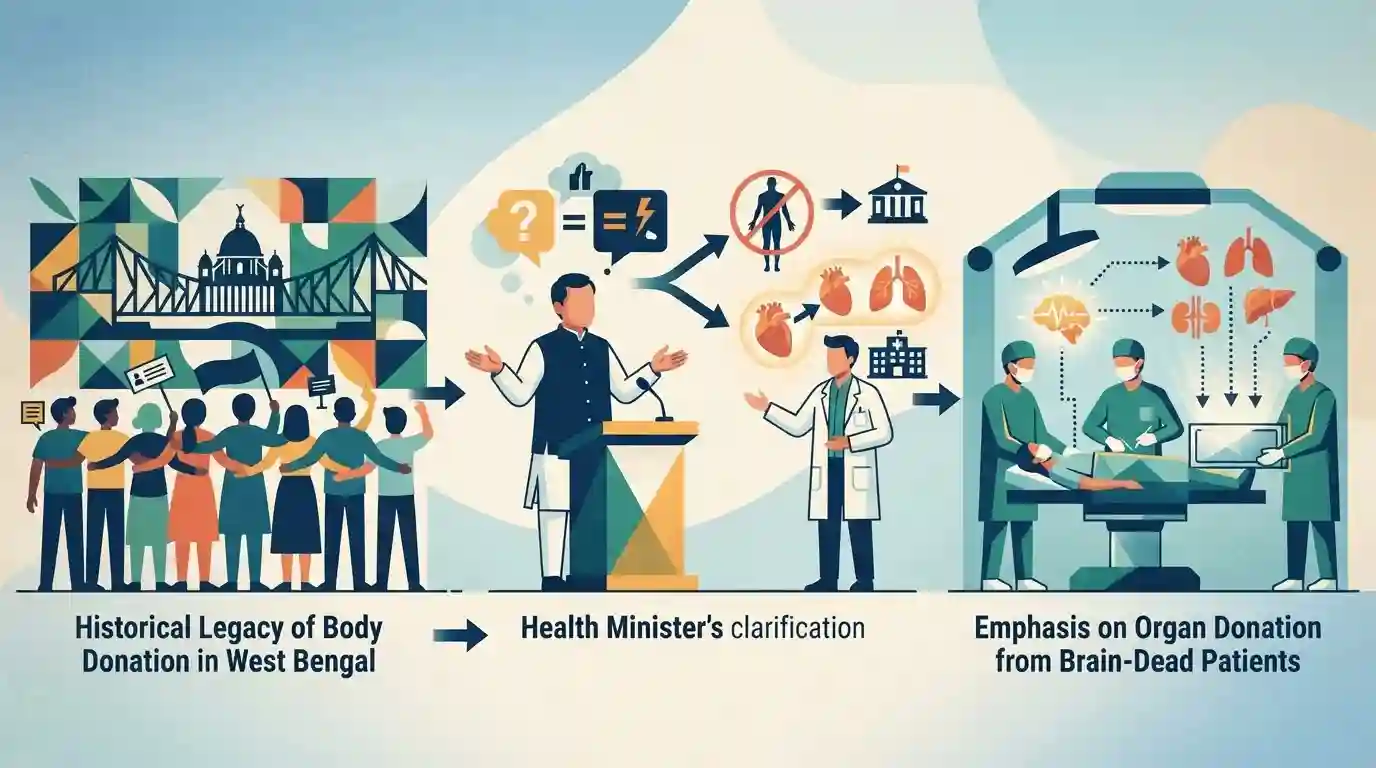
West Bengal State Health Minister Sharadwat Mukherjee clarified that his recent remarks were not intended to discourage body donations, but rather to emphasize that organ donation is crucial and highly beneficial in the case of brain-dead patients, compared to whole-body donations which have limited medical utility. The issue sparked public debate due to the historical legacy of body donation awareness campaigns in West Bengal.
Key Points
- West Bengal State Health Minister Sharadwat Mukherjee clarified his remarks regarding body and organ donation, specifying that for brain-dead patients who are not yet declared dead, organ donation should be prioritized over whole-body donation.
- The minister emphasized that while whole-body donation has limited medical utility, donating organs from brain-dead individuals can directly save multiple lives.
- The clarification came after public resentment over earlier reports suggesting the government was discouraging whole-body donations, citing that former Chief Minister Jyoti Basu's donated body was not utilized for medical purposes.
- Body donation awareness has historical significance in West Bengal, having been extensively promoted during the Left Front (CPI-M) administration.
Important Terms
Government of West Bengal

The subnational government of West Bengal, consisting of an executive headed by the Governor and Chief Minister, a unicameral legislature, and a judiciary.
UPSC context
Paper V (Indian Polity), tests state executive structures, administrative governance, and regional health policies.
CPI(M)
Communist Party of India (Marxist), a political party that governed West Bengal for 34 years (1977–2011), promoting social reforms and body donation.
UPSC context
Paper III & V (History & Polity of Bengal), tests the influence of regional political movements on social consciousness.
KPC Medical College
Located in Jadavpur, Kolkata, it is the first private medical college in West Bengal, renowned for introducing public-private partnership models.
UPSC context
Paper III & IV (GK & Science), tests West Bengal's health infrastructure, medical education, and PPP initiatives.
Ganadarpan
A pioneering West Bengal-based non-governmental organization established in 1977 that coordinates and raises awareness for voluntary body and tissue donation.
UPSC context
Paper III (West Bengal GK), tests the role of civil society and NGOs in the state's socio-medical campaigns.
Sharadwat Mukherjee
An oncologist and BJP politician elected from the Bidhannagar constituency in 2026, currently serving as the Health and Family Welfare Minister of West Bengal.
UPSC context
Current Affairs (Paper III/V), tests contemporary political leaders, Cabinet Portfolios, and state health administration.
Prelims Trap
Whole-body donations for medical student dissection are governed nationally under the Transplantation of Human Organs and Tissues Act (THOTA).
While THOTA, 1994 regulates therapeutic organ transplants, willed or unclaimed body donations for anatomical dissection are governed strictly by state-specific Anatomy Acts.
Static Concepts Connected
What is the regulatory framework governing body and organ donation in India?
- THOTA 1994: Governs the removal, storage, and transplantation of human organs and tissues for therapeutic purposes nationwide.
- Anatomy Acts: State-specific legislations that govern the donation and acquisition of unclaimed or willed bodies for anatomical study in medical colleges.
- NMC Guidelines: Mandates a strict 1:10 cadaver-to-student ratio for medical colleges conducting undergraduate anatomical dissections.
What is the historical significance of Ganadarpan in West Bengal?
- Origins: Established in Kolkata in 1986 by social reformer Brojo Roy, it is eastern India's pioneer NGO in voluntary body donation.
- Social Reform: Successfully shifted societal norms toward rationalism, culminating in high-profile pledges such as that of former CM Jyoti Basu.
Cross-Topic Patterns
Scientific Temper vs State-led Rationalism
Links WBCS Paper IV with state governance. Bengal's historical rationalist movements utilized body donation campaigns to counter religious orthodoxy, directly shaping state health policies.
Medical Education Infrastructure & NMC norms
Connects state health policy with central regulations. The NMC's mandatory 1:10 cadaver-to-student ratio illustrates the heavy reliance of medical colleges on local body donation frameworks.

Questions may target West Bengal's specific legislative frameworks for cadaver distribution versus national organ transplant laws.
Linked PYQs · 2
Linked PYQs · 2
- 2021WBCS_PRELIMSGS1
How many new Government Medical Colleges have become functional in West Bengal during the last ten years?
- 2016WBCS_PRELIMSGS1
An ophthalmologist deals with:
