Maharashtra Assembly Passes Nashik Kumbh Mela Authority Bill
Source:Indian Express ↗
Why It Matters
The article illustrates the practical challenges in drafting environmental laws that must balance ecological goals against the socio-economic realities of farmers. It also highlights the governance mechanisms—specifically the creation of statutory authorities—employed by states to manage infrastructure and coordination for mega-events like the Kumbh Mela.
Summary
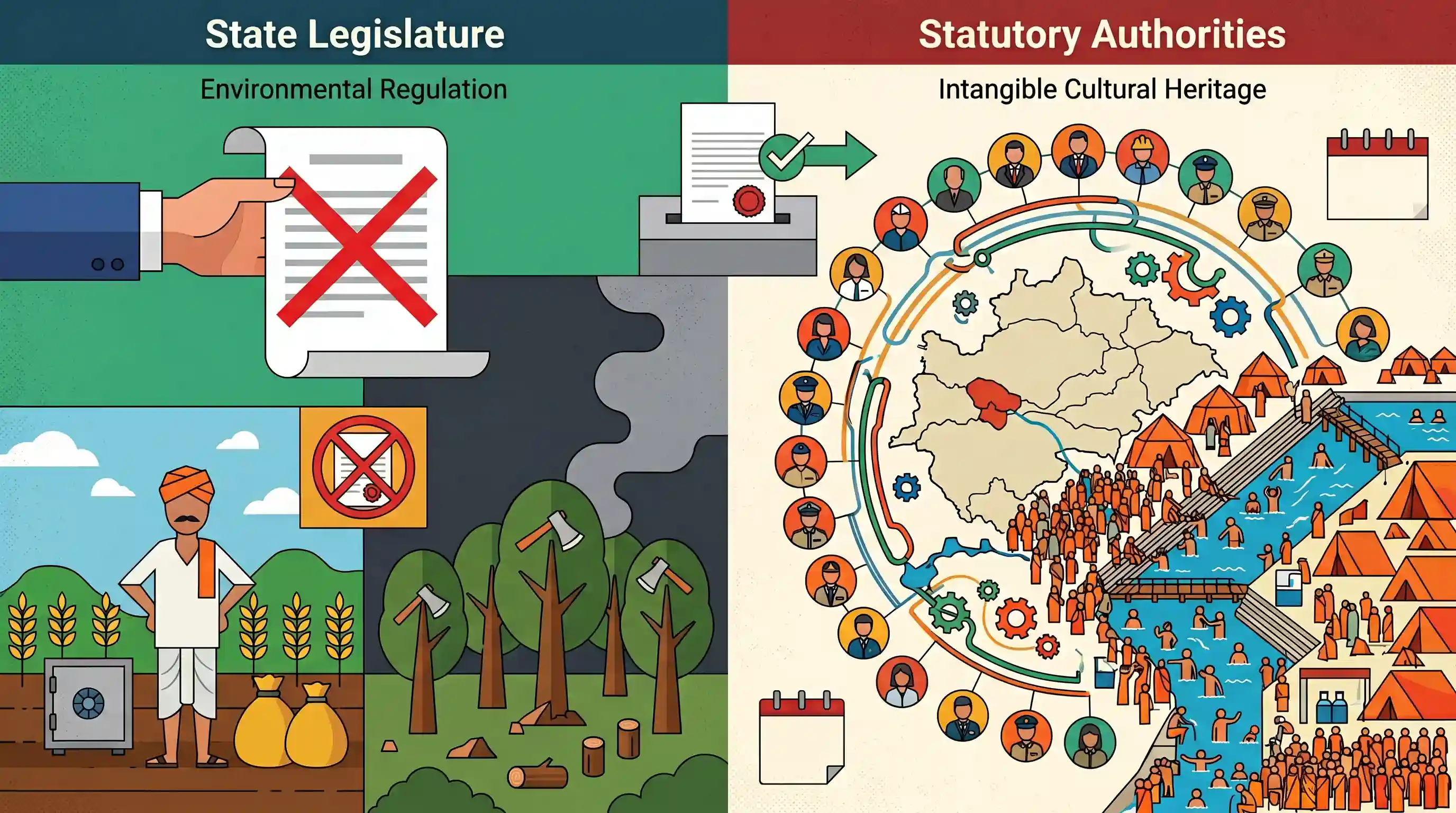
The Maharashtra Legislative Assembly saw contrasting legislative moves concerning the environment and cultural event management. Forest Minister Ganesh Naik withdrew the Maharashtra Felling of Trees (Regulation) Amendment Bill, citing the need to protect farmers from exorbitant fines due to the bill's failure to differentiate between forest areas and private agricultural lands. Former minister Sudhir Mungantiwar opposed the rollback, highlighting rampant illegal felling and global warming. Concurrently, the Assembly passed a bill to constitute a 22-member Nashik-Trimbakeshwar Kumbh Mela Authority. Headed by the Nashik division commissioner, this statutory body is mandated to requisition facilities and coordinate inter-departmental efforts for the massive Simhastha Kumbh Mela congregation scheduled between October 2026 and July 2028.
Key Points
- The Maharashtra government temporarily withdrew the Maharashtra Felling of Trees (Regulation) Amendment Bill, which aimed to increase the fine for illegal tree cutting from Rs 1,000 to Rs 50,000.
- The withdrawal followed concerns from MLAs that the bill did not distinguish between forest land and private agricultural property, potentially leading to hefty fines for farmers making honest mistakes.
- Former forest minister Sudhir Mungantiwar opposed the rollback, warning against widespread illegal felling and citing the broader impacts of global warming.
- Separately, the state assembly passed a bill to establish the 22-member Nashik-Trimbakeshwar Kumbh Mela Authority, headed by the Nashik division commissioner.
- This statutory body will streamline inter-departmental efforts, organize preparations, and requisition facilities for the upcoming Simhastha Kumbh Mela (spanning October 2026 to July 2028).
Important Terms
Nashik-Trimbakeshwar Kumbh Mela Authority

A 22-member statutory body, chaired by the Nashik Division Commissioner, established to plan, coordinate, and manage the massive Simhastha Kumbh Mela congregation.
UPSC context
GS Paper II: Statutory bodies and administrative management of mega-events/festivals. Tests understanding of regional administrative structures.
Nashik-Trimbakeshwar Kumbh Mela Authority Bill
A legislative measure providing a legal framework for the 2026-2028 Nashik Kumbh Mela, granting the state sweeping powers for infrastructure development and crowd management.
UPSC context
GS Paper II: Government policies and interventions. Relevant for topics on state-level legislation and cultural management.
Maharashtra Felling of Trees (Regulation) Amendment Bill
A withdrawn legislative proposal that sought to hike penalties for illegal tree felling from ₹1,000 to ₹50,000 under the 1964 Act.
UPSC context
GS Paper III: Environmental legislation and conservation. Tests the balance between environmental protection and agricultural rights/livelihoods.
Maharashtra Legislative Assembly
The lower house of the Maharashtra State Legislature, responsible for debating and passing state laws on subjects like environment and local administration.
UPSC context
GS Paper II: State Legislature—structure, functioning, and conduct of business. Fundamental to Indian Polity.
Simhastha Kumbh Mela
A major Hindu religious fair held every 12 years in Nashik and Trimbakeshwar on the banks of the Godavari River during specific astrological alignments.
UPSC context
GS Paper I: Indian Culture and Heritage. UNESCO-recognized intangible cultural heritage, testing knowledge of pilgrimage sites and traditions.
Prelims Trap
The central Forest (Conservation) Act regulates the felling of all trees, including those on private agricultural lands.
The FCA 2023 explicitly exempts agroforestry and plantations on non-forest private land from central oversight. State acts regulate tree felling on private agricultural lands.
Static Concepts Connected
What are the four Kumbh Mela sites and their associated rivers?
- Prayagraj: Located at the sacred confluence (Triveni Sangam) of the Ganga, Yamuna, and mythical Saraswati rivers.
- Haridwar: Situated on the banks of the river Ganga in Uttarakhand.
- Nashik: Held on the banks of the Godavari river in Maharashtra, primarily centered around Trimbakeshwar.
- Ujjain: Celebrated on the banks of the Shipra river in Madhya Pradesh.
How is the legislative jurisdiction over forests defined in the Constitution?
- Concurrent List: Forests and Protection of Wild Animals and Birds were moved from the State List to the Concurrent List via the 42nd Constitutional Amendment Act, 1976.
- Central FCA: The central Forest (Conservation) Act regulates the diversion of designated 'forest land' for non-forest purposes.
- State Legislations: The felling of trees on private, non-forest agricultural lands is largely governed by specific state-level legislative acts rather than central laws.
Cross-Topic Patterns
Agroforestry vs. Timber Smuggling
While the Centre's FCA 2023 exempts private land plantations to boost carbon sinks, states must balance this deregulation with strict local laws to prevent illegal timber felling disguised as agroforestry.
Disaster Management at Cultural Mega-Events
Statutory authorities for Kumbh Mela bridge a critical governance gap, allowing legal requisitioning of land and resources for crowd control, moving beyond ad-hoc disaster management guidelines for mega-festivals.

Expect a Prelims pair-matching question linking Kumbh Mela sites (Nashik, Ujjain) to their respective rivers (Godavari, Shipra).
Linked PYQs · 2
Linked PYQs · 2
- 2022MainsGS3
Discuss global warming and mention its effects on the global climate. Explain the control measures to bring down the level of greenhouse gases which cause global warming, in the light of the Kyoto Protocol, 1997.
- 2024PrelimsGS1
Which one of the following was the latest inclusion in the Intangible Cultural Heritage List of UNESCO?
