Role of Cooperative Sector in Rural Economy and Autonomy Issues
Source:The Hindu ↗
Why It Matters
The cooperative sector remains a core topic for UPSC (GS2 and GS3), particularly regarding agricultural finance, rural development, and the debate over the autonomy of cooperative institutions versus state intervention.
Summary
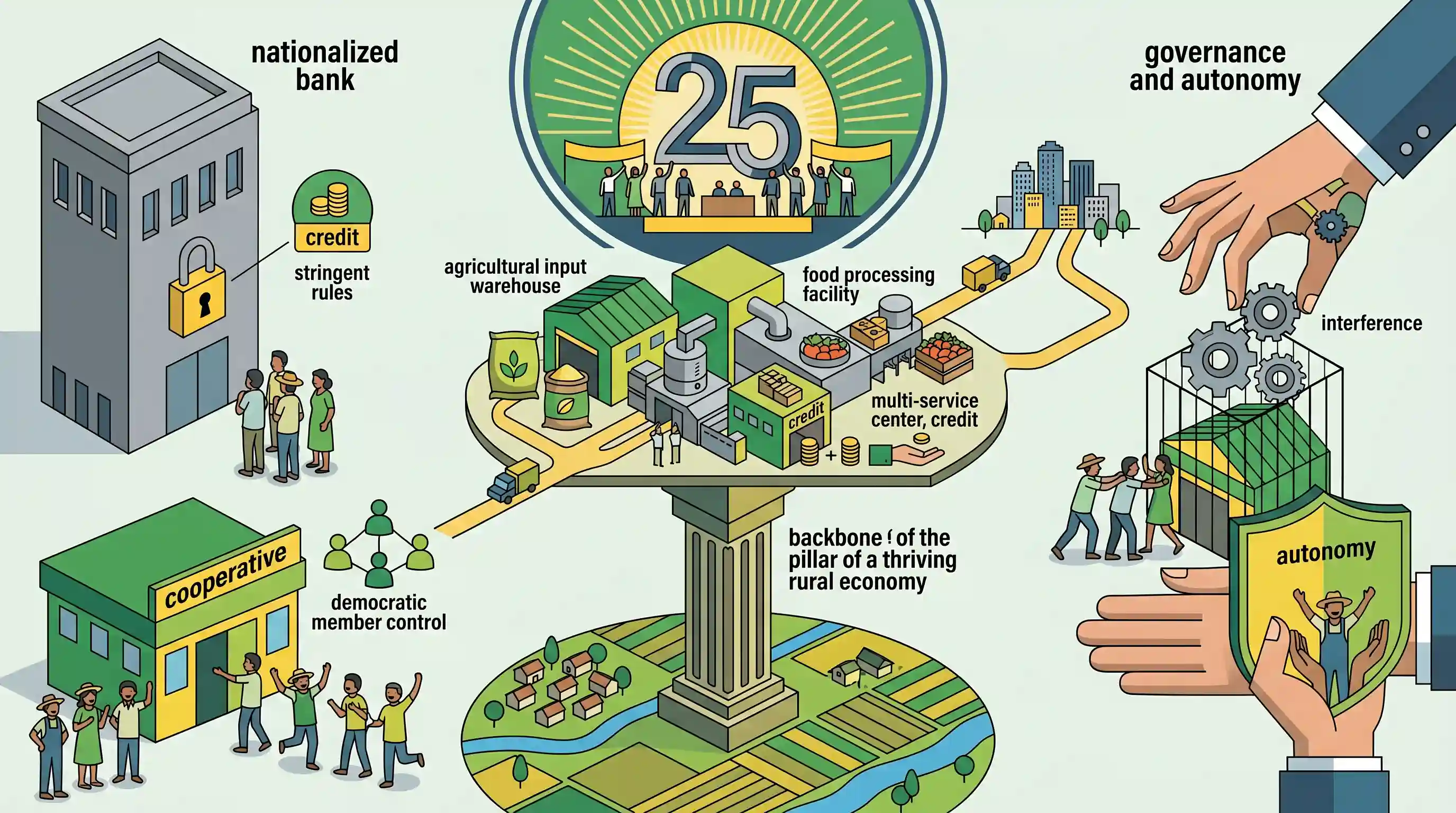
During the silver jubilee celebrations of the Karnataka Rajya Souharda Samyukta Sahakari Federation, State Ministers emphasised the cooperative sector's critical role as the backbone of the rural economy. They highlighted that cooperatives have transformed into multi-service hubs offering agricultural inputs, credit, and food processing facilities, filling the gap left by stringent nationalised banks. However, leaders also cautioned against the growing trend of government interference and control over cooperative institutions, advocating for the preservation of their autonomy to effectively serve farmers and rural communities.
Key Points
- The cooperative sector is described as the backbone of the rural economy, playing a pivotal role in poverty alleviation and agricultural support.
- Cooperatives have evolved into multi-service centres beyond just providing credit, now facilitating joint purchase of inputs, food processing, and value addition.
- Concerns were raised regarding increasing government control over cooperative institutions, highlighting the need to protect their autonomy.
- Cooperatives ensure timely credit delivery to rural populations, stepping in where nationalised banks impose stringent conditions.
Important Terms
Karnataka Rajya Souharda Samyukta Sahakari Federation (KSSFCL)

The apex self-regulatory body for cooperatives registered under the Karnataka Souharda Sahakari Act, 1997. It monitors and supervises autonomous cooperatives to ensure member-driven governance with minimal state interference.
UPSC context
GS-II: Governance and Cooperatives. Tests knowledge of state-specific cooperative models and the role of apex federations.
Agricultural Produce Market Committee (APMC)
A statutory marketing board established by state governments to regulate agricultural trade. It aims to protect farmers from exploitation, ensure fair prices, and manage designated market yards (mandis).
UPSC context
GS-III: Agricultural Marketing. Essential for understanding farm-to-market links, price discovery, and agricultural reforms.
97th Constitutional Amendment Act
A 2011 amendment granting constitutional status to cooperative societies. It added Article 19(1)(c), Article 43B, and Part IXB to ensure democratic management and voluntary formation of cooperatives.
UPSC context
GS-II: Indian Constitution. Tests understanding of fundamental rights, DPSPs, and the legal framework of cooperatives.
District Central Cooperative Bank (DCCB)
Cooperative banks operating at the district level that link State Cooperative Banks with grassroots societies. They mobilize local deposits and provide credit primarily for agricultural and rural development.
UPSC context
GS-III: Indian Economy. Key to the three-tier rural credit structure and financial inclusion strategies.
Primary Agricultural Credit Society (PACS)
Grassroots-level cooperative institutions providing short and medium-term agricultural loans directly to farmers. They form the base of the cooperative credit structure and increasingly serve as multi-service hubs.
UPSC context
GS-III: Rural Credit and Agriculture. Crucial for understanding the delivery mechanism of agricultural finance.
Souharda Cooperatives
A unique category of cooperatives in Karnataka registered under the 1997 Act. They operate with high autonomy, focusing on member-control and self-reliance while being shielded from excessive government control.
UPSC context
GS-II: Statutory Bodies. Tests understanding of autonomous cooperative models as alternatives to traditional state-controlled societies.
Multi-Service Centers (MSCs)
The transformed role of cooperative societies, particularly PACS, providing diverse services beyond credit, including fertilizer distribution, storage, food processing, and operating fair-price shops.
UPSC context
GS-III: Rural Development. Important for understanding the diversification and modernization of the rural economy.
Prelims Trap
Cooperative societies are now governed under the Concurrent List following the establishment of the Union Ministry of Cooperation.
Cooperatives remain exclusively a State subject (Entry 32 of State List). Only Multi-State Cooperative Societies fall under the Union List (Entry 44), despite the creation of a Union Ministry.
Static Concepts Connected
What are the constitutional provisions safeguarding cooperative societies in India?
- Fundamental Right: Article 19(1)(c) guarantees the right of citizens to form cooperative societies.
- Directive Principles: Article 43B directs the State to promote voluntary formation, democratic control, and professional management of cooperatives.
- Part IXB: Added by the 97th Amendment (2011), it structurally outlines incorporation, board terms, and election mandates for cooperative societies.
What is the short-term cooperative credit structure in India?
- Apex Level: State Cooperative Banks (StCBs) operate at the state level, acting as intermediaries between NABARD and the lower cooperative tiers.
- District Level: District Central Cooperative Banks (DCCBs) manage funds and provide credit to primary societies within a specific district.
- Village Level: Primary Agricultural Credit Societies (PACS) operate at the village level, directly providing short-term crop loans and inputs to farmers.
Cross-Topic Patterns
PACS Evolution & Digital Financial Inclusion
The shift of PACS from basic credit delivery to multi-service centers connects directly with NABARD's massive computerization drive to transform them into rural digital and financial service hubs.
Federalism vs. Cooperative Governance
Political calls for cooperative autonomy echo the 2021 Supreme Court ruling which struck down parts of the 97th Amendment for encroaching on exclusive State legislative powers over cooperative societies.

A 2026 multi-statement prelims question will likely contrast the constitutional status and regulatory oversight of PACS versus RRBs.
Linked PYQs · 1
Linked PYQs · 1
- 2014MainsGS3
In the villages itself no form of credit organization will be suitable except the cooperative society. -All India Rural Credit Survey. Discuss this statement in the background of agricultural finance in India. What constraints and challenges do financial institutions supplying agricultural finance face? How can technology be used to better reach and serve rural clients?
