SWAGAT E Governance Public Redressal Portal in Gujarat
Source:gujarattribune ↗
આ શા માટે મહત્વનું છે
SWAGAT is a landmark model of e-governance and public grievance redressal in India. It serves as an essential case study for GS2 Governance topics, demonstrating how ICT can be utilized to improve administrative responsiveness, transparency, and top-down accountability at the state level.
સારાંશ
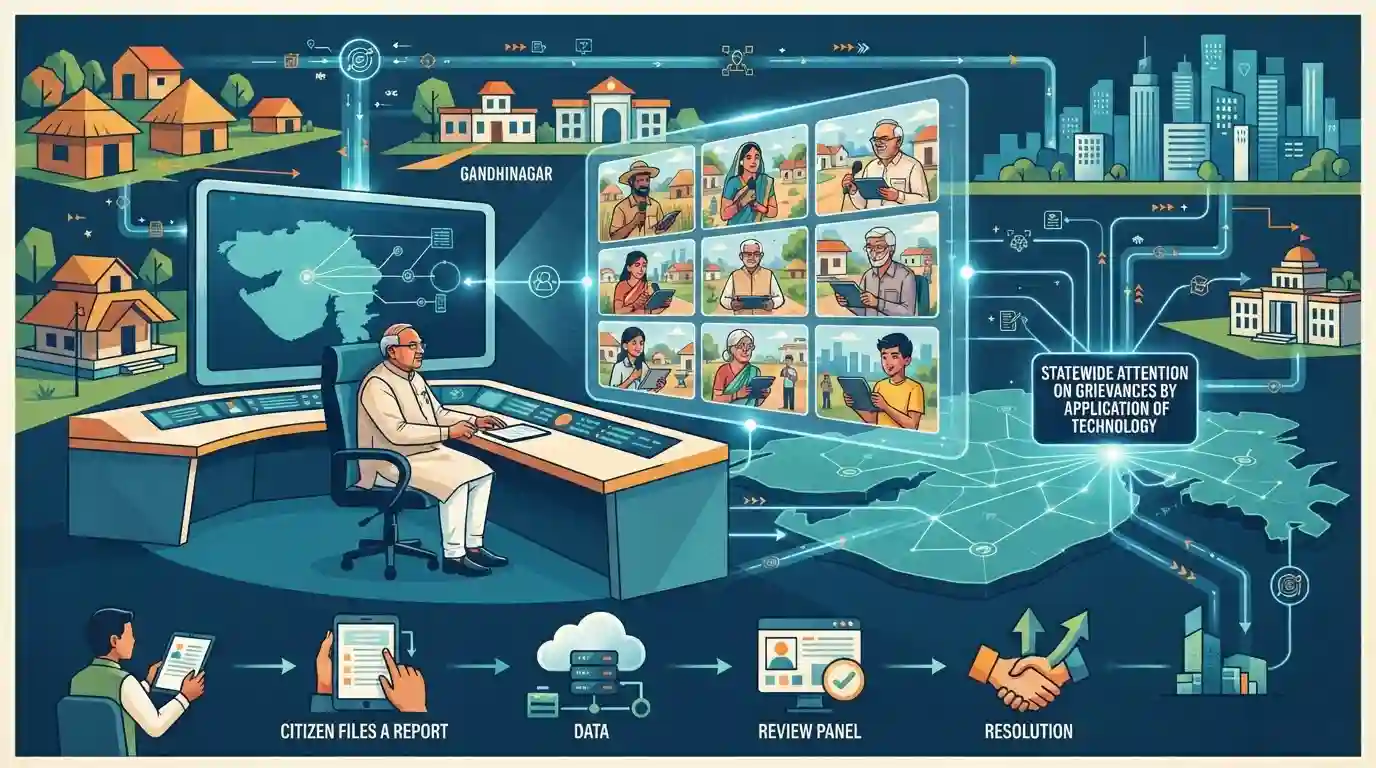
The Gujarat State Government is conducting its monthly SWAGAT (Statewide Attention on Grievances by Application of Technology) online public grievance redressal program in Gandhinagar, chaired by Chief Minister Bhupendra Patel. Launched in 2003, SWAGAT is a pioneering e-governance initiative that leverages technology to provide a direct platform for citizens to resolve their grievances by connecting village-to-state administrative tiers in real-time.
મુખ્ય મુદ્દા
- The Gujarat government has scheduled its monthly SWAGAT online public grievance redressal session for July 2026, which will be chaired by Chief Minister Bhupendra Patel at Swarnim Sankul-2 in Gandhinagar.
- SWAGAT (Statewide Attention on Grievances by Application of Technology) was launched in April 2003 by the then-Chief Minister Narendra Modi.
- It is recognized as India's first technology-enabled public grievance management framework, aimed at enhancing citizen-centric administration and accountability.
- The system integrates grievance resolution across village, taluka, district, and state levels, utilizing video conferencing to facilitate direct, real-time interaction between citizens, top state officials, and district administrations.
મહત્વપૂર્ણ શબ્દો
SWAGAT (Statewide Attention on Grievances by Application of Technology)

A pioneering e-governance program launched in Gujarat in 2003 that uses technology and video-conferencing to resolve citizen grievances directly, linking administrative tiers from village to state level.
UPSC context
GS Paper II: E-governance case studies, accountability, and citizen-centric administrative reforms.
E-Governance
The application of Information and Communication Technologies (ICT) by the government to deliver public services, exchange information, and ensure simple, moral, accountable, responsive, and transparent administration.
UPSC context
GS Paper II: Important aspects of governance, transparency, accountability, and institutional models.
Public Grievance Redressal Mechanisms
Institutional frameworks and online portals designed to systematically receive, track, investigate, and resolve citizens' complaints against administrative actions, corruption, or public service delivery deficiencies.
UPSC context
GS Paper II: Grievance redressal; tests administrative structures and citizen service delivery.
Citizen-Centric Administration
An administrative model putting citizens' needs and well-being at the core of public administration, ensuring services are accessible, transparent, and participatory.
UPSC context
GS Paper II & IV: Governance and ethics; tests understanding of the 2nd ARC recommendations.
પ્રિલિમ્સ ટ્રેપ
SWAGAT is a pan-India central government portal for public grievance redressal managed by DARPG.
SWAGAT is a state-level initiative of Gujarat launched in 2003. While it inspired the national-level PRAGATI platform, SWAGAT itself remains state-specific.
સંલગ્ન સ્થિર ખ્યાલો
What is the structure and purpose of the PRAGATI platform?
- Core purpose: A multi-modal platform launched in 2015 to monitor key developmental projects and address public grievances.
- Three-tier integration: Uniquely connects the Prime Minister's Office, Union Secretaries, and State Chief Secretaries for collaborative monitoring.
- Technology stack: Combines digital data management, video conferencing, and geo-spatial technology (GIS) for real-time issue resolution.
What is CPGRAMS and its role in governance?
- Nodal agency: An online platform developed by NIC and managed by the Department of Administrative Reforms and Public Grievances (DARPG).
- Function: Enables citizens to lodge grievances online against Central and State government authorities, track progress, and file appeals.
આંતર-વિષય પેટર્ન
State e-gov scaling to national platforms
State-level digital successes like SWAGAT serve as architectural blueprints for national frameworks like PRAGATI, showcasing cooperative federalism in administrative reforms.
Digital portals vs. statutory service guarantees
Online redressal models like SWAGAT bridge implementation gaps in State Public Service Guarantee Acts by enforcing direct, tech-enabled administrative accountability.

GS-2 may contrast state-level e-governance architectures like SWAGAT with central platforms like PRAGATI for federal project monitoring.
સંલગ્ન PYQ · 3
સંલગ્ન PYQ · 3
- 2022GPSC_PRELIMSGS1
One of the following is not a benefit of e-Governance to the citizens:
- 2024GPSC_PRELIMSGS1
Public Administration is the study of
- 2017GPSC_PRELIMSGS1
The Multi Purpose and Multi model platform PRAGATI (Pro Active Governance and Timely Implementation) launched in March 2015 aims to
