Madhya Pradesh Initiates Budget Exercise for Financial Year 2027
Source:times-of-india ↗
Why It Matters
The article provides practical insights into the timeline, digital mechanisms (IFMIS), and policy shifts (rolling budget, scheme rationalization) involved in state financial administration. Knowledge of gender, child, and agriculture budgeting practices in Madhya Pradesh is directly relevant for GS Prelims questions related to state governance, economy, and public policy.
Summary
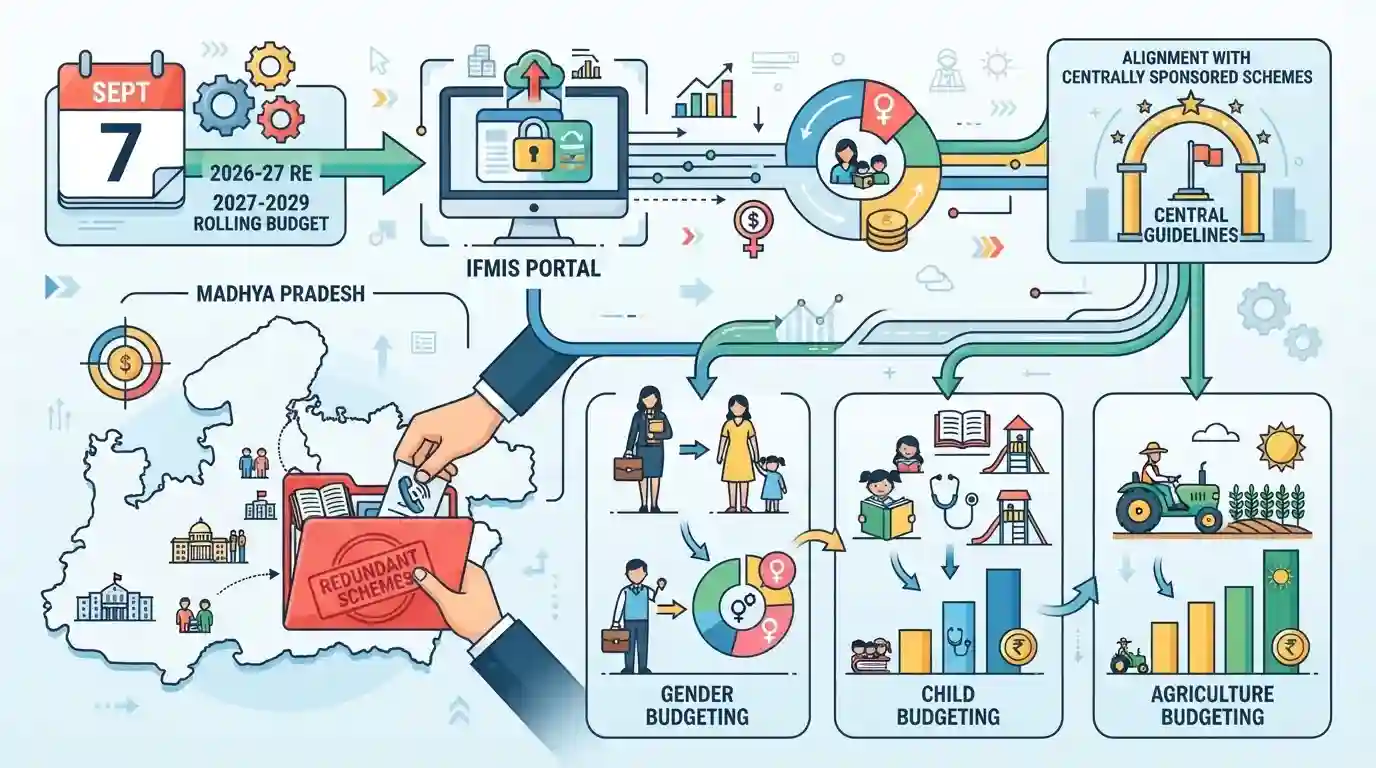
The Madhya Pradesh government has formally commenced its budget formulation exercise for the financial year 2027-28. The Finance Department has mandated all administrative departments to submit their comprehensive budget proposals, including revised estimates for 2026-27 and a rolling budget for the subsequent two years, by September 7, 2026, through the online IFMIS portal. The state aims to rationalize expenditure by shutting down redundant schemes and mandates detailed earmarking for gender, child, and agriculture budgets, as well as alignment with Centrally Sponsored Schemes.
Key Points
- The Madhya Pradesh government has initiated the budget preparation process for the fiscal year 2027-28, setting September 7, 2026, as the deadline for departments to submit their proposals.
- Proposals will cover estimates for 2027-28, revised estimates for 2026-27, and outline the rolling budget plans for 2028-29 and 2029-30.
- All budget submissions must be processed exclusively through the Integrated Financial Management Information System (IFMIS).
- The state is discontinuing obsolete schemes and mandates specific allocations under specialized categories like the gender, child, and agriculture budgets.
Important Terms
Centrally Sponsored Schemes

Programs formulated by the Central Government but implemented by State Governments. Funding is typically shared between the Centre and States. They aim to achieve national development goals in areas on the State or Concurrent Lists.
UPSC context
Crucial for GS-2 (Center-State Relations) and GS-3 (Economy). Tests understanding of fiscal federalism and welfare scheme implementation.
Gender budget
A public financial tool that disaggregates the government's budget to analyze and track resource allocation from a gender perspective, ensuring policies and funds actively promote women's empowerment and reduce gender disparities.
UPSC context
High relevance in GS-1 (Society) and GS-2 (Social Justice), highlighting the fiscal commitment to vulnerable sections and gender equity.
Child budget
A public finance method that isolates, quantifies, and tracks government budget allocations specifically directed toward the welfare, education, health, and protection of children (persons under 18 years).
UPSC context
Relevant to GS-2 (Governance and Social Justice). Tests accountability and outcome-oriented governance for vulnerable populations like children.
Integrated Financial Management Information System (IFMIS)
An IT-based platform used by governments to automate, integrate, and manage core financial functions, including budgeting, accounting, payment processing, and reporting, ensuring real-time tracking of public expenditures.
UPSC context
Fits into GS-2 (e-Governance) and GS-3 (Resource Mobilization). Highlights transparency, efficiency, and digital transformation in public financial administration.
Agriculture budget
A separate state or central budget exclusively dedicated to the agricultural sector and allied activities, aiming to specifically address farmer incomes, agrarian distress, and precise agro-climatic resource allocation.
UPSC context
Appears in GS-3 (Agriculture). Tests knowledge of agrarian reforms, state-specific policy innovations, and tailored fiscal strategies for farmers.
Prelims Trap
The Constitution of India mandates states to prepare multi-year rolling budgets and separate gender budgets.
Article 202 only requires the Governor to present an Annual Financial Statement. Rolling, child, or gender budgets are state policy innovations, not constitutional mandates.
Static Concepts Connected
What are the constitutional provisions for a State Budget?
- Article 202: Mandates the Governor to lay the Annual Financial Statement (state budget) before the State Legislature in respect of every financial year.
- Expenditure types: The budget must explicitly distinguish expenditure on revenue account from other expenditures, and show charged items separately from voted items.
- Article 203: No demand for a grant shall be made except on the recommendation of the Governor.
What is Gender and Child Budgeting?
- Gender Budgeting: Not a separate budget, but an analytical dissection of the government budget to establish its gender-differential impacts and track women's empowerment initiatives.
- Child Budgeting: Isolates and targets resources specifically for child welfare, education, and nutrition. Madhya Pradesh was the first Indian state to introduce a dedicated child budget.
- Rolling Budget: Provides estimates for the base year alongside indicative forecasts for subsequent years, enhancing long-term fiscal planning (first introduced by MP).
Cross-Topic Patterns
E-Governance in Public Finance
The mandate to use IFMIS ties GS2 (e-Governance) to GS3 (Fiscal Management), reflecting a broader push akin to the Centre's PFMS to ensure transparency and track Centrally Sponsored Scheme funds.
Fiscal Space and CSS Rationalization
Shutting down obsolete state schemes to fund specialized budgets illustrates an ongoing challenge in fiscal federalism: states need fiscal space to provide matching grants for Centrally Sponsored Schemes.

Expect a prelims statement mixing Article 202 mandates with state-led fiscal innovations like rolling budgets or dedicated child budgets.
Linked PYQs · 2
Linked PYQs · 2
- 2024MPPSC_PRELIMSGS1
In the year 2022-23, on comparing the per capita income of Madhya Pradesh and that of India on the basis of advanced estimates at constant (2011-12) prices, we find that
- 2023MPPSC_PRELIMSGS1
What is the objective of Tantyia Mama Economic Welfare Scheme (New Scheme)?
