Supreme Court Ruling on Advocate Enrollment Fees and Bar Councils
Source:The Hindu ↗
Why It Matters
This ruling is highly relevant for GS Paper 2 as it highlights the limitations of delegated legislation (statutory bodies overriding parliamentary fiscal policy). It also touches on Constitutional principles regarding fundamental rights and social justice, emphasizing how financial barriers in professional entry violate the right to equality and profession.
Summary
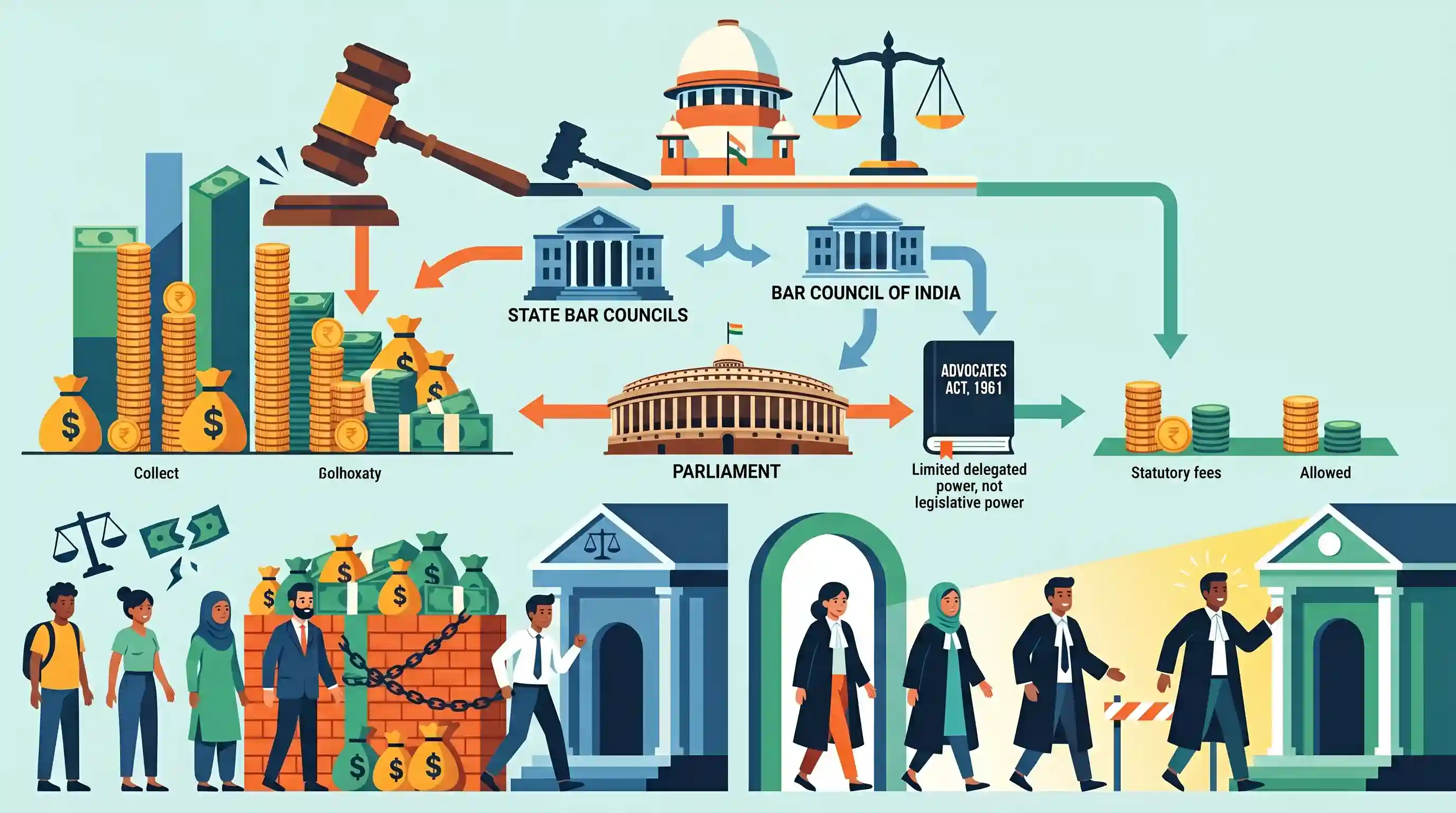
The Supreme Court of India has directed State Bar Councils (SBCs) and the Bar Council of India (BCI) to immediately cease charging any optional fees from enrolling lawyers beyond the statutory limits set by the Advocates Act, 1961. The statutory fees are fixed at ₹750 for the general category and ₹125 for SC/ST candidates. The Court noted that as delegated authorities, the BCI and SBCs cannot alter Parliament's fiscal policy. Furthermore, exorbitant fees violate fundamental rights under Article 14 and Article 19(1)(g) of the Constitution by creating financial barriers that perpetuate systemic discrimination against economically weaker and marginalized sections attempting to join the legal profession.
Key Points
- The Supreme Court ruled that State Bar Councils (SBCs) and the Bar Council of India (BCI) cannot collect optional fees from enrolling lawyers over and above the statutory limits.
- Under the Advocates Act, 1961, the enrollment fee is capped at ₹750 for general category and ₹125 for SC/ST candidates.
- The Court held that SBCs and the BCI act as delegates under the statute and lack the authority to alter or modify the fiscal policy laid down by Parliament.
- Charging exorbitant fees was deemed a violation of Article 14 (right to equality) and Article 19(1)(g) (right to practice a profession).
- The Court emphasized that such financial barriers cause systemic discrimination and marginalize economically weaker sections from entering the legal profession.
Important Terms
Bar Council of India (BCI)

A statutory body established under the Advocates Act, 1961, to regulate and represent the Indian legal profession and legal education standards.
UPSC context
GS-II: Statutory, regulatory, and various quasi-judicial bodies; tests understanding of professional regulatory frameworks.
Advocates Act, 1961
The primary legislation governing India's legal profession, establishing a unified bar, professional ethics, and the framework for enrollment and disciplinary action.
UPSC context
GS-II: Important aspects of governance and legislation; tests knowledge of laws regulating essential professions.
Delegated Legislation
The process where the legislature grants rule-making authority to subordinate bodies (like BCI) to implement statutes within specific parliamentary limits.
UPSC context
GS-II: Separation of powers and executive-legislative relations; tests limits on administrative rule-making.
Article 19(1)(g)
A Fundamental Right under the Indian Constitution granting all citizens the freedom to practice any profession or carry on any occupation.
UPSC context
GS-II: Fundamental Rights; tests understanding of 'reasonable restrictions' on professional freedom.
Article 14
A Fundamental Right guaranteeing 'equality before the law' and 'equal protection of the laws' within India.
UPSC context
GS-II: Fundamental Rights; tests the concept of systemic discrimination and financial barriers to justice.
State Bar Councils (SBCs)
State-level statutory bodies responsible for maintaining the roll of advocates and handling local enrollment and disciplinary matters.
UPSC context
GS-II: Governance and administrative structure; tests the dual-tier regulatory system for the legal profession.
Prelims Trap
"The Bar Council of India has the autonomous regulatory authority to revise enrollment fees to maintain professional standards."
The BCI is merely a delegated authority under the Advocates Act, 1961. It lacks the essential legislative power to alter fiscal policy or revise fee caps set by Parliament.
Static Concepts Connected
What are the limits of Delegated Legislation in India?
- Subordination: A delegated authority (like BCI) cannot override, alter, or expand upon the provisions of its parent statute (Advocates Act).
- Fiscal restrictions: Imposing taxes or mandatory financial levies is an essential legislative function. Delegates cannot levy fees unless explicitly authorized by the parent act.
- Ultra vires principle: Any rule, regulation, or fee structure made beyond the powers conferred by the parent Act is declared ultra vires (void) by the courts.
How is the right to practice a profession (Article 19(1)(g)) regulated?
- Fundamental Right: Article 19(1)(g) guarantees citizens the right to practice any profession, or carry on any occupation, trade, or business.
- Reasonable Restrictions: Under Article 19(6), the State can impose reasonable restrictions in the interests of the general public. Arbitrary financial barriers are considered unreasonable.
- Professional Qualifications: The State has the right to prescribe professional or technical qualifications necessary for practicing any profession, such as clearing a bar exam.
Cross-Topic Patterns
Delegated Legislation vs. Fundamental Rights
Administrative overreach by statutory bodies creating arbitrary financial barriers is increasingly viewed by the Supreme Court through the lens of fundamental rights (Articles 14 and 19), linking administrative law directly with Part III.
Access to Profession and Social Justice
Exorbitant enrollment fees lead to systemic exclusion of marginalized communities from the legal profession. This connects statutory professional regulations directly to substantive equality and the constitutional goal of equitable justice.

Expect a 2026 Prelims question testing if delegated statutory authorities can alter parent-act fee caps and violate Article 19(1)(g) rights.
Linked PYQs · 1
Linked PYQs · 1
- 2022PrelimsGS1
With reference to India, consider the following statements: 1. Government law officers and legal firms are recognised as advocates, but corporate lawyers and patent attorneys are excluded from recognition as advocates. 2. Bar Councils have the power to lay down the rules relating to legal education and recognition of law colleges. Which of the statements given above is/are correct?
