Decentralized startup growth and economic policy reforms in India
Source:Indian Express ↗
Why It Matters
The decentralization of startups to Tier-2 and Tier-3 cities is a critical dimension of inclusive economic growth and employment generation. Understanding the impact of schemes like Startup India and Stand Up India, along with reforms like the IBC, is essential for GS-3 answers on economic development, ease of doing business, and industrial policies.
Summary
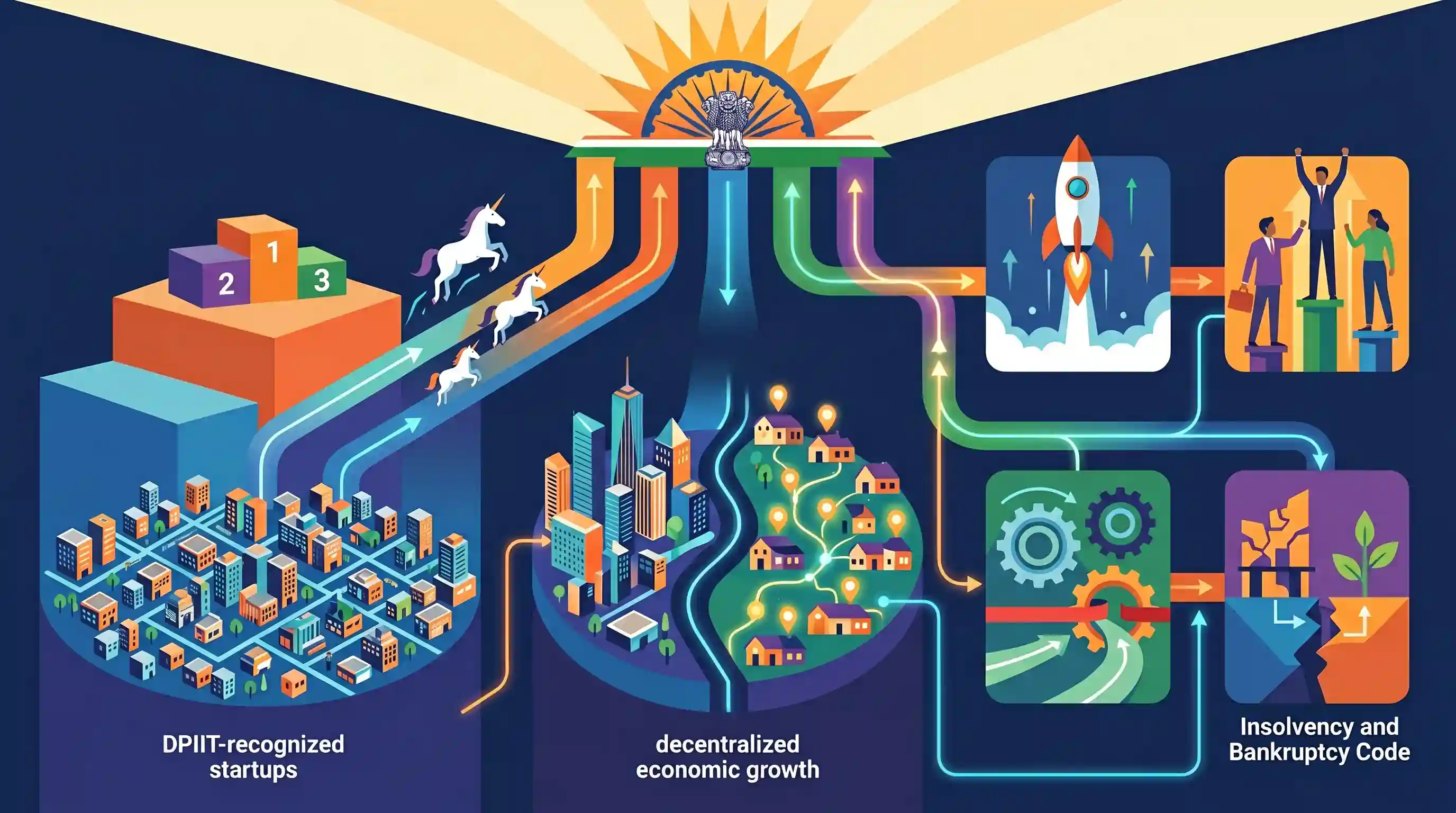
Former Union Minister Anurag Thakur, speaking at TiECon Chandigarh 2026, highlighted the robust expansion of India's startup ecosystem as a testament to public trust in government policies. He emphasized that India is now the world’s third-largest startup ecosystem, with over 120 unicorns and 2,12,000 DPIIT-recognised startups. Crucially, he noted that more than 50% of these startups are emerging from Tier-2 and Tier-3 cities, reflecting decentralized and inclusive economic growth. Thakur credited this success to key initiatives under the Modi government, including Startup India, Stand Up India, Ease of Doing Business reforms, and the Insolvency and Bankruptcy Code (IBC).
Key Points
- India has emerged as the world's 3rd largest startup ecosystem, boasting over 2,12,000 DPIIT-recognised startups and more than 120 unicorns.
- Demonstrating decentralized economic growth, over 50% of the country's recognized startups are now based in Tier-2 and Tier-3 cities.
- Former Union Minister Anurag Thakur attributed this growth to trust in government policies such as Startup India and Stand Up India.
- Structural reforms like the Insolvency and Bankruptcy Code (IBC) and initiatives to promote the 'Ease of Doing Business' were highlighted as key enablers of this ecosystem.
- The economic backdrop frames India as the world's 4th largest economy with a GDP of $4.18 trillion.
Important Terms
Startup India

Flagship initiative launched in 2016 to foster innovation and entrepreneurship. It provides tax benefits, funding support (Fund of Funds), and simplified compliance to transform India into a job-creating economy.
UPSC context
GS III: Industrial Policy; tests understanding of government ecosystems for innovation, employment, and sustainable economic growth.
Stand Up India
Scheme facilitating bank loans between ₹10 lakh and ₹1 crore to SC, ST, and women entrepreneurs. It specifically supports "greenfield" projects to promote grassroots entrepreneurship and financial inclusion.
UPSC context
GS III: Inclusive Growth; GS II: Welfare Schemes; tests knowledge of socio-economic empowerment and financial inclusion strategies.
Insolvency and Bankruptcy Code (IBC)
A 2016 legislative framework for time-bound insolvency resolution. It aims to maximize asset value, promote entrepreneurship by simplifying business exits, and improve the credit culture by empowering creditors.
UPSC context
GS III: Indian Economy; tests understanding of banking reforms, NPA resolution, and "Ease of Doing Business" mechanisms.
DPIIT
The Department for Promotion of Industry and Internal Trade under the Ministry of Commerce and Industry. It is the nodal agency for industrial policy, FDI, and startup recognition.
UPSC context
GS III: Industrial Policy; tests knowledge of executive bodies managing India’s trade, investment, and industrial development.
Unicorns
Privately held startup companies valued at over $1 billion. India currently ranks as the world’s third-largest startup ecosystem, with more than 120 companies achieving this prestigious valuation status.
UPSC context
GS III: Growth & Development; tests awareness of India’s economic competitiveness, technological innovation, and global investment trends.
Tier-2 and Tier-3 Cities
Urban centers beyond major metros (Tier-1). The emergence of over 50% of startups from these cities reflects decentralized economic growth and the bridging of regional developmental disparities.
UPSC context
GS III: Inclusive Growth/Regional Disparity; tests understanding of balanced development and the geographic expansion of the digital economy.
Prelims Trap
"Stand Up India provides loans for both greenfield and brownfield expansion by women and SC/ST entrepreneurs."
Stand Up India is strictly limited to setting up greenfield (first-time) enterprises in manufacturing, services, agri-allied, or trading sectors. Existing brownfield ventures are ineligible.
Static Concepts Connected
What are the criteria for an entity to be recognized as a 'Startup' by DPIIT?
- Age Limit: Must be up to 10 years from the date of its incorporation or registration.
- Turnover Cap: Annual turnover must not have exceeded ₹100 crore for any financial year since incorporation.
- Innovation focus: Must be working towards innovation, development, or improvement of products, processes, or services.
What are the core eligibility conditions under the Stand Up India Scheme?
- Target Group: Loans are exclusively for at least one SC/ST borrower or one woman borrower per bank branch.
- Loan Amount: Facilitates bank loans between ₹10 lakh and ₹1 crore for setting up enterprises.
- Enterprise Type: Only applies to greenfield (first-time) enterprises. For non-individuals, 51% shareholding must be held by SC/ST/woman.
Cross-Topic Patterns
IBC as an innovation catalyst
A robust bankruptcy framework lowers the cost of failure, providing a safe 'exit' mechanism. This behavioral shift reduces systemic risk-aversion, which is crucial for funding and scaling risk-heavy startup ecosystems.
Innovation-led counter-magnet urbanization
Over 50% of startups emerging from Tier-2/3 cities reduces migration pressure on traditional metros, acting as economic counter-magnets and promoting decentralized, inclusive regional growth.

Expect a multi-statement prelims question mixing DPIIT recognition criteria, Stand Up India's 'greenfield' caveat, and recent IBC reforms.
Linked PYQs · 3
Linked PYQs · 3
- 2016PrelimsGS1
With reference to 'Stand Up India Scheme', which of the following statements is/are correct? 1. Its purpose is to promote entrepreneurship among SC/ST and women entrepreneurs. 2. It provides for refinance through SIDBI. Select the correct answer using the code given below.
- 2022MainsGS3
Is inclusive growth possible under market economy ? State the significance of financial inclusion in achieving economic growth in India.
- 2016PrelimsGS1
'SWAYAM', an initiative of the Government of India, aims at
