Nuclear arms control collapse and global strategic stability
Source:Indian Express ↗
Why It Matters
Nuclear arms control agreements like New START are crucial for global strategic stability. Their collapse affects international security dynamics, which directly impacts India's security calculations vis-à-vis China and Pakistan, making it a critical topic for UPSC GS2 (IR) and GS3 (Security).
Summary
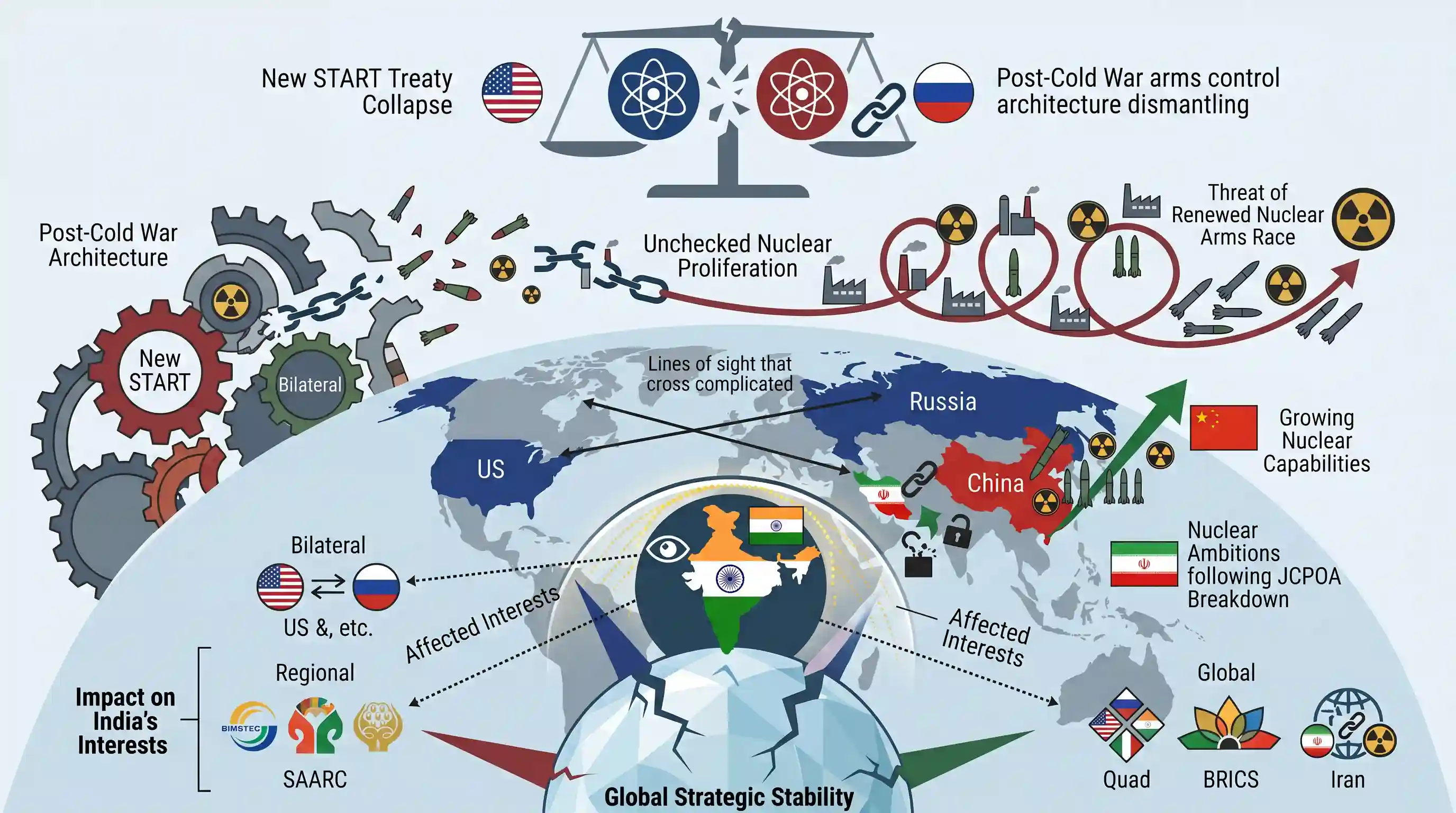
The article discusses the collapse of the New START Treaty and the looming threat of a renewed nuclear arms race involving the US and Russia. It highlights the shift from a bipolar nuclear world to a more complex, multi-polar landscape, complicated by China's growing nuclear capabilities and Iran's nuclear ambitions following the breakdown of the JCPOA. The dismantling of the post-Cold War arms control architecture signals a dangerous era of unchecked nuclear proliferation and shifting global strategic stability.
Key Points
- The suspension or expiration of the New START Treaty between the US and Russia risks dismantling the last remaining pillar of bilateral nuclear arms control.
- The collapse of this architecture threatens to trigger a new nuclear arms race, potentially involving China's rapidly expanding nuclear arsenal.
- The geopolitical landscape is further complicated by Iran's advancing nuclear program and the defunct JCPOA, creating a multi-polar nuclear threat environment.
- For India, the deterioration of global arms control mechanisms and a potential US-Russia-China arms race present significant strategic and security challenges in the Indo-Pacific and South Asia.
Important Terms
New START Treaty

A 2010 bilateral agreement between the US and Russia capping deployed strategic nuclear warheads (1,550) and launchers. It officially expired in February 2026, marking the end of regulated nuclear arms control.
UPSC context
GS Paper 2 (International Relations); critical for understanding US-Russia strategic stability and the shift from bipolar to multipolar nuclear competition.
JCPOA (Iran Nuclear Deal)
The 2015 agreement between Iran and world powers (P5+1) limiting Iran's nuclear enrichment in exchange for sanctions relief. It largely collapsed following the 2018 US withdrawal.
UPSC context
GS Paper 2; tests knowledge of Middle East geopolitics, international sanctions regimes, and nuclear non-proliferation challenges in West Asia.
Non-Proliferation Treaty (NPT)
A 1970 landmark treaty to prevent the spread of nuclear weapons and promote disarmament. India remains a non-signatory, citing the treaty's discriminatory divide between nuclear 'haves' and 'have-nots'.
UPSC context
GS Paper 2 & 3; essential for discussing India's Nuclear Doctrine, global disarmament frameworks, and its refusal to sign 'atomic apartheid' treaties.
IAEA (International Atomic Energy Agency)
A UN-affiliated autonomous organization (est. 1957) that promotes peaceful nuclear energy and monitors compliance through a system of safeguards and inspections.
UPSC context
GS Paper 2 (International Institutions); focuses on the role of specialized agencies in global safety, security, and verification of nuclear activities.
United Nations (UN)
Global intergovernmental organization whose Security Council oversees international peace and security, enforces nuclear non-compliance resolutions, and manages the 'snapback' of sanctions under agreements like the JCPOA.
UPSC context
GS Paper 2; central to international governance, institutional mandates, and the role of the P5 in global security architecture.
Vertical Proliferation
The expansion of a nuclear-armed state's existing arsenal in terms of quantity or quality (modernization), as opposed to 'horizontal' proliferation (spread to new states).
UPSC context
GS Paper 3 (Security); relevant to debates on the arms race, strategic modernization by US/Russia/China, and the limitations of the NPT.
Prelims Trap
"The New START Treaty limited both the strategic and tactical nuclear weapons of the United States and Russia."
New START only capped deployed *strategic* nuclear warheads and delivery systems. It completely excluded tactical (non-strategic) nuclear weapons, which Russia possesses in large numbers.
Static Concepts Connected
What are the key pillars and India's stance on the NPT?
- Three pillars: Non-proliferation, disarmament, and the right to peacefully use nuclear technology.
- India's stance: India refused to sign, viewing it as discriminatory for dividing the world into nuclear 'haves' (tested before 1967) and 'have-nots'.
- De facto compliance: Despite not signing, India maintains a 'No First Use' policy and self-imposed moratoria, gaining an NSG waiver in 2008.
What was the mandate of the New START and INF treaties?
- New START: A bilateral US-Russia treaty capping deployed strategic nuclear warheads (at 1,550) and deployed strategic delivery systems.
- INF Treaty: Banned all land-based ballistic and cruise missiles with ranges of 500 to 5,500 km. It collapsed in 2019.
- China's exclusion: Neither treaty covered China, prompting recent US demands to integrate Beijing into a trilateral arms control framework.
Cross-Topic Patterns
China's buildup + India's Nuclear Doctrine
The shift to a US-Russia-China tri-polar nuclear race strains India's 'credible minimum deterrence', potentially sparking debates on revising its established 'No First Use' posture to counter Beijing.
JCPOA collapse + West Asian geopolitics
The JCPOA's collapse pushes Iran toward a nuclear breakout, risking a regional arms race in West Asia that directly threatens India's energy security, investments, and diaspora.

A 2026 prelims question will likely match arms control treaties (New START, INF, CTBT, JCPOA) with their member states and exact scopes.
Linked PYQs · 4
Linked PYQs · 4
- 2011PrelimsGS1
The "New START" treaty was in the news. What is this treaty?
- 2015PrelimsGS1
Consider the following countries: 1. China 2. France 3. India 4. Israel 5. Pakistan Which among the above are Nuclear Weapons States as recognized by the Treaty on the Non-Proliferation of Nuclear Weapons, commonly known as Nuclear Non-Proliferation Treaty (NPT)?
- 2018MainsGS2
In what ways would the ongoing US-Iran Nuclear Pact Controversy affect the national interest of India? How should India respond to this situation?
- 2012MainsGS2
How have the US sanctions against Iran affected India's bilateral relations with Iran?
