Starlink India Market Entry Regulatory and Security Hurdles
Source:The Hindu ↗
Why It Matters
It highlights the intersection of cutting-edge space technology, national security regulations, and economic policy regarding spectrum allocation in India's evolving telecommunications landscape.
Summary
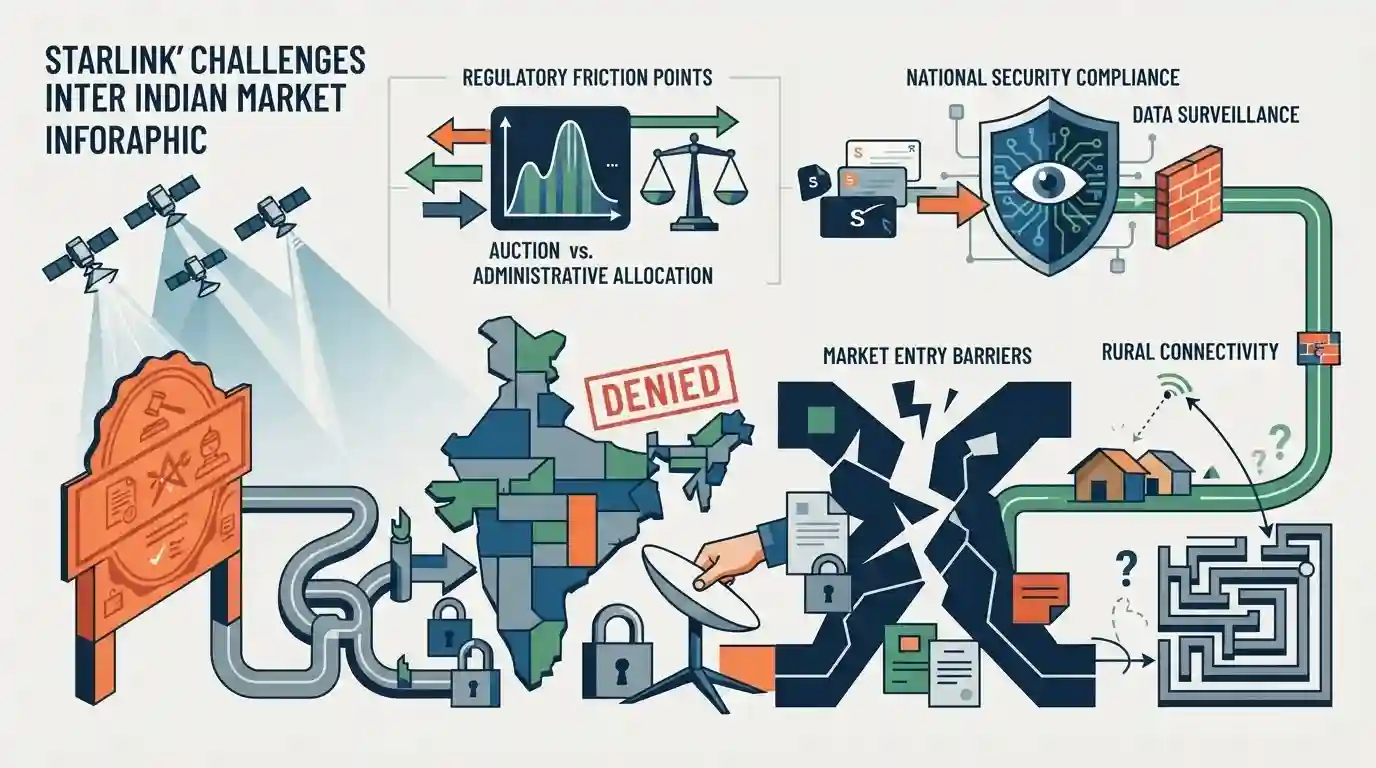
The article details Starlink's ongoing challenges in entering the Indian market, focusing on complex regulatory friction points such as spectrum allocation methods, national security compliance, data surveillance, and delivering connectivity.
Key Points
- Starlink faces regulatory hurdles in India involving spectrum allocation methods (administrative pricing vs auction), security clearances, and data localization compliance.
- The debate centers on whether satellite communication spectrum should be administratively assigned in line with global norms or auctioned, impacting level playing field considerations with terrestrial telecom operators.
- National security and surveillance concerns remain paramount, particularly data storage, encryption standards, and lawful interception capabilities for satellite broadband providers.
- Bridging the digital divide in remote and rural connectivity through low Earth orbit (LEO) satellite constellations forms a core promise of companies like Starlink, weighed against domestic regulatory mandates.
Important Terms
Telecommunications Act, 2023

A landmark Indian legislation replacing colonial-era laws to modernize telecom governance, providing frameworks for administrative spectrum allocation for satellite communications and stricter security compliance.
UPSC context
UPSC GS Paper III (Economy - Infrastructure & IT/Telecom); tests legal reforms in digital infrastructure, spectrum policy, and regulatory updates.
TRAI
An independent statutory body that regulates the telecommunications sector in India, recommending spectrum pricing, licensing terms, and policy frameworks to the Department of Telecommunications.
UPSC context
UPSC GS Paper III (Economy - Infrastructure); tests the role of regulatory bodies in economic governance and telecom competition.
Department of Telecommunications (DoT)
The executive arm under the Ministry of Communications responsible for formulating telecom policies, issuing licenses, and managing national spectrum resources in India.
UPSC context
UPSC GS Paper II/III (Governance & Infrastructure); tests administrative mechanics of public sector governance and licensing policies.
Prelims Trap
All spectrum in India must be mandatorily auctioned to ensure transparency and prevent arbitrary state largesse.
Aspirants often assume all telecom spectrum in India must be auctioned following the Supreme Court's 2G verdict; however, the Telecommunications Act, 2023 permits administrative allocation for satellite spectrum in line with global norms.
Static Concepts Connected
How does international regulation and domestic licensing govern satellite communication spectrum?
- ITU Role: ITU allocates orbit-spectrum resources internationally through a coordination and registration process to prevent harmful interference among satellite networks.
- Global vs Domestic: Unlike terrestrial spectrum, satellite footprints cross national boundaries, requiring both international ITU filings and national landing rights/licenses.
What are the key structural changes introduced by the Telecommunications Act, 2023 regarding spectrum?
- Overview: Enacted to replace colonial-era telegraph acts, providing modern legal frameworks for spectrum assignment, cybersecurity, and right-of-way.
- Satellite Spectrum: Explicitly enables administrative assignment of spectrum for satellite communications (GMPCS) aligned with global standards.
Cross-Topic Patterns
Telecom Spectrum Allocation vs. Level Playing Field
The debate between spectrum auctions and administrative assignment directly intersects with competitive neutrality principles between capital-heavy terrestrial telecom incumbents and asset-light LEO satellite operators.
Satellite Broadband and National Security Compliance
Cross-border LEO satellite data routing raises vital questions about sovereignty, data localization mandates under the Digital Personal Data Protection Act, and lawful interception frameworks.

Telecommunications Act 2023 provisions on administrative spectrum assignment vs auctions for satellite comms will feature in Prelims.
Linked PYQs · 2
Linked PYQs · 2
- 2024MainsGS3
Social media and encrypting messaging services pose a serious security challenge. What measures have been adopted at various levels to address the security implications of social media? Also suggest any other remedies to address the problem.
- 2020MainsGS3
Discuss different types of cyber crimes and measures required to be taken to fight the menace.
