Satpura Melghat Corridor Rail Project Receives Wildlife Clearance
Source:visionias ↗
Why It Matters
MPPSC frequently tests the geography and environment of Madhya Pradesh, including its national parks, tiger reserves, and river systems. The approval of a project through the Satpura-Melghat corridor connects MP-specific geography to national environmental regulations (WPA 1972, SC-NBWL), making it highly relevant for Prelims questions on conservation and protected areas.
Summary
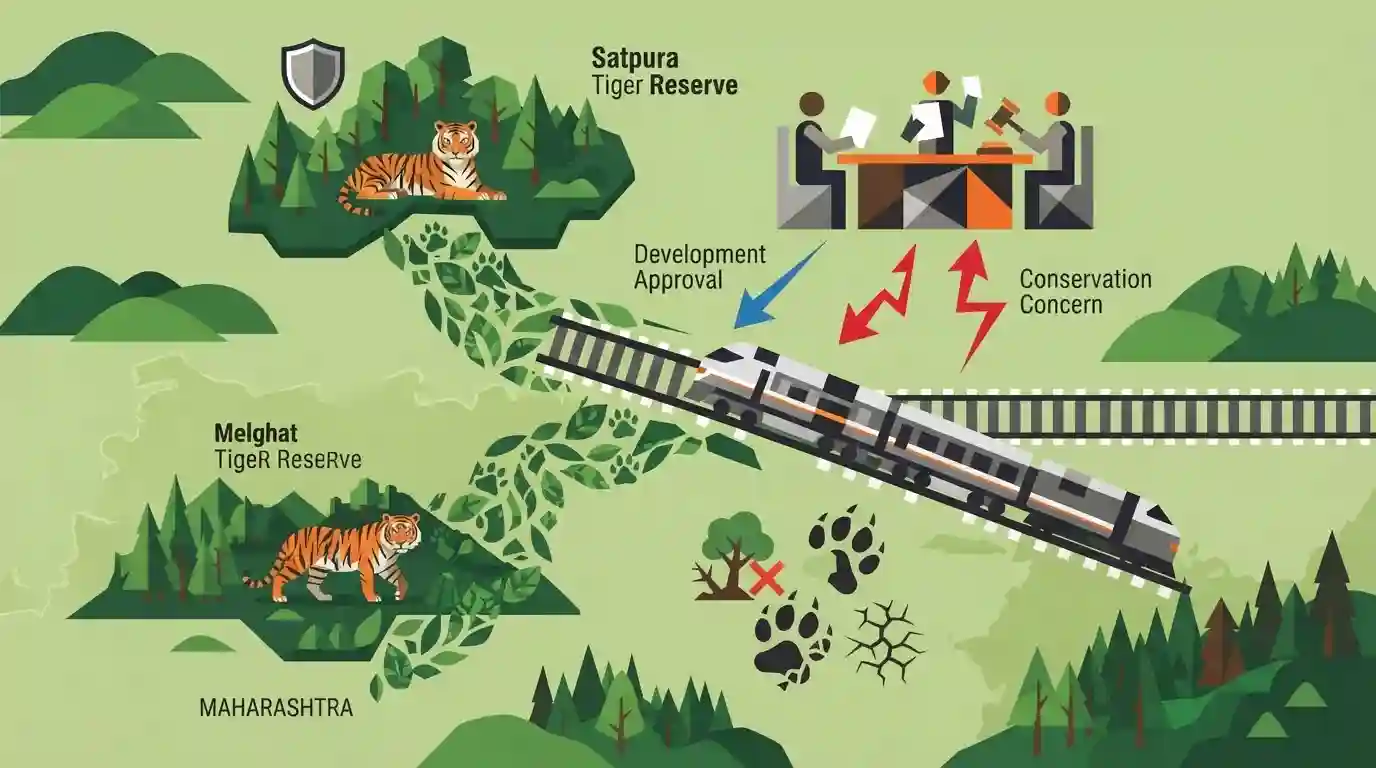
The Standing Committee of the National Board for Wildlife (SC-NBWL) has granted in-principle approval for a broad-gauge railway line between Khandwa and Akola that cuts through the vital Satpura-Melghat Tiger Corridor. This corridor links the Satpura Tiger Reserve in Madhya Pradesh to the Melghat Tiger Reserve in Maharashtra, highlighting a tension between regional infrastructure development and crucial wildlife conservation efforts.
Key Points
- The Standing Committee of the National Board for Wildlife (SC-NBWL) has granted in-principle approval for a broad-gauge railway line project connecting Khandwa (Madhya Pradesh) to Akola (Maharashtra).
- The proposed railway line passes through the critical Satpura-Melghat Tiger Corridor, raising concerns regarding habitat fragmentation and disruption of wildlife movement.
- The corridor provides an essential ecological linkage connecting the Satpura Tiger Reserve in Madhya Pradesh with the Melghat Tiger Reserve in Maharashtra.
- The SC-NBWL, constituted under the Wildlife (Protection) Act, 1972, is responsible for clearing infrastructure and development projects in and around protected areas and eco-sensitive zones.
Important Terms
Wildlife (Protection) Act, 1972

India's landmark legislation providing a comprehensive legal framework for conserving wild animals, plants, and their habitats. It mandates the creation of protected areas like National Parks and Wildlife Sanctuaries, restricting hunting and wildlife trade.
UPSC context
Core syllabus for GS Paper III (Environment). Essential for understanding biodiversity conservation, protected area management, and wildlife-related legislation.
Project Tiger
A flagship centrally sponsored conservation scheme launched in 1973 to safeguard the Bengal tiger population and preserve its natural habitats. It pioneered the "core-buffer" landscape strategy across designated Tiger Reserves in India.
UPSC context
Highly relevant for GS Paper III (Ecology and Biodiversity). Tests knowledge of conservation initiatives, core-buffer management, and habitat protection strategies.
National Board for Wildlife (NBWL)
The apex statutory body in India for wildlife-related matters, constituted under the Wildlife (Protection) Act, 1972. Chaired by the Prime Minister, it advises the government on framing conservation policies and reviews development projects near protected areas.
UPSC context
Key statutory body under GS Paper III (Environment & Governance). Frequently tested in Prelims regarding composition, chairmanship, and advisory functions.
Standing Committee of National Board for Wildlife (SC-NBWL)
A specialized, active regulatory sub-body under the NBWL, chaired by the Union Environment Minister. It is legally empowered to review and grant clearances for developmental or infrastructure projects requiring land diversion within Protected Areas and Eco-Sensitive Zones.
UPSC context
Important for GS Paper III (Infrastructure vs. Conservation). Tests administrative understanding of environmental clearance pathways and statutory sub-bodies.
National Tiger Conservation Authority (NTCA)
A statutory body under the Ministry of Environment, Forest and Climate Change, established in 2005 under the Wildlife (Protection) Act. It provides legal oversight, standardizes reserve management, and approves Tiger Conservation Plans across India.
UPSC context
Crucial for GS Paper III (Environmental Institutions). Tests understanding of tiger governance, statutory bodies, and federal-state coordination in conservation.
Prelims Trap
The Standing Committee of the NBWL (SC-NBWL), which clears infrastructure projects, is chaired by the Prime Minister.
While the Prime Minister chairs the full NBWL, the Standing Committee (SC-NBWL)—which actively clears projects—is chaired by the Minister of Environment, Forest, and Climate Change.
Static Concepts Connected
What is the statutory setup and clearance authority of the National Board for Wildlife (NBWL)?
- Statutory Basis: Constituted under Section 5A of the Wildlife (Protection) Act, 1972 as an apex advisory body.
- Leadership Structure: The Prime Minister chairs the NBWL, while the Union Minister of Environment, Forest, and Climate Change is the Vice-Chairperson.
- Standing Committee: Empowered under Section 5B, the Standing Committee (chaired by the Environment Minister) handles actual project clearances in protected areas.
What are the key geographical and ecological features of Satpura and Melghat Tiger Reserves?
- Satpura Reserve: Located south of Narmada River in MP; includes Satpura NP, Bori Sanctuary, and Pachmarhi Sanctuary.
- Melghat Reserve: Situated in Gavilgarh hills of Maharashtra's Satpura Range; bordered by the Tapti River; first 9 reserves under Project Tiger.
- Central Landscape: The corridor between them is vital for genetic migration and wildlife movement across the Central Indian Landscape.
Cross-Topic Patterns
Linear infrastructure vs Forest Conservation
Mega infrastructure projects (railway gauge conversion) cut across wildlife corridors, testing the limits of statutory mitigation under the Wildlife Protection Act and Forest Conservation Act.
River hydrology and Tiger Reserves
Central Indian tiger reserves (Satpura, Melghat) double as major catchment zones for rivers like Narmada and Tapti, highlighting the link between wildlife conservation and river basin management.

Expect a multi-statement question linking Melghat-Satpura geography (Tapti/Gavilgarh) with the statutory clearance powers of the SC-NBWL.
Linked PYQs · 4
Linked PYQs · 4
- 2016MPPSC_PRELIMSGS1
In which year was the wildlife protection act enforced in India?
- 2021MPPSC_PRELIMSGS1
Corbett Tiger Reserve is located in which Indian State?
- 2023MPPSC_PRELIMSGS1
Purna river is a tributary of which of the following rivers?
- 2010MPPSC_PRELIMSGS1
Except Narmada and Tapi rivers of Madhya Pradesh flow into:
