Temple Stampede Exposes Crowd Management Lapses in Andhra Pradesh
Source:The Hindu ↗
Why It Matters
Recurrent stampedes at religious gatherings expose systemic gaps in crowd management and regulatory oversight of private trusts. It emphasizes the need for a paradigm shift from reactive disaster response to proactive risk mitigation and strict enforcement of NDMA guidelines at the local level.
Summary
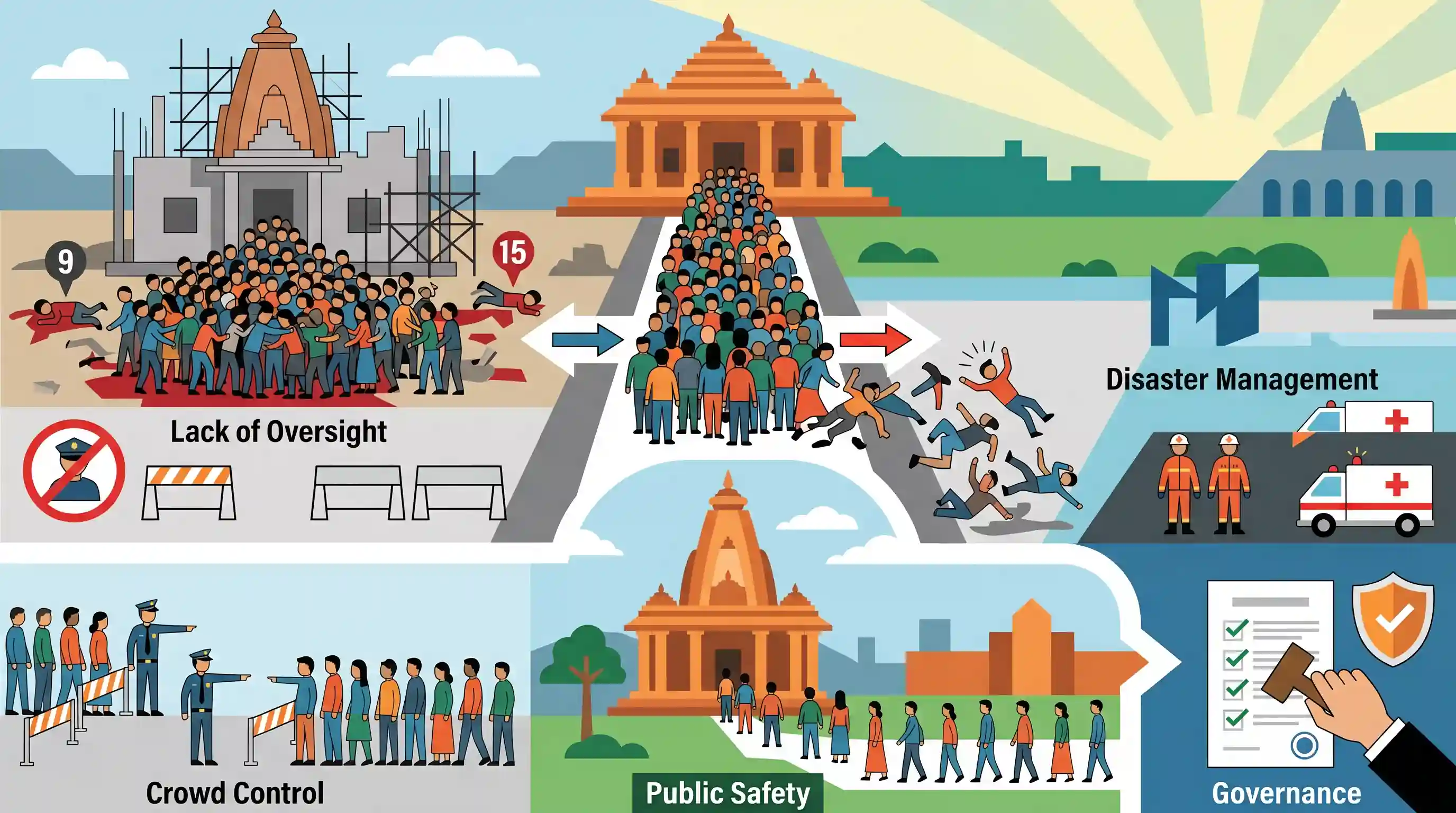
At least nine devotees died and 15 were injured in a stampede at the Venkateswara Swamy temple in Srikakulam, Andhra Pradesh. The tragedy occurred due to unprecedented overcrowding at the privately-managed, under-construction temple during an 'ekadashi' festival, as over 20,000 people converged on a single passageway used for both entry and exit. The lack of prior intimation to local police, absence of crowd control infrastructure, and inadequate safety measures highlight severe administrative and private negligence. The incident reiterates the urgent necessity for strict regulatory oversight over religious trusts, mandatory local police integration for crowd control, and proactive implementation of disaster management frameworks to prevent recurrent mass-casualty events at religious gatherings.
Key Points
- A stampede at an under-construction, privately managed Venkateswara Swamy temple in Srikakulam district caused nine deaths and left 15 injured due to severe overcrowding.
- The incident was triggered when over 20,000 devotees gathered on 'ekadashi', causing barricades to collapse in a single passageway used for both entry and exit.
- Severe administrative negligence was evident: the temple owner failed to anticipate the crowd, did not inform local police for deployment, and lacked basic safety infrastructure like CCTVs.
- The tragedy adds to a long history of fatal stampedes at Indian religious gatherings (e.g., Hathras, Sabarimala), underscoring the pressing need for strict enforcement of NDMA crowd management guidelines and better oversight by Endowments Departments.
Important Terms
Endowments Department

A state government agency responsible for the administration and oversight of Hindu religious and charitable institutions, ensuring proper property management and pilgrim safety.
UPSC context
GS Paper 2 (Governance/Statutory Bodies); tests understanding of state oversight over religious institutions and administrative accountability.
State Police
The primary law enforcement agency responsible for maintaining public order, managing crowds at mass gatherings, and ensuring public safety during large-scale events.
UPSC context
GS Paper 3 (Internal Security/Disaster Management); tests knowledge of the police\'s role in preventive disaster management.
National Disaster Management Authority (NDMA)
The apex statutory body in India, chaired by the Prime Minister, responsible for laying down policies and guidelines for disaster management.
UPSC context
GS Paper 3 (Disaster Management); essential for understanding national protocols on crowd safety and stampede prevention.
Crowd Management
The systematic planning and guidance of orderly crowd movement to prevent overcrowding, panic, and casualties at mass gatherings like festivals or rallies.
UPSC context
GS Paper 3 (Disaster Management); a recurring topic regarding administrative lapses and public safety infrastructure.
Disaster Management Act, 2005
The primary legal framework in India that mandates the creation of disaster management authorities and guides the state\'s response to man-made and natural disasters.
UPSC context
GS Paper 3 (Disaster Management); the legal basis for all emergency response and risk mitigation strategies in India.
Andhra Pradesh Charitable and Hindu Religious Institutions and Endowments Act, 1987
The state-level legislation governing the administration of religious trusts in Andhra Pradesh, recently extended to enforce safety checklists on private temples.
UPSC context
GS Paper 2 (Governance); specific example of state-level regulation of religious entities for public welfare.
Prelims Trap
Religious endowments and trusts are exclusively managed by state governments under the State List.
Religious endowments actually fall under the Concurrent List (Entry 28), meaning both Parliament and state legislatures hold jurisdiction over them, not just states.
Static Concepts Connected
How are religious endowments and trusts governed under the Constitution?
- Concurrent List: Listed under Entry 28 of the Seventh Schedule, allowing both Parliament and state legislatures to enact laws governing charities and religious institutions.
- State Legislation: Many states enforce specific laws (like TN HR&CE Act) to regulate administration of public temples, though privately managed shrines often lack such oversight.
What are the core pillars of NDMA's Crowd Management Guidelines?
- Capacity Planning: Mandates scientifically calculating venue holding capacity to restrict entry and avoid exceeding critical crowd densities.
- Infrastructure Design: Requires strict physical separation of entry and exit routes to eliminate bidirectional flow and structural bottlenecks.
- Medical Preparedness: Demands dedicated medical posts, clear ambulance access routes, and rapid evacuation plans to mitigate compressive asphyxia risks.
Cross-Topic Patterns
Urbanization of Pilgrimage
The shift from seasonal to year-round mass religious tourism severely strains local infrastructure, linking GS3 Disaster Management with GS1 Urbanization and GS2 governance.
Article 26 vs. Public Order
State interventions in privately managed temples to enforce safety often spark debates balancing the fundamental right to manage religious affairs (Article 26) with public order limitations.

Expect a Mains question linking Article 26 (managing religious affairs) with public order limitations, focusing on crowd safety norms.
Linked PYQs · 3
Linked PYQs · 3
- 2020MainsGS3
Discuss the recent measures initiated in disaster management by the Government of India departing from the earlier reactive approach.
- 2024MainsGS2
Public charitable trusts have the potential to make India's development more inclusive as they relate to certain vital public issues. Comment.
- 2018MainsGS4
Explain the process of resolving ethical dilemmas in Public Administration.
