Tamil Nadu cash transfer scheme and fiscal impact of freebies
Source:Indian Express ↗
Why It Matters
This development serves as a contemporary case study for the ongoing debate over the blurred lines between genuine welfare state policies and electoral 'freebies'. It is highly relevant for UPSC answers evaluating the socio-economic impact of Direct Benefit Transfers (DBT), the fiscal implications of competitive state populism, and the role of cash transfers in women's empowerment.
Summary
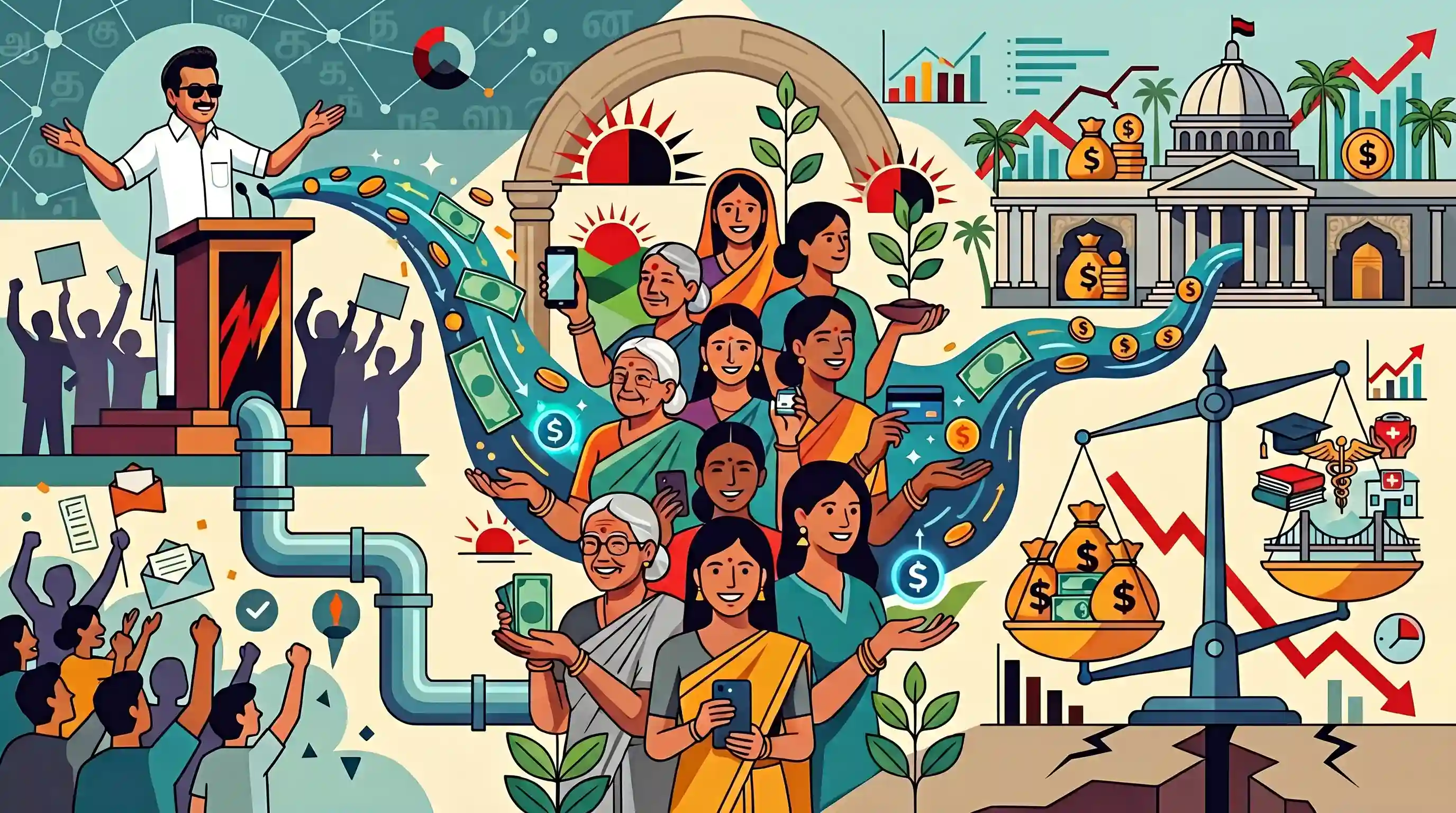
Tamil Nadu Chief Minister M.K. Stalin has announced a major electoral initiative, promising a direct transfer of Rs 5,000 into the bank accounts of 1.31 crore women across the state. Positioned as an empowerment and welfare scheme, this Direct Benefit Transfer (DBT) serves as a significant 'poll bonanza' ahead of the upcoming elections. The policy underscores a growing political trend of utilizing targeted cash transfers for vulnerable demographic groups, particularly women, to consolidate vote banks. At the same time, it raises critical macroeconomic questions regarding state fiscal discipline, the distinction between populist freebies and essential welfare interventions, and the long-term sustainability of bearing such massive subsidy burdens on the state exchequer.
Key Points
- Tamil Nadu Chief Minister M.K. Stalin announced a significant pre-election initiative to transfer Rs 5,000 directly into the bank accounts of 1.31 crore women in the state.
- The scheme highlights the increasing use of Direct Benefit Transfers (DBT) and targeted cash assistance as primary tools for both women's empowerment and electoral mobilization.
- Such measures reignite the national debate on the fine line between constitutional welfare state obligations and unsustainable electoral 'freebies' (populism).
- The massive scale of the payout poses questions about state fiscal health, revenue deficit management, and the economic sustainability of competitive populism.
Important Terms
Kalaignar Magalir Urimai Thogai

A Tamil Nadu welfare scheme providing monthly financial assistance to eligible women heads of households, aimed at recognizing unpaid labor and enhancing women's economic independence.
UPSC context
GS Paper II: Welfare schemes for vulnerable sections; tests understanding of state-level social security and gender-focused developmental interventions.
Direct Benefit Transfer (DBT)
A mechanism to transfer government subsidies and benefits directly into beneficiaries' bank accounts, leveraging the JAM trinity (Jan Dhan-Aadhaar-Mobile) to reduce leakages and eliminate intermediaries.
UPSC context
GS Paper III: Indian Economy/Public Finance; tests knowledge of governance reforms, financial inclusion, and efficiency in public spending.
Freebies vs Welfare Debate
A policy debate distinguishing between 'populist doles' (short-term electoral gains) and 'merit goods' (long-term human capital investments like education/health) under constitutional mandates like Directive Principles.
UPSC context
GS Paper II: Governance/Judiciary; tests ability to analyze Supreme Court interventions, electoral ethics, and fiscal sustainability of populist promises.
Fiscal Discipline
The practice of managing government finances to minimize deficits and debt, ensuring long-term economic stability and compliance with frameworks like the FRBM Act.
UPSC context
GS Paper III: Government Budgeting; tests understanding of state-level fiscal health, revenue deficits, and the sustainability of subsidy-heavy budgets.
Model Code of Conduct (MCC)
A set of guidelines issued by the Election Commission of India to regulate the conduct of political parties and candidates during elections, specifically regarding announcements and expenditures.
UPSC context
GS Paper II: Representation of People’s Act/Elections; tests knowledge of regulatory frameworks ensuring level playing fields in democratic processes.
Directive Principles of State Policy (DPSP)
Constitutional guidelines (Articles 36-51) that direct the State to promote the welfare of people by securing a social order imbued with justice, equality, and social security.
UPSC context
GS Paper II: Indian Constitution; tests the conceptual link between constitutional mandates and the formulation of modern socio-economic welfare policies.
Prelims Trap
"Promising freebies in election manifestos is deemed a 'corrupt practice' under the Representation of the People Act, 1951."
In the 2013 S. Subramaniam Balaji case, the Supreme Court ruled that promising freebies does NOT constitute a 'corrupt practice' under Section 123 of the RPA. Aspirants often assume it does.
Static Concepts Connected
How does the Constitution restrict State borrowing to fund populist schemes?
- Article 293: States cannot raise loans without the Centre's consent if there is any outstanding loan owed to the Government of India.
- Territorial Limits: Unlike the Centre, States can only borrow within the territory of India upon the security of the Consolidated Fund of the State.
- FRBM Caps: Borrowing capacity is strictly pegged to State GDP via fiscal deficit targets codified in State-level Fiscal Responsibility and Budget Management Acts.
What distinguishes a 'welfare measure' from a 'freebie' in public finance?
- Merit Goods: Goods with positive societal externalities (e.g., education, health, PDS) are considered constitutional welfare or merit goods.
- Non-Merit Goods: Items providing pure private consumption benefits with minimal broader social return (e.g., free TVs, electricity waivers) are classified as non-merit freebies.
- Asset Creation: Welfare measures usually build long-term human or physical capital, whereas freebies represent recurring, unproductive consumption transfers that strain the exchequer.
Cross-Topic Patterns
DBT, financial inclusion and patriarchy
Routing cash unconditionally to women's accounts directly improves intra-household bargaining power and disrupts patriarchal control, linking GS3 financial inclusion (JAM trinity) with GS2 gender parity themes.
Sub-national fiscal stress & Centre's levers
The Centre increasingly uses Article 293 and Finance Commission borrowing caps to rein in state-level competitive populism, sparking federal friction over welfare autonomy and debt sustainability.

Expect a 2026 Mains GS2/GS3 question linking state-level competitive populism to sub-national debt sustainability and Article 293.
Linked PYQs · 4
Linked PYQs · 4
- 2015MainsGS3
In what way could replacement of price subsidy with Direct Benefit Transfer (DBT) change the scenario of subsidies in India ? Discuss.
- 2023MainsGS2
“Development and welfare schemes for the vulnerable, by its nature, are discriminatory in approach.” Do you agree? Give reasons for your answer.
- 2022MainsGS2
Besides the welfare schemes, India needs deft management of inflation and unemployment to serve the poor and the underprivileged sections of the society. Discuss.
- 2019MainsGS2
Performance of welfare schemes that are implemented for vulnerable sections is not so effective due to absence of their awareness and active involvement at all stages of policy process. Discuss.
