Rajasthan First High Performance Data Centre Launched in Jaipur
Source:sttgdc ↗
Why It Matters
RPSC Prelims regularly tests knowledge of 'firsts' in the state, particularly regarding technological advancements, IT infrastructure, and investment milestones. Awareness of Rajasthan's first high-performance data centre is essential for questions on the state's digital economy, industrial development, and AI readiness.
Summary
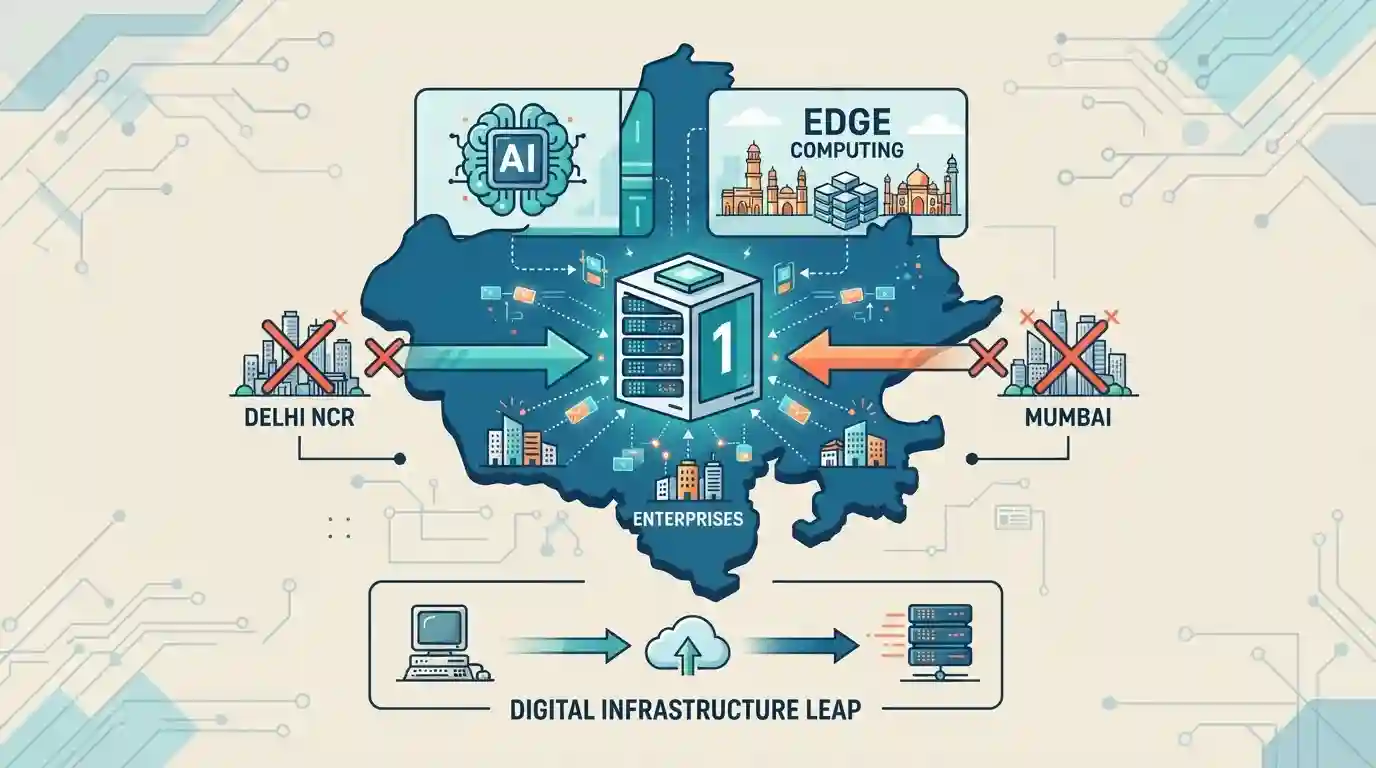
ST Telemedia Global Data Centres (India) has inaugurated STT Jaipur 1, making it Rajasthan's first high-performance data centre. Designed to handle intensive computing demands such as Artificial Intelligence (AI) and edge computing, the facility represents a major leap in the state's digital infrastructure. By providing local, high-speed data processing capabilities, the data centre aims to serve enterprises across the state, minimizing data latency and reducing dependency on major hubs like Delhi NCR and Mumbai. This milestone is expected to catalyze Rajasthan's IT ecosystem and digital economy.
Key Points
- ST Telemedia Global Data Centres (India) has launched STT Jaipur 1, which is the first high-performance data centre in Rajasthan.
- The state-of-the-art facility is engineered to support advanced workloads including Artificial Intelligence (AI), high-performance computing, and edge computing.
- The establishment of the data centre will significantly reduce latency for local businesses, decreasing their reliance on traditional digital hubs like Mumbai and Delhi NCR.
- The launch underscores Rajasthan's growing prominence in India's digital economy, boosting data localization and attracting further technology investments to the state.
Important Terms
ST Telemedia Global Data Centres (India)

An IT infrastructure provider operating a nationwide network of co-location data centres. It recently launched STT Jaipur 1, Rajasthan's first high-performance facility designed for compute-intensive demands.
UPSC context
GS Paper 3 (Infrastructure). Highlights private sector investment in expanding tier-2 regional digital ecosystems and computing capacity.
STT GDC India
The operational acronym for ST Telemedia Global Data Centres (India). It currently operates 34 data centres across 10 Indian cities, enabling enterprise digitalization and AI readiness.
UPSC context
GS Paper 3 (IT & Computers). Demonstrates the rapid growth of enterprise-grade cloud computing and AI-ready hardware networks in India.
Edge computing
A distributed computing model where data is processed locally near its generation source—like IoT devices or sensors—rather than being transmitted to a centralized cloud.
UPSC context
GS Paper 3 (Science & Tech). Essential for reducing data latency, saving bandwidth, and powering real-time applications like autonomous vehicles.
Data latency
The time delay involved in processing and transmitting data across a network. Minimizing latency is crucial for high-performance computing, artificial intelligence, and edge networks.
UPSC context
GS Paper 3 (Science & Tech). Tests understanding of digital communication hurdles and why localized data centres are critical for emerging technologies.
Prelims Trap
All data centres in India automatically enjoy infrastructure status regardless of their power capacity.
The draft National Data Centre Policy stipulates a minimum IT capacity threshold of 5 MW to qualify for infrastructure status.
Static Concepts Connected
What is Edge Computing and how does it differ from Cloud Computing?
- Data Proximity: Processes data locally at the network edge near the source (devices/sensors) instead of transmitting it to distant centralized servers.
- Latency Reduction: Minimizes network latency and bandwidth consumption, facilitating real-time decision-making for critical AI and IoT applications.
- Distributed Architecture: Creates a decentralized mesh of micro-data centres, contrasting with the highly centralized physical architecture of traditional cloud computing.
What benefits does 'Infrastructure Status' offer to emerging sectors in India?
- Cheaper Financing: Allows companies to secure long-term institutional loans, external commercial borrowings (ECBs), and access pension/insurance funds at lower interest rates.
- Longer Tenures: Facilitates longer loan repayment periods matching the long gestation cycles of major infrastructure and utility assets.
- Priority Clearances: Ensures streamlined regulatory, land, and environmental approvals through state and central fast-track single-window systems.
Cross-Topic Patterns
Edge computing + DPDP Act compliance
Decentralizing data storage via Tier-2 data centres helps local businesses comply with India's strict local processing and security mandates under the DPDP Act.
Infrastructure status + investment federalism
State-level promotional schemes align with central 'infrastructure status' guidelines to attract long-term institutional capital and streamline Ease of Doing Business.

Expect a 2026 prelims question pairing the 5MW threshold for infrastructure status with core concepts of edge computing.
Linked PYQs · 4
Linked PYQs · 4
- 2025RPSC_PRELIMSGS1
Identify the correct statements with respect to Artificial Intelligence (AI) with the help of the codes given below: A. Machine learning is a subset of AI. B. In supervised learning, computer systems are trained without marked input data. C. Machines learn through trial and error, and are rewarded during reinforcement learning. Code:
- 2025RPSC_PRELIMSGS1
The Indian Competition Commission has appointed which institute in 2024 to conduct a market study on Artificial Intelligence and Competition?
- 2025RPSC_PRELIMSGS1
Which of the following statements regarding the Raj Nivesh Portal of Rajasthan is incorrect?
- 2025RPSC_PRELIMSGS1
What has been formed in place of the Chief Minister Rajasthan Economic Reforms Advisory Council (CMRETAC)?
