Election Commission Special Summary Revision for Voter Rolls
Source:Indian Express ↗
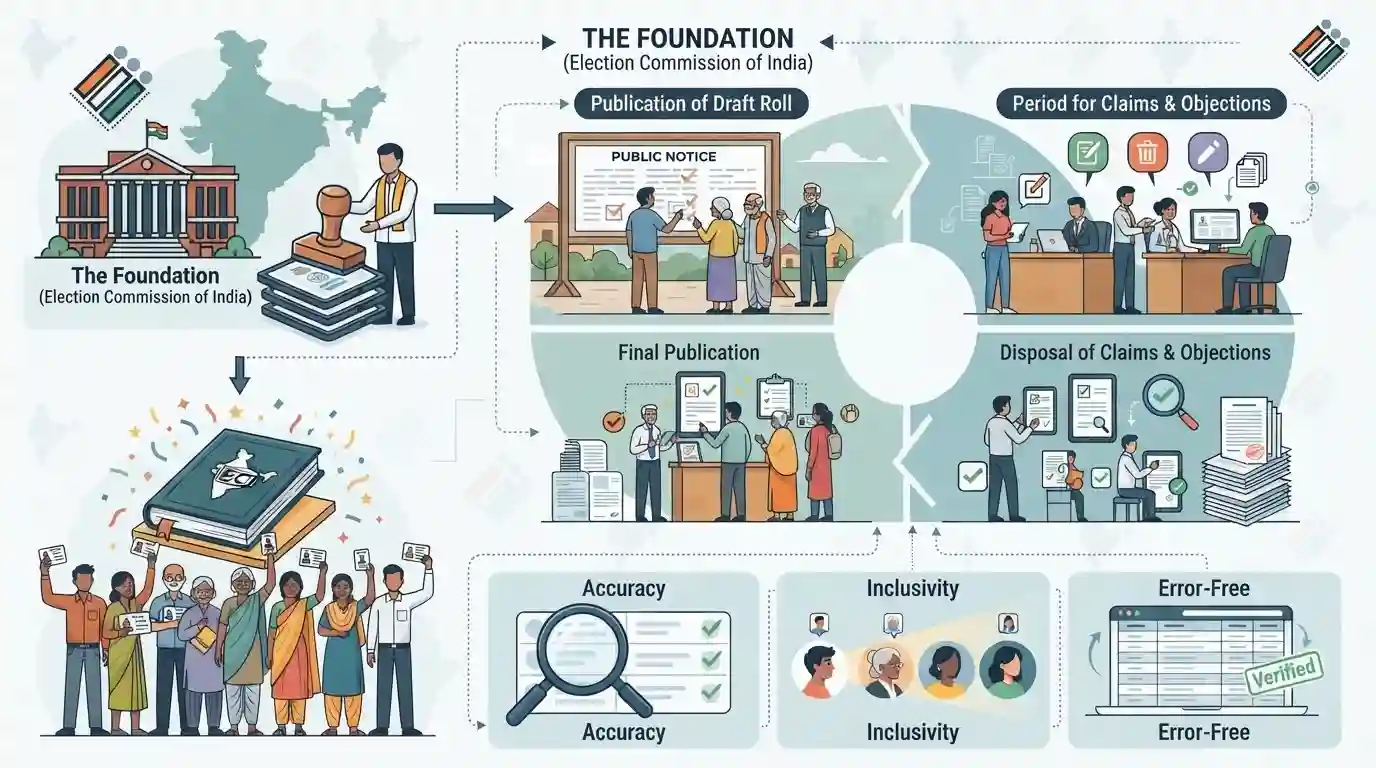
Why It Matters
Understanding the mechanics of electoral roll updates like the Special Summary Revision (SSR) is essential for grasping the administrative framework of Indian elections and ongoing electoral reforms.
Summary
An overview of the Special Summary Revision (SSR) process conducted by the Election Commission of India to update electoral rolls, ensuring accurate, inclusive, and error-free voter lists.
Key Points
- The Special Summary Revision (SSR) is an annual process carried out by the Election Commission of India (ECI) to update electoral rolls.
- It involves adding new eligible voters (especially those turning 18), removing names of deceased or shifted voters, and correcting demographic details.
- The process is crucial for maintaining the integrity, accuracy, and comprehensiveness of electoral rolls ahead of upcoming elections.
- It is anchored in statutory provisions under the Representation of the People Act, 1950 and Registration of Electors Rules, 1960.
Important Terms
Representation of the People Act, 1950

An Act of Parliament that provides for the allocation of seats, delimitation of constituencies, and the preparation and revision of electoral rolls for elections to the Houses of Parliament and state legislatures.
UPSC context
GS Paper II (Polity & Governance). Tests understanding of electoral laws, preparation of electoral rolls, and administrative framework of Indian elections.
Representation of the People Act, 1951
Comprehensive legislation governing the actual conduct of elections in India, detailing administrative machinery, qualifications and disqualifications for membership, corrupt practices, and election disputes.
UPSC context
GS Paper II (Polity & Governance). Crucial for questions on electoral reforms, candidate eligibility, and the legal framework governing election processes.
Election Commission of India
An autonomous constitutional authority established under Article 324 of the Constitution to administer elections to the Lok Sabha, Rajya Sabha, State Legislative Assemblies, and offices of President and Vice-President.
UPSC context
GS Paper II (Polity & Governance). Evaluates constitutional bodies, independence, powers, and role in ensuring free and fair elections.
Static Concepts Connected
What is the statutory framework governing electoral rolls and registration in India?
- Statutory Basis: Section 21 of RPA 1950 provides for annual revision of electoral rolls by the Election Commission of India.
- Rules Framework: Registration of Electors Rules 1960 governs the detailed procedure including claims, objections, and forms like Form 6 and Form 8.
- Qualifying Dates: Four qualifying dates (Jan 1, Apr 1, Jul 1, Oct 1) allow youth turning 18 to register progressively.
Cross-Topic Patterns
Electoral Rolls + Administrative Decentralization
The 2021 RP Act amendment introduced four qualifying dates, linking electoral roll updates with administrative decentralization and youth demography.

Expect statements on single vs. multiple qualifying dates for voter registration under the RPA 1950 in Prelims.
Linked PYQs · 3
Linked PYQs · 3
- 2022MainsGS2
Discuss the role of the Election Commission of India in the light of the evolution of the Model Code of Conduct.
- 2020PrelimsGS1
Consider the following statements: 1. According to the Constitution of India, a person who is eligible to vote can be made a minister in a State for six months even if he/she is not a member of the Legislature of that State. 2. According to the Representation of People Act, 1951, a person convicted of a criminal offence and sentenced to imprisonment for five years is permanently disqualified from contesting an election even after his release from prison. Which of the statements given above is/are correct?
- 2024MainsGS2
Examine the need for electoral reforms as suggested by various committees with particular reference to "one nation one election" principle.
