Sample Registration System Findings on India Demographic Trends
Source:The Hindu ↗
Why It Matters
Demography and population dynamics are core to UPSC GS1 and GS3. The transition to sub-replacement fertility and the emerging issue of an aging population are paradigm shifts that impact future economic growth, federalism (e.g., delimitation debates), and social security planning.
Summary
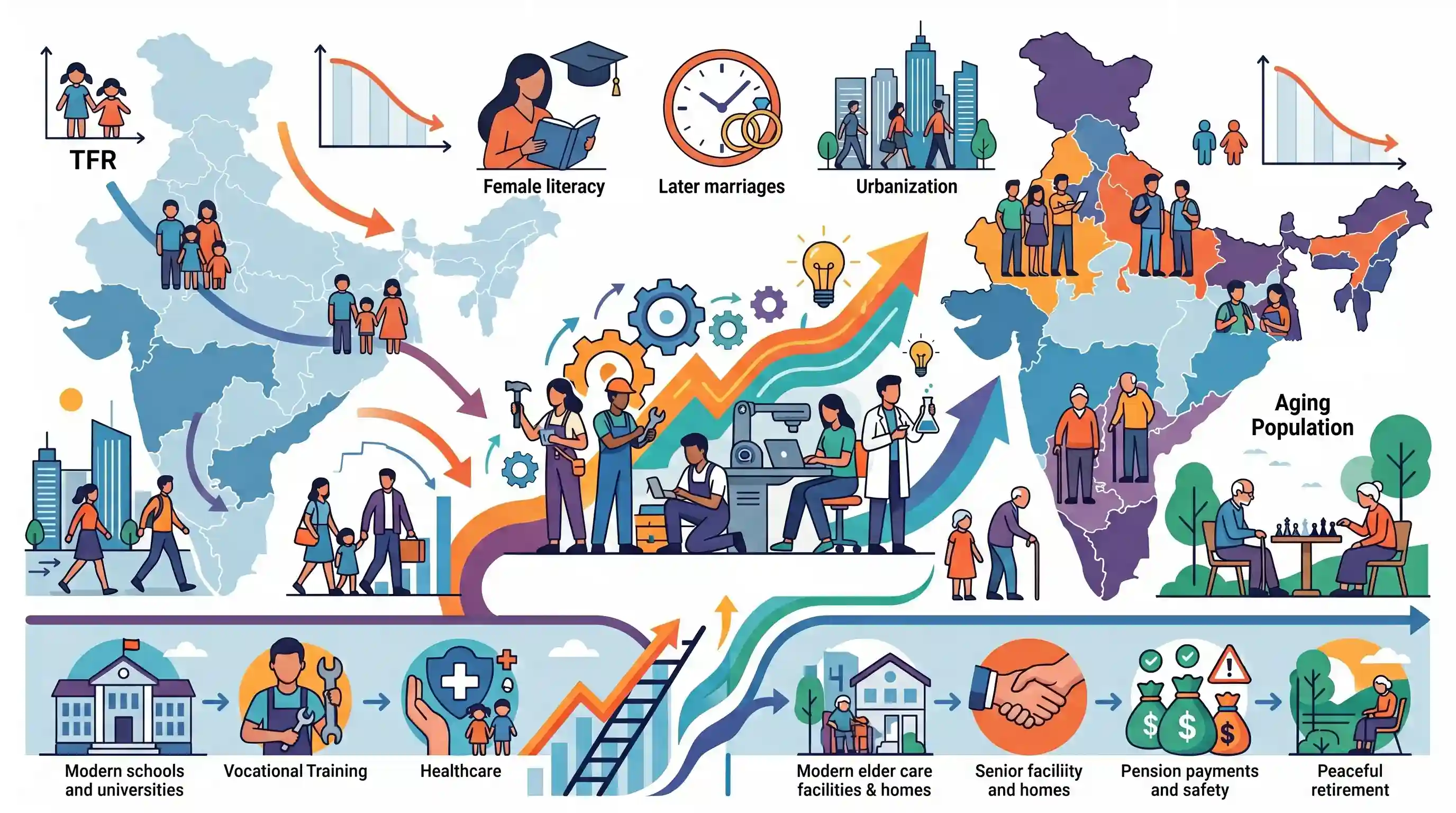
The latest Sample Registration System (SRS) Statistical Report highlights that India is squarely in the throes of a demographic transition. The Total Fertility Rate (TFR) is declining across the country, dropping below the replacement level (2.1) in several states. This shift is primarily driven by socio-economic improvements, including higher female literacy, later marriages, and urbanization. While this allows India to reap a 'demographic dividend' with a massive working-age population, it also presents a stark regional divergence. Southern states are moving towards an aging population, whereas northern states retain a youth bulge. This changing demographic profile requires a bifurcated policy approach: investing aggressively in health, education, and skilling to harness the demographic dividend in the north, while developing robust elder care and social security infrastructure for the aging population in the south.
Key Points
- The latest Sample Registration System (SRS) report indicates India is in a rapid demographic transition, characterized by declining fertility and mortality rates.
- India's Total Fertility Rate (TFR) has fallen to or below the replacement level of 2.1 in multiple states, driven by rising female literacy, urbanization, and better family planning.
- There is a strong demographic divergence: southern states face an aging population, while northern states continue to see a growing working-age youth population.
- Policy recalibration is required to manage both the youth bulge (requiring job creation and skilling) and the growing elderly population (requiring social security and healthcare).
Important Terms
Total Fertility Rate (TFR)

The average number of children born to a woman during her reproductive years (15-49); India's national TFR has recently dropped to approximately 1.9-2.0.
UPSC context
GS Paper I (Society) & GS II (Social Justice). Tests knowledge of population stabilization and effectiveness of family welfare programs.
Replacement Level Fertility
The specific TFR (typically 2.1) at which a population exactly replaces itself from one generation to the next without migration.
UPSC context
GS Paper I (Geography/Population). Crucial for discussing population policy, stabilization trends, and future demographic projections.
Demographic Dividend
The economic growth potential resulting from a shift in age structure where the working-age population (15-64) share is larger than the dependent population.
UPSC context
GS Paper III (Economy). Tests ability to analyze human capital as a driver of GDP and the 'window of opportunity.'
Sample Registration System (SRS)
A large-scale demographic survey by the Registrar General of India providing reliable annual estimates of birth rates, death rates, and other fertility/mortality indicators.
UPSC context
GS Paper I & II. Essential for understanding the primary data source for national health targets and social sector planning.
Registrar General of India (RGI)
The statutory authority under the Ministry of Home Affairs responsible for conducting the decennial Census and overseeing the registration of births and deaths.
UPSC context
GS Paper II (Governance/Polity). Relates to administrative machinery, the Census Act 1948, and data-driven governance.
Demographic Transition
The historical shift from high birth and death rates to low levels as a country develops economically and socially.
UPSC context
GS Paper I (Population/Geography). Tests theoretical models of population change and India's current stage of development.
Prelims Trap
India's population will begin to decline immediately since the national TFR has fallen below the 2.1 replacement level.
Due to 'population momentum', a large base of young people are still entering reproductive age. India's absolute population will continue growing for decades before peaking.
Static Concepts Connected
What are the core stages of the Demographic Transition Theory?
- Stage 1 (Pre-industrial): High birth and high death rates cancel each other out, leading to a stable but low overall population.
- Stage 2 (Developing): High birth rates persist, but improved healthcare causes rapidly declining mortality, leading to a population explosion.
- Stage 3 & 4: Birth rates decline significantly to approach low death rates, slowing growth and eventually stabilizing the population (India's current trajectory).
What is the Sample Registration System (SRS) mechanism in India?
- Nodal Agency: Operated by the Office of the Registrar General of India (RGI) under the Ministry of Home Affairs.
- Methodology: Employs a dual-record system combining continuous demographic enumeration by resident part-time enumerators with retrospective half-yearly surveys.
- Core Utility: Serves as the most reliable annual source for national and state-level vital statistics like IMR, MMR, and TFR outside the decadal Census.
Cross-Topic Patterns
Demographic divergence + Delimitation freeze
Southern states face potential political marginalization in the upcoming post-2026 delimitation exercise due to their successful early achievement of sub-replacement fertility.
TFR decline + Finance Commission devolution
The mandate for Finance Commissions to use the 2011 Census penalizes states that successfully controlled population growth, heavily intertwining demographic indicators with fiscal federalism debates.

Expect a 2026 Prelims question on 'population momentum' despite TFR < 2.1, or a GS1 Mains question on the South-North policy dichotomy.
Linked PYQs · 4
Linked PYQs · 4
- 2024MainsGS1
What is the concept of a 'demographic winter'? Is the world moving towards such a situation? Elaborate.
- 2024PrelimsGS1
The total fertility rate in an economy is defined as:
- 2012PrelimsGS1
Consider the following specific stages of demographic transition associated with economic development: 1. Low birthrate with low death rate 2. High birthrate with high death rate 3. High birthrate with low death rate Select the correct order of the above stages using the codes given below:
- 2011PrelimsGS1
India is regarded as a country with “Demographic Dividend”. This is due to
