South and Southeast Asia monsoon floods and disaster response
Source:The Hindu ↗
Why It Matters
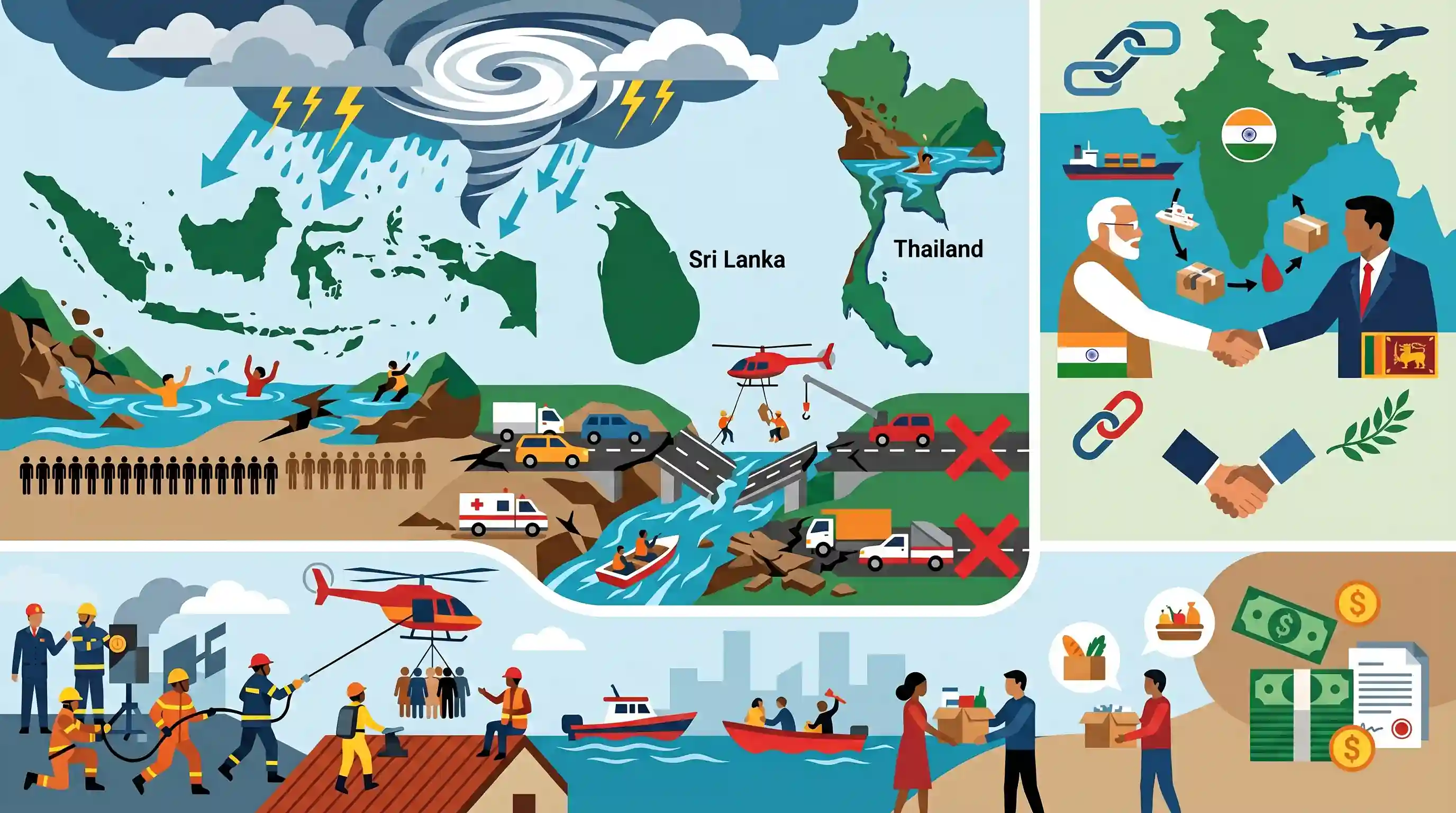
The staggering death toll and infrastructure collapse underscore the extreme vulnerability of South and Southeast Asian nations to climate-induced disasters. It highlights the urgent need for climate-resilient infrastructure, proactive disaster preparedness, and regional cooperation (like India's neighborhood assistance) during mega-disasters.
Summary
Catastrophic flooding and landslides triggered by heavy monsoon rains and Cyclone Ditwah have resulted in over 1,200 deaths across Indonesia, Sri Lanka, and Thailand. With hundreds still missing, rescue operations are being severely hindered by widespread infrastructure damage, including collapsed bridges and washed-out roads. In response to the crisis, Indian Prime Minister Narendra Modi offered cyclone relief support to Sri Lanka, highlighting regional disaster diplomacy. Meanwhile, affected nations are mobilizing emergency services and rolling out compensation packages to aid victims.
Key Points
- Over 1,200 people have died and more than 800 are missing across Indonesia, Sri Lanka, and Thailand due to catastrophic floods and landslides.
- The disaster was triggered by heavy monsoon rains and Cyclone Ditwah.
- Rescue and relief operations are severely hampered by collapsed bridges and washed-out roads.
- Indian PM Narendra Modi has reached out to the Sri Lankan President to offer continued support for cyclone relief.
- Thailand has initiated cleanup efforts and announced a $7.4 million compensation package for affected residents.
Important Terms
Disaster Management Centre (Sri Lanka)

Sri Lanka's apex agency for disaster risk management, established under the Disaster Management Act No. 13 of 2005 to coordinate preparedness, early warnings, and emergency response.
UPSC context
Relevant for GS Paper 3 (Disaster Management) and GS Paper 2 (India's 'Neighborhood First' policy and regional disaster cooperation).
National Disaster Management Agency (Indonesia)
(Badan Nasional Penanggulangan Bencana) Indonesia's central authority for disaster mitigation and response, established in 2008. It coordinates efforts across the archipelago and reports directly to the President.
UPSC context
GS Paper 3: Disaster Management. Tests knowledge of international institutional frameworks and regional vulnerability to hydro-meteorological hazards.
Disaster Diplomacy
The use of disaster-related activities and humanitarian aid to foster cooperation between nations. It is a key tool in India's soft power and strategic regional engagement.
UPSC context
GS Paper 2: International Relations. Examines how humanitarian assistance (HADR) influences bilateral ties and geopolitical leadership in the Indo-Pacific.
Cyclone Ditwah
A catastrophic tropical cyclone that struck Sri Lanka and Southern India in late 2025, causing record-breaking rainfall, landslides, and the nation's highest death toll since the 2004 tsunami.
UPSC context
GS Paper 1: Geography (Cyclones) and GS Paper 3: Disaster Management. Represents climate-change-induced extreme weather phenomena in the North Indian Ocean.
Department of Disaster Prevention and Mitigation (Thailand)
(DDPM) The primary agency under Thailand’s Ministry of Interior responsible for disaster response, emergency services, and victim compensation during national crises like catastrophic flooding.
UPSC context
GS Paper 3: Disaster Management. Relevant for comparative studies of governance and institutional responses to disasters in Southeast Asia.
Infrastructure Resilience
The capacity of critical physical systems (e.g., roads, bridges, power) to withstand, adapt to, and rapidly recover from natural disasters without catastrophic failure.
UPSC context
GS Paper 3: Infrastructure and Disaster Management. Vital for understanding how 'built environments' impact the effectiveness of rescue and relief operations.
Humanitarian Assistance and Disaster Relief (HADR)
The multi-agency provision of life-saving aid and services during disasters. India’s HADR operations are a central pillar of its 'SAGAR' and 'Neighborhood First' visions.
UPSC context
GS Paper 2 (IR) and GS Paper 3 (DM). Tests the strategic importance of rapid-response capabilities in regional security and cooperation.
Prelims Trap
The IMD provides names for all tropical cyclones occurring across the entire Indian Ocean Region.
IMD only names cyclones in the North Indian Ocean. Basins south of the equator (affecting parts of Indonesia) fall under different regional centers.
Static Concepts Connected
How are tropical cyclones in the North Indian Ocean named?
- RSMC Mandate: IMD New Delhi acts as the RSMC, issuing advisories and names for cyclones in the Bay of Bengal and Arabian Sea.
- Member Contributions: 13 WMO/ESCAP member countries contribute 13 names each, forming a rotating, sequential list of 169 names.
- Naming Criteria: Names must be politically neutral, non-offensive, and short (maximum 8 letters) to ensure swift communication.
What is the Coalition for Disaster Resilient Infrastructure (CDRI)?
- Global Partnership: An India-led global partnership of national governments, UN agencies, and private sectors launched at the 2019 UN Climate Action Summit.
- Core Mandate: It aims to promote the resilience of new and existing infrastructure systems to climate and disaster risks.
- Sendai Alignment: It directly supports Target D of the Sendai Framework, which focuses on reducing disaster damage to critical infrastructure.
Cross-Topic Patterns
Compound Extreme Events
The concurrent strike of a cyclone and heavy monsoon rains reflects the rising frequency of "compound extremes", complicating traditional multi-hazard zonation mapping in GS-1 Geography.
Disaster Diplomacy and SAGAR doctrine
India's swift aid to Sri Lanka highlights Humanitarian Assistance and Disaster Relief (HADR) as a core tool to project its 'Net Security Provider' status under the SAGAR vision.

Expect a 2026 GS-3 Mains question linking "compound climate extremes" to the mandate of the Coalition for Disaster Resilient Infrastructure.
Linked PYQs · 5
Linked PYQs · 5
- 2021MainsGS3
Describe the various causes and the effects of landslides. Mention the important components of the National Landslide Risk Management Strategy.
- 2019MainsGS3
Disaster preparedness is the first step in any disaster management process. Explain how hazard zonation mapping will help disaster mitigation in the case of landslides.
- 2024MainsGS3
What is disaster resilience? How is it determined? Describe various elements of a resilience framework. Also mention the global targets of Sendai Framework for Disaster Risk Reduction (2015–2030).
- 2020MainsGS3
Discuss the recent measures initiated in disaster management by the Government of India departing from the earlier reactive approach.
- 2017MainsGS1
What characteristics can be assigned to monsoon climate that succeeds in feeding more than 50 percent of the world population residing in Monsoon Asia?
