India Denies Coast Guard Assault on Sri Lankan Fisherfolk
Source:Indian Express ↗
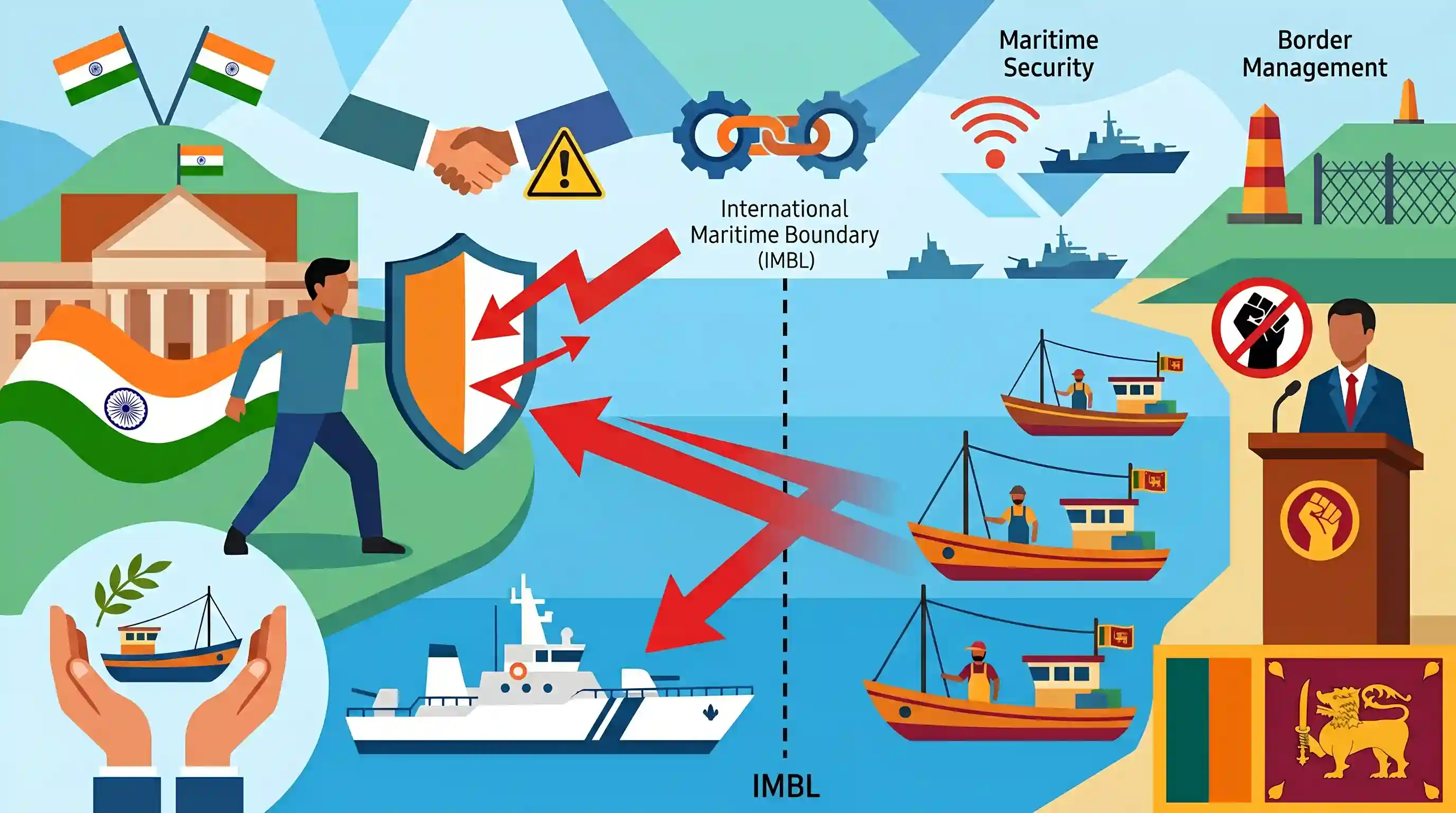
Why It Matters
The recurrent fishermen dispute between India and Sri Lanka is a significant bilateral friction point that involves livelihoods, territorial sovereignty, and maritime security. It tests diplomatic relations and highlights challenges in enforcing the International Maritime Boundary Line (IMBL) while maintaining a humanitarian approach.
Summary
The Indian High Commission has strongly rejected allegations that the Indian Coast Guard assaulted Sri Lankan fisherfolk, describing the claims as completely baseless. The incident reportedly took place on January 29, involving three Sri Lankan trawlers and over a dozen fishermen. Sri Lankan Fisheries Minister Ramalingam Chandrasekeran announced plans to lodge a formal protest. Meanwhile, India reiterated its longstanding position that matters concerning fishermen should be handled using a humanitarian approach. The event highlights the ongoing friction over the International Maritime Boundary Line (IMBL) between the two nations.
Key Points
- The Indian High Commission dismissed allegations that the Indian Coast Guard attacked Sri Lankan fisherfolk, calling them completely baseless.
- Sri Lanka claimed that three trawlers were attacked on January 29, injuring several fishermen who had to be brought ashore by the Sri Lankan Navy.
- India reiterated its consistent stance that fishermen-related issues should be resolved through a humanitarian approach.
- Sri Lankan Fisheries Minister Ramalingam Chandrasekeran indicated that Colombo would lodge a formal protest regarding the incident.
- The incident underscores the persistent and sensitive nature of the fishermen dispute and maritime boundary policing between India and Sri Lanka.
Important Terms
International Maritime Boundary Line (IMBL)

A maritime boundary established by 1974 and 1976 agreements between India and Sri Lanka to delineate territorial waters and exclusive economic zones in the Palk Strait and Gulf of Mannar.
UPSC context
GS Paper 2 (India and its Neighbourhood); tests maritime delimitation and sovereignty issues like the Katchatheevu island dispute.
Indian Coast Guard (ICG)
A statutory maritime law enforcement and search-and-rescue agency under the Ministry of Defence, responsible for coastal security, surveillance, and protecting India's maritime interests in territorial waters and the EEZ.
UPSC context
GS Paper 3 (Internal Security); tests roles of specialized forces in India's multi-tier maritime security architecture.
Indian High Commission
The official diplomatic mission of India in a Commonwealth country (like Sri Lanka), responsible for representing Indian interests, managing bilateral relations, and providing consular assistance to citizens.
UPSC context
GS Paper 2 (International Relations); focuses on diplomatic mechanisms for bilateral engagement and protecting the diaspora/fisherfolk abroad.
Sri Lankan Navy
The maritime wing of the Sri Lankan Armed Forces, tasked with defending maritime borders and enforcing laws, frequently involved in detaining foreign vessels for poaching in territorial waters.
UPSC context
GS Paper 2 (Bilateral Relations); relevant for security interactions and the humanitarian handling of the Palk Bay fisheries dispute.
Prelims Trap
The 1974 agreement guarantees traditional fishing rights for Indian fishermen around Katchatheevu island.
While the 1974 pact ceded Katchatheevu and allowed Indians to rest/dry nets, the subsequent 1976 agreement explicitly revoked traditional Indian fishing rights in Sri Lanka's Exclusive Economic Zone.
Static Concepts Connected
How is India's three-tier coastal security grid structured?
- Marine Police: Secures shallow coastal waters up to 12 nautical miles from the baseline.
- Coast Guard: Patrols the Territorial Waters and Exclusive Economic Zone (EEZ) up to 200 nautical miles, enforcing maritime law.
- Indian Navy: Responsible for overall maritime defense, protecting the IMBL, and patrolling broader oceanic limits.
What is bottom trawling and why does it cause bilateral friction?
- Destructive method: Involves dragging weighted nets across the seafloor to catch benthic species, which severely damages coral reefs and marine ecology.
- Bilateral friction: Sri Lanka banned the practice in 2017 to protect its marine environment, leading to strict enforcement against mechanized Indian trawlers crossing the IMBL.
Cross-Topic Patterns
Ecological laws as sovereignty tools
Sri Lanka leverages environmental conservation (banning bottom trawling) as a legal tool to enforce its territorial sovereignty and deter mechanized Indian trawlers, blending ecology with border management.
Federal friction in foreign policy
The IMBL dispute routinely triggers state-centre tensions, with Tamil Nadu's legislative resolutions demanding the retrieval of Katchatheevu clashing with New Delhi's sovereign treaty obligations.

A 2026 Prelims question will likely test UNCLOS maritime zone definitions against the statutory mandate of the Indian Coast Guard.
Linked PYQs · 4
Linked PYQs · 4
- 2022MainsGS2
India is an age-old friend of Sri Lanka.’ Discuss India's role in the recent crisis in Sri Lanka in the light of the preceding statement.
- 2025MainsGS3
Why is maritime security vital to protect India's sea trade? Discuss maritime and coastal security challenges and the way forward.
- 2022MainsGS3
What are the maritime security challenges in India ? Discuss the organisational, technical and procedural initiatives taken to improve the maritime security.
- 2022PrelimsGS1
With reference to the United Nations Convention on the Law of Sea, consider the following statements : 1. A coastal state has the right to establish the breadth of its territorial sea up to a limit not exceeding 12 nautical miles, measured from baseline determined in accordance with the convention. 2. Ships of all states, whether coastal or land-locked, enjoy the right of innocent passage through the territorial sea. 3. The Exclusive Economic Zone shall not extend beyond 200 nautical miles from the baseline from which the breadth of the territorial sea is measured. Which of the statements given above are correct?
