Rooftop Solar Grid Stability Lessons for India from Sri Lanka Blackout
Source:Indian Express ↗
Why It Matters
As India rapidly expands its distributed renewable energy footprint, particularly through rooftop solar, understanding the grid stability risks and technical mitigation measures highlighted by neighbor crises is essential for energy security and infrastructure planning.
Summary
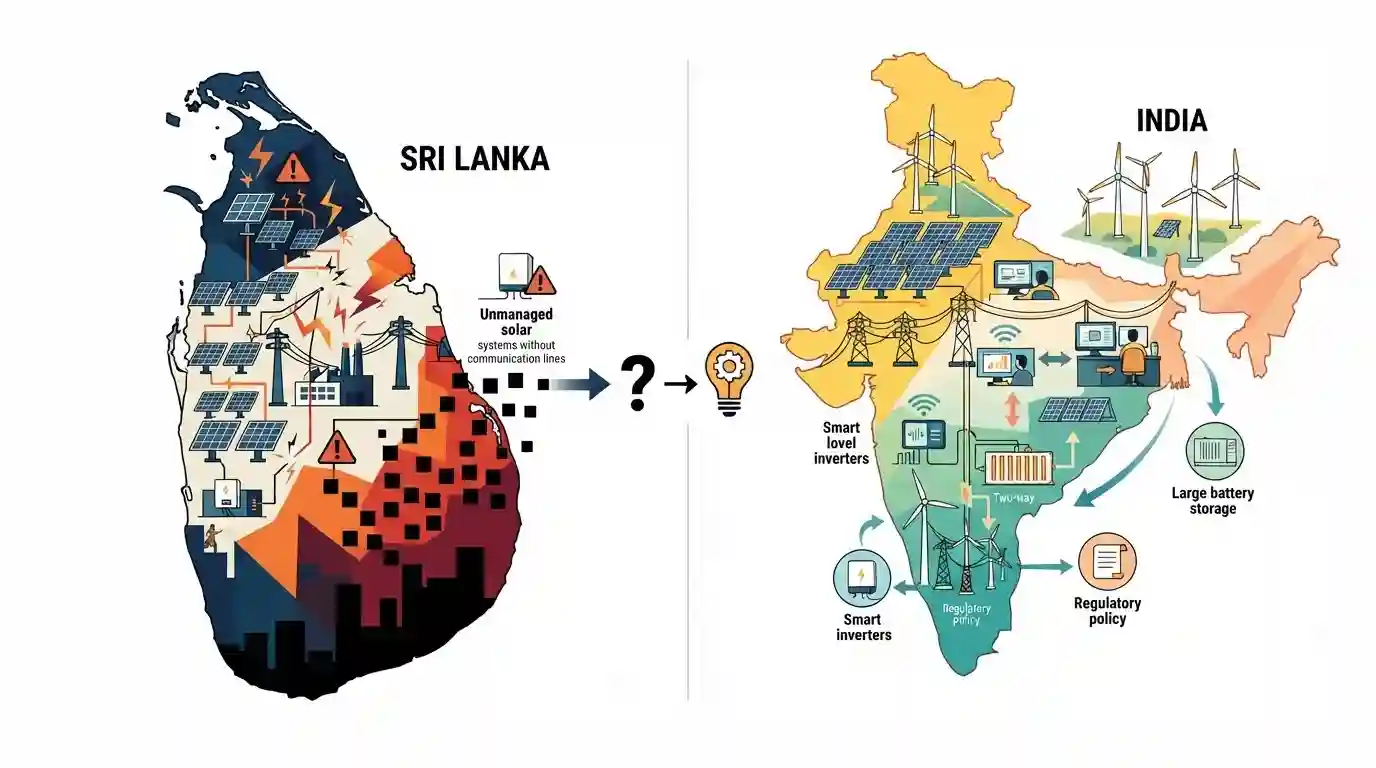
Sri Lanka's nationwide blackout highlights the vulnerability of national grids to high penetration of unmanaged rooftop solar systems. The incident underscores critical lessons for India's massive renewable energy expansion, emphasizing the need for robust grid codes, advanced smart inverters, and storage systems to prevent cascading failures.
Key Points
- Sri Lanka experienced a nationwide blackout triggered by grid instability issues linked to a sudden tripping of rooftop solar systems during a minor fault.
- Rooftop solar systems lack advanced grid-supportive features such as ride-through capabilities, causing them to disconnect automatically during voltage fluctuations and dumping excess power into the grid.
- As India scales up its rooftop solar capacity under schemes like PM-Surya Ghar, managing grid stability, frequency fluctuations, and intermittency becomes critical.
- Lessons for India include mandating smart inverters, strict grid-code compliance, battery energy storage systems (BESS), and enhanced spinning reserves to handle high penetration of distributed renewables.
Important Terms
Ceylon Electricity Board

The state-owned electricity utility in Sri Lanka responsible for generation, transmission, and distribution, which faced severe criticism and operational challenges following nationwide grid blackouts linked to high rooftop solar penetration.
UPSC context
UPSC GS Paper III (Infrastructure: Energy): Important for case studies on South Asian energy security, utility reforms, and grid management challenges.
Static Concepts Connected
What are the key technical parameters and grid-supportive functions required for high renewable energy integration in India's power grid?
- Smart Inverters: Advanced inverters equipped with Volt-Var, Volt-Watt, and frequency-watt controls to dynamically manage local voltage and frequency fluctuations.
- Fault Ride-Through: Ability of generators or solar inverters to stay connected to the grid during short-duration voltage drops or faults instead of tripping immediately.
- Energy Storage: Decentralized storage solutions like BESS that absorb excess daytime solar generation and supply power during evening peak demand hours.
- Grid Codes: Mandatory compliance with updated Central Electricity Authority (CEA) technical standards for grid connectivity of distributed energy resources.
Cross-Topic Patterns
Distributed Renewables + DISCOM Financial Sustainability
Rapid rooftop solar scaling under PM-Surya Ghar tests DISCOM financial health and technical grid resilience simultaneously.
Grid Security + Critical Information Infrastructure Protection
Grid modernization for high renewable penetration links energy infrastructure directly to national security and cyber vulnerabilities.

Rooftop solar grid integration risks (smart inverters, BESS, fault ride-through) will likely be tested via a conceptual matching MCQs.
Linked PYQs · 2
Linked PYQs · 2
- 2022MainsGS3
Do you think India will meet 50 percent of its energy needs from renewable energy by 2030 ? Justify your answer. How will the shift of subsidies from fossil fuels to renewables help achieve the above objective ? Explain.
- 2020MainsGS3
Describe the benefits of deriving electric energy from sunlight in contrast to the conventional energy generation. What are the initiatives offered by our Government for this purpose?
