Sree Narayana Guru Teachings and Socio-Religious Reform in Kerala
Source:The Hindu ↗
Why It Matters
Sree Narayana Guru is a seminal figure in India's socio-religious reform movements, actively working to dismantle the caste system in Kerala. His teachings are directly relevant to GS1 (Modern History and Indian Society) and provide excellent fodder for GS4 (Ethics) and Essay papers on themes of universal brotherhood, empathy, and fighting social discrimination.
Summary
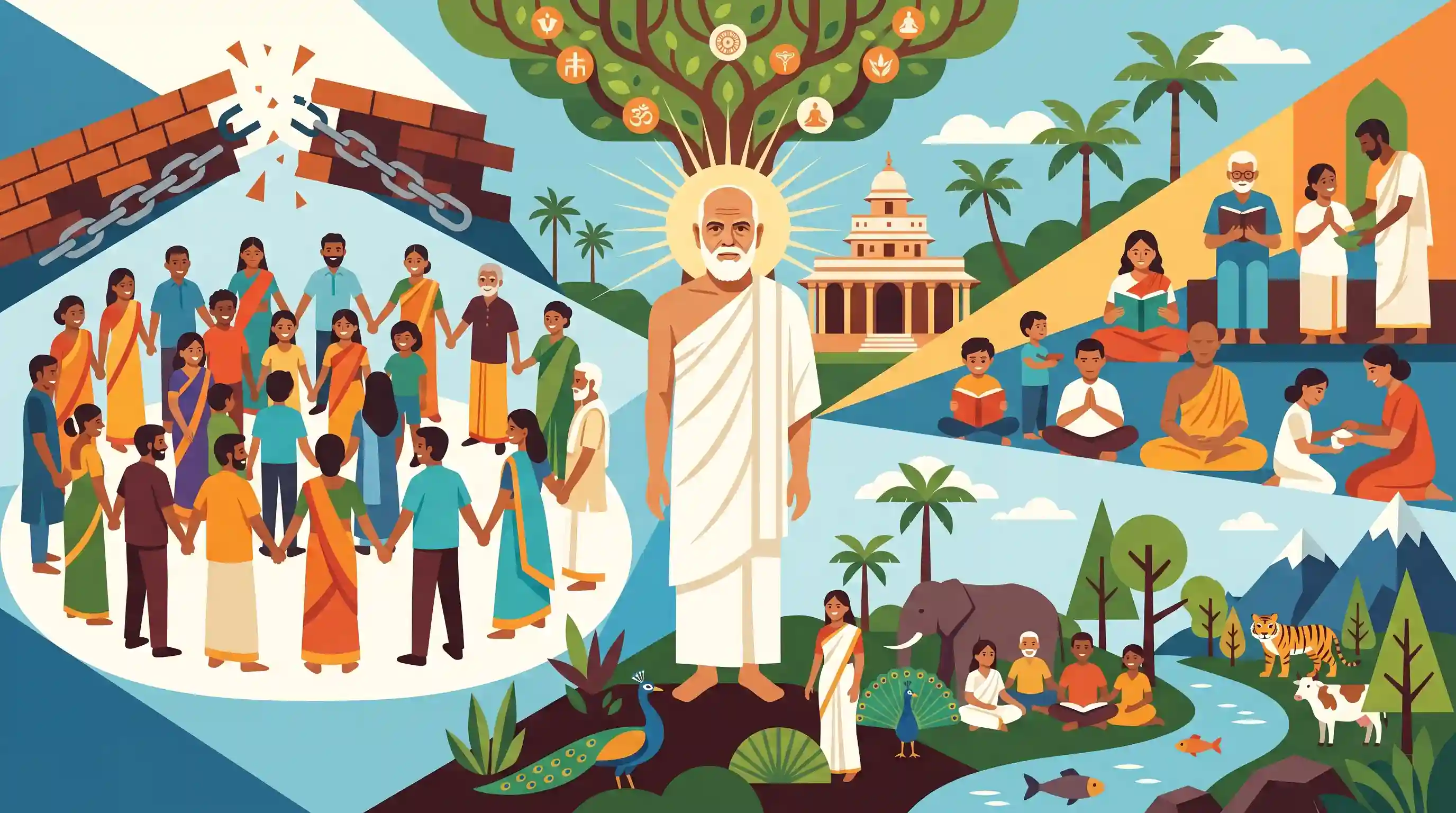
Speaking at the Sree Narayana Guru Jayanthi celebrations at the Sivagiri Madhom in Thiruvananthapuram, Kerala Governor Rajendra Vishwanath Arlekar emphasized that Sree Narayana Guru's teachings on unity, equality, and compassion continue to transcend generations. The spiritual leader and social reformer advocated a vision of universal brotherhood, famously encapsulated as 'One caste, one religion, one mankind, one world'. He actively fought against superstition, social inequalities, and caste discrimination. Furthermore, the Guru viewed Dharma as a practical way of life based on deep empathy and a 'live and let live' philosophy that extended beyond humanity to encompass all living creatures and nature.
Key Points
- Sree Narayana Guru advocated for universal brotherhood with his foundational philosophy of 'One caste, one religion, one mankind, one world'.
- He viewed Dharma not merely as a set of religious rituals, but as a practical way of life rooted in compassion for all living beings, including nature.
- His socio-religious reform initiatives specifically targeted entrenched inequalities, superstitions, and caste-based discrimination in Kerala.
- The Kerala Governor stressed the relevance of the Guru's 'live and let live' philosophy for resolving contemporary social prejudices and fostering inclusive coexistence.
Important Terms
Sree Narayana Guru

A 20th-century social reformer and spiritual leader from Kerala who led the 'Kerala Renaissance.' He championed equality, education, and the dismantling of the caste-based hierarchy.
UPSC context
GS Paper I: Modern Indian History & Social Reformers; GS Paper IV: Ethics (Moral Thinkers). Often tested in Prelims and Mains.
Sree Narayana Dharma Paripalana (SNDP) Yogam
Founded in 1903 by Sree Narayana Guru and Dr. Padmanabhan Palpu, this organization aimed to uplift marginalized communities, specifically the Ezhavas, through education and social reform.
UPSC context
GS Paper I: Socio-religious reform movements in the 19th/20th century. High relevance for questions on Kerala's social transformations.
Sivagiri Madhom
A spiritual and social reform center in Varkala, Kerala, established by Sree Narayana Guru in 1904. It serves as the headquarters of his followers and a major pilgrimage site.
UPSC context
GS Paper I: Indian Heritage & Culture; Prelims: Important spiritual sites and their historical founders.
Aruvippuram Movement
The 1888 consecration of a Shiva idol by Sree Narayana Guru at Aruvippuram, challenging the Brahminical monopoly on priesthood and asserting the right of all castes to worship.
UPSC context
GS Paper I: History of the caste system and temple entry movements. A landmark event in Indian social history.
Vaikom Satyagraha
A non-violent protest (1924–25) in the princely state of Travancore for the right of lower castes to use roads near the Vaikom Temple, supported by Sree Narayana Guru.
UPSC context
GS Paper I: National Movement & Temple Entry Movements. Essential for understanding Gandhi's and local reformers' roles.
One Caste, One Religion, One God
Sree Narayana Guru's famous Malayalam slogan ('Oru Jathi, Oru Matham, Oru Daivam Manushyanu') emphasizing the spiritual unity and fundamental equality of all human beings.
UPSC context
GS Paper IV: Ethics and Human Values. Used as a quote to argue for universal brotherhood and social justice.
Prelims Trap
"Sree Narayana Guru famously advocated the philosophy of 'No caste, no religion, no God for mankind'."
Aspirants often confuse Narayana Guru's original unifying slogan ("One Caste, One Religion, One God") with the radical atheistic amendment ("No Caste, No Religion, No God") by his disciple Sahodaran Ayyappan.
Static Concepts Connected
What were the key socio-religious contributions of Sree Narayana Guru?
- Aruvippuram Consecration: He installed a Shiva idol in 1888, directly challenging the Brahminical monopoly over temple consecration and priesthood.
- SNDP Yogam: Established in 1903 to drive the educational, spiritual, and socio-economic upliftment of the marginalized Ezhava community.
- Vaikom Satyagraha: Actively backed the 1924–1925 non-violent agitation demanding the right of lower castes to use public roads around the Vaikom temple.
How does Narayana Guru's philosophy reinterpret traditional 'Dharma'?
- Practical Ethics: He redefined Dharma away from rigid religious rituals towards a practical, daily way of life rooted in human empathy.
- Ecological Compassion: His 'live and let live' philosophy explicitly extended compassion beyond humanity to encompass all living creatures and the natural environment.
Cross-Topic Patterns
Subaltern Movements: Kerala vs. Tamil Nadu
Compare Narayana Guru's Aruvippuram movement with EVR Periyar's Self-Respect Movement. Both targeted Brahminical hegemony and temple monopolies, but Narayana Guru retained a deeply spiritual, inclusive framework rather than atheism.
GS4 Moral Thinkers & Ecological Ethics
His reinterpretation of 'Dharma' as universal empathy and ecological compassion provides a high-scoring GS4 example for essays on universal brotherhood versus ritualistic religion.

Expect a multi-statement Prelims question contrasting Narayana Guru's 'One Religion' with Sahodaran Ayyappan's 'No Religion' philosophies.
Linked PYQs · 3
Linked PYQs · 3
- 2021MainsGS1
Trace the rise and growth of socio-religious reform movements with special reference to Young Bengal and Brahmo Samaj.
- 2025PrelimsGS1
Who among the following was the founder of the 'Self-Respect Movement?
- 2022MainsGS4
Apart from intellectual competency and moral qualities, empathy and compassion are some of the other vital attributes that facilitate the civil servants to be more competent in tackling the crucial issues or taking critical decisions. Explain with suitable illustrations.
