Spurious liquor tragedy exposes enforcement gaps in Bhavnagar district
Source:rediff ↗
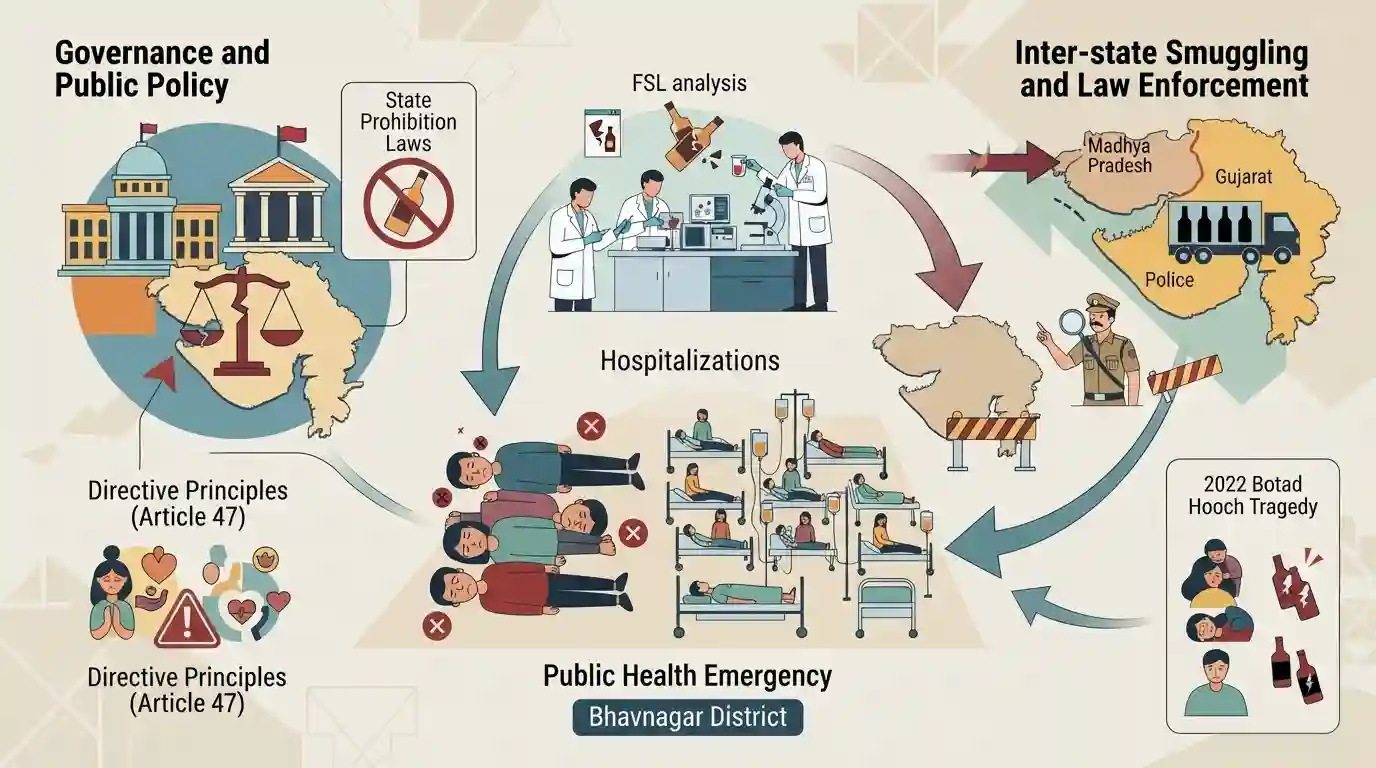
Why It Matters
This incident exposes severe vulnerabilities in the enforcement of Gujarat's dry state policy. It emphasizes the complex governance challenges associated with implementing Article 47 of the DPSP (which advocates the prohibition of intoxicating drinks). Furthermore, the inter-state smuggling angle highlights the need for robust coordination between state police forces to curb illicit trade and protect public health.
Summary
A suspected spurious liquor tragedy in Gujarat's Bhavnagar district has resulted in 4 deaths and 18 hospitalizations. The victims consumed counterfeit Indian Made Foreign Liquor (IMFL), which a preliminary investigation traced back to an illegal supply network originating in Madhya Pradesh. Forensic Science Laboratory (FSL) teams are conducting analyses to determine the exact toxic components involved. The incident raises serious questions regarding border security and the effective implementation of prohibition laws in Gujarat, echoing the devastating 2022 hooch tragedy in neighboring Botad.
Key Points
- At least four people died and 18 others were hospitalized in Gujarat's Bhavnagar district after consuming suspected spurious liquor.
- The victims, primarily agricultural laborers, consumed illicit duplicate Indian Made Foreign Liquor (IMFL) suspected to be adulterated with deadly chemicals.
- Police investigations revealed the spurious liquor was smuggled into Gujarat from a supplier based in Madhya Pradesh.
- Forensic Science Laboratory (FSL) teams have been mobilized to analyze the toxic substance, though preliminary findings suggest fatal chemical poisoning (likely methanol).
- The incident highlights persistent challenges in enforcing the Gujarat Prohibition Act, recalling a similar 2022 hooch tragedy in Botad that claimed 42 lives.
Important Terms
Gujarat Prohibition Act, 1949

A sumptuary law enforcing the total ban on the manufacture, sale, and consumption of alcohol in Gujarat, in effect since its formation in 1960. It includes severe penalties, notably a death penalty provision for fatal spurious liquor cases.
UPSC context
Crucial for GPSC Paper 2 (Polity/Governance) to discuss State laws, Law Enforcement challenges, and socio-economic effects of dry state policies.
Article 47 (DPSP)
A Gandhian Directive Principle of State Policy (DPSP) obligating the State to improve public health and endeavor to prohibit the consumption of intoxicating drinks and health-injurious drugs, except for medicinal purposes.
UPSC context
Core constitutional basis for Gujarat's prohibition policy. Highly relevant for GPSC Prelims and Mains (Polity & Constitution).
Forensic Science Laboratory (FSL)
State-run specialized facilities in Gujarat that conduct chemical and toxicological analyses on evidence, such as determining methanol levels in spurious liquor to aid criminal investigations and prosecutions.
UPSC context
Tests knowledge of State administrative and investigative machinery, relevant for GPSC topics on Internal Security and Law Enforcement.
Sir Takhatsinhji (Sir T) Hospital
Sir Takhatsinhji Hospital is a major government hospital in Bhavnagar, Gujarat, built in the 1880s. It serves as a primary healthcare center for managing large-scale public health emergencies in the region.
UPSC context
Useful for State-specific GS examples regarding public health infrastructure, disaster response, and historical heritage in Gujarat.
Prelims Trap
"Alcohol regulation falls under the Concurrent List, and Article 47 legally binds states to enforce prohibition."
Alcohol remains exclusively under the State List (Entry 8). Furthermore, Article 47 is a DPSP, making state-wide prohibition non-justiciable, not a legally binding mandate.
Static Concepts Connected
What is the constitutional basis for alcohol regulation in India?
- Article 47 (DPSP): Directs the state to endeavor to prohibit the consumption of intoxicating drinks and drugs, except for medicinal purposes.
- State List, Entry 8: Places the production, manufacture, transport, purchase, and sale of intoxicating liquors under the exclusive legislative control of state governments.
- Non-justiciable nature: Being a Directive Principle, prohibition is an ideal the state should strive for, but cannot be legally enforced by citizens in courts.
What makes spurious liquor (hooch) scientifically lethal to humans?
- Methanol adulteration: Illicit brewers mix toxic industrial methanol (methyl alcohol) with standard ethanol to cheaply increase the potency and volume of the brew.
- Toxic metabolism: The liver enzyme alcohol dehydrogenase (ADH) mistakenly converts methanol into highly toxic formaldehyde and formic acid in the human body.
- Lethal health impacts: This biochemical reaction causes severe metabolic acidosis, irreversible optic nerve damage leading to permanent blindness, and ultimately death.
Cross-Topic Patterns
Interstate smuggling & jurisdiction limits
While alcohol is a state subject, cross-border smuggling from non-dry states (like MP to Gujarat) highlights the limits of localized prohibition laws and the need for inter-state cooperative policing.
DPSP Article 47 + Methanol toxicity
Exams frequently test Polity (DPSP Article 47) paired with General Science (the chemical difference between ethanol and methanol metabolism) in composite statement-based questions.

Expect a multi-statement question merging Schedule VII (State List Entry 8), Article 47, and the biochemistry of methanol poisoning.
Linked PYQs · 3
Linked PYQs · 3
- 2024GPSC_PRELIMSGS1
The Directive Principles are non-justiciable in nature. This implies that 1. A citizen cannot move the Hon. court if the government fails to legally enforce the Directive Principles or even violate them in some instances. 2. The government cannot enact laws to implement Directive Principles. Select the correct answer code:
- 2025GPSC_PRELIMSGS1
Which of the following statements accurately reflect/(s) the provisions of the Indian Constitution? Statements: 1. The Directive Principles of State Policy (DPSP) are enforceable by the courts. 2. The Indian Constitution provides a federal system with unitary features. 3. The Fundamental Rights can be amended by the Parliament without any restrictions. Which of the statement/statements given above is/are correct?
- 2024GPSC_PRELIMSGS1
Public Administration is the study of
