Samajwadi Party chief whip in UP assembly resigns from post
Source:The Hindu ↗
Why It Matters
The office of the Whip and the Tenth Schedule are critical constitutional and parliamentary areas frequently tested in the UPPSC PCS Prelims, especially concerning structural sources of authority and disqualification criteria.
Summary
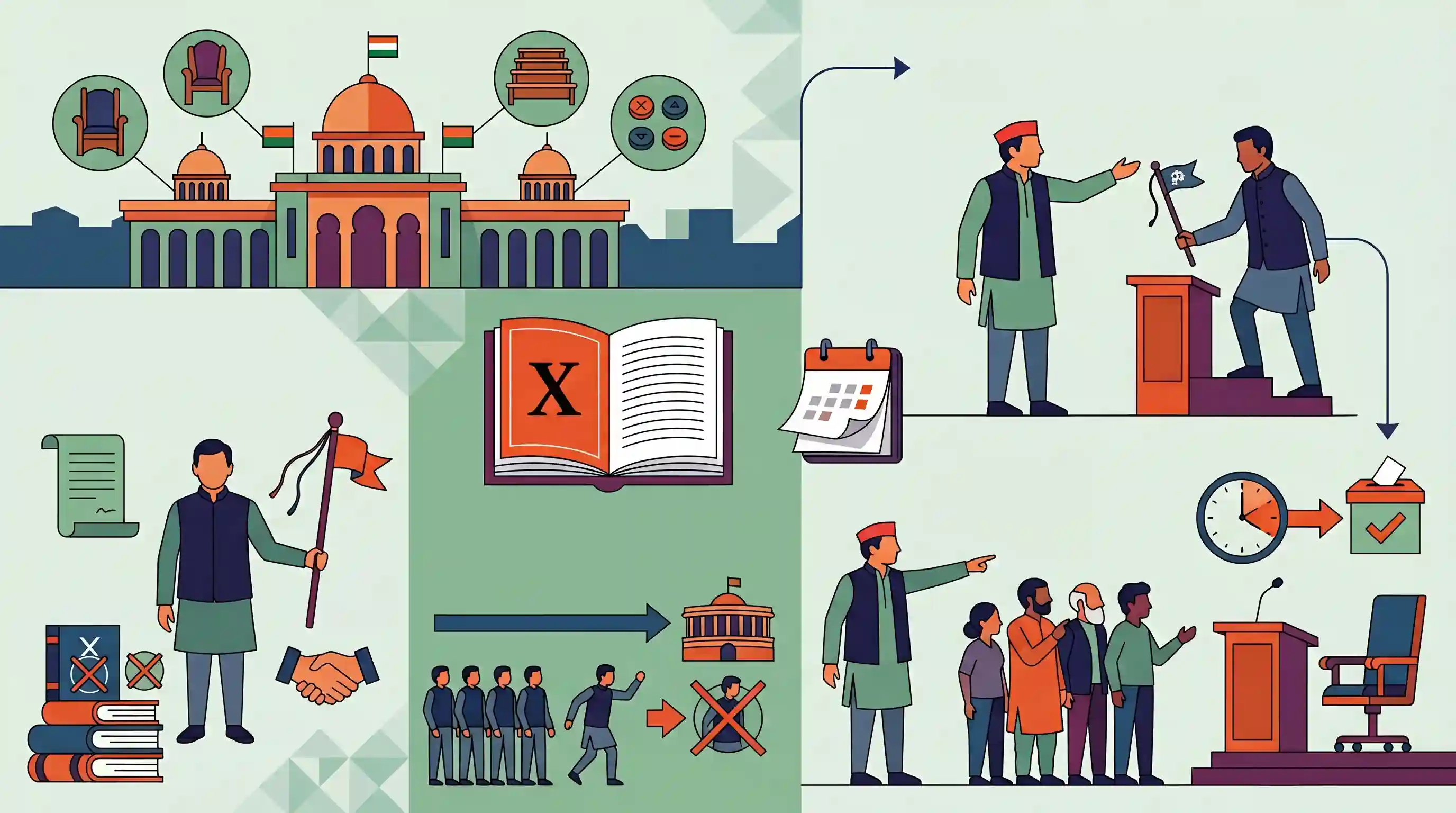
On June 30, 2026, Samajwadi Party's Chief Whip in the Uttar Pradesh Legislative Assembly, Kamal Akhtar, resigned from his post upon directions from party president Akhilesh Yadav. Representing the Kanth constituency, Akhtar took up the role in 2024 after Manoj Pandey's resignation. The party plans to appoint a new Chief Whip from the PDA (OBC, SC, and Minority) communities ahead of the 2027 assembly elections. Politically and constitutionally, the development highlights the significance of the 'Whip'—a position established by parliamentary convention rather than constitutional or statutory mandates—and its crucial linkage to the Anti-Defection Law under the Tenth Schedule.
Key Points
- Samajwadi Party (SP) Chief Whip Kamal Akhtar resigned from his post in the Uttar Pradesh Legislative Assembly on June 30, 2026, following instructions from party president Akhilesh Yadav.
- Kamal Akhtar is a senior SP MLA representing the Kanth Assembly constituency in the Moradabad district of Uttar Pradesh.
- He was appointed as the Chief Whip in 2024 following the resignation of Manoj Pandey, who left the post after voting for the BJP candidate during Rajya Sabha elections.
- The resignation is part of SP's internal restructuring, with plans to appoint a new Chief Whip representing the 'PDA' (Pichhada, Dalit, and Alpasankhyak—OBCs, SCs, and Minorities) communities.
- The office of the 'Whip' is based entirely on parliamentary convention and is not mentioned in the Constitution of India, the Rules of the House, or any parliamentary statute.
- Under the Tenth Schedule (Anti-Defection Law), a legislator can face disqualification if they vote or abstain contrary to any direction (whip) issued by their political party, unless authorized or condoned within 15 days.
Important Terms
Tenth Schedule of the Constitution of India

Added by the 52nd Amendment in 1985, this schedule outlines the Anti-Defection Law, detailing the grounds on which Members of Parliament and State Legislative Assemblies can be disqualified for changing parties or defying whips.
UPSC context
GS Paper II (Polity); tests understanding of legislative discipline, political defection, and the quasi-judicial power of the Presiding Officer.
52nd Constitutional Amendment Act, 1985
The constitutional amendment that formally introduced the Anti-Defection Law into the Indian Constitution by inserting the Tenth Schedule, aiming to curb political opportunism, floor-crossing, and the frequent collapse of elected governments.
UPSC context
GS Paper II (Polity); tests knowledge of landmark constitutional amendments, historical developments in party politics, and measures to preserve electoral mandates.
Uttar Pradesh Legislative Assembly
The lower house (Vidhan Sabha) of India's largest state legislature, consisting of 403 directly elected members. It wields primary legislative and financial powers within the state, operating under Article 170 of the Constitution.
UPSC context
GS Paper II (State Legislature); tests knowledge of state legislative structures, bicameralism, regional political dynamics, and division of powers.
Samajwadi Party
A prominent regional political party in India, primarily active in Uttar Pradesh, founded by Mulayam Singh Yadav in 1992. It advocates socialist principles, representing secularism and the interests of backward classes.
UPSC context
GS Paper II (Elections & Polity); tests knowledge of party systems, national vs. regional party status, and the political representation of marginalized groups.
Bharatiya Janata Party
One of the two major contemporary political parties in India, founded in 1980. It champions nationalist and conservative ideologies, currently serving as a dominant political force at both the federal and state levels.
UPSC context
GS Paper II (Polity & Governance); tests understanding of party systems, ideological landscapes, and the mechanics of parliamentary majority in Indian democracy.
Prelims Trap
The office of the Whip and its duties are officially codified under the Rules of Procedure of the State Legislative Assemblies.
The Whip is based purely on parliamentary convention. It is not mentioned in the Constitution, any statute, or the Rules of the House.
Static Concepts Connected
What is the legal status and structure of a political Whip in India?
- Source of authority: The office is based entirely on British Westminster conventions. It is not mentioned in the Constitution, statutes, or Rules of the House.
- Three-line whip: The strongest directive requiring members to be present and vote strictly along party lines; defiance triggers Tenth Schedule disqualification.
How did the Supreme Court clarify Whip appointments in Subhash Desai (2023)?
- Parent party supremacy: The Supreme Court ruled that the power to appoint a Whip lies strictly with the political party (organizational wing), not the legislative party.
- Speaker limitation: The Speaker must recognize only the Whip authorized by the parent political party, rather than a breakaway legislative majority.
Cross-Topic Patterns
Whip vs Representative Democracy
The strict application of the Whip reduces legislators' independence, forcing them to prioritize party allegiance over constituency interests, raising debates on Article 105 and 194 free speech rights.
Rajya Sabha elections & Whip limits
While Whips govern assembly proceedings, the SC in Kuldip Nayar ruled that voting in Rajya Sabha elections cannot be bound by formal party whips under the Tenth Schedule.

2026 Prelims may test the distinction between 'political party' and 'legislative party' in appointing Whips under the Tenth Schedule.
Linked PYQs · 3
Linked PYQs · 3
- 2025UPPSC_PRELIMSGS1
Match List - I with List - II and choose the correct answer using the code given below the lists. List-I (Schedule): (A) 7th Schedule (B) 8th Schedule (C) 9th Schedule (D) 10th Schedule List-II (Subject): 1. Languages 2. Disqualification on ground of defection 3. Union, State and Concurrent lists 4. Validation of certain Acts and Regulations
- 2023UPPSC_PRELIMSGS1
Which one of the following pairs (Schedule - Subjects) is not correctly matched?
- 2008UPPSC_PRELIMSGS1
Anti defection law was passed on
