State Anti-Conversion Laws and Constitutional Freedoms
Source:The Hindu ↗
Why It Matters
Understanding the debate around anti-conversion laws is crucial for UPSC aspirants as it touches upon core constitutional principles, including secularism, fundamental rights (Articles 21 and 25), and the balance between state regulation and individual autonomy.
Summary
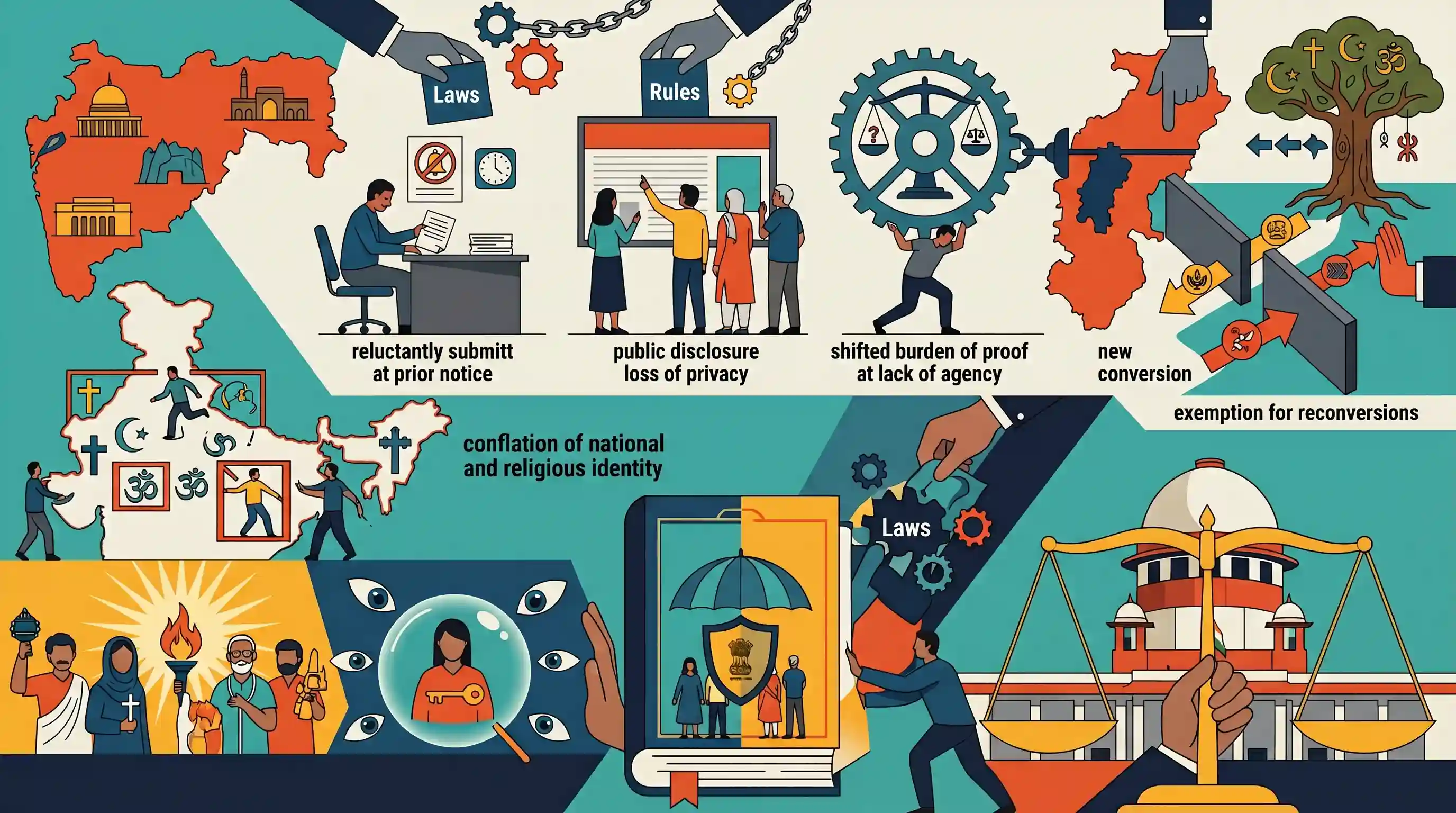
The editorial critically analyzes recent legislation passed by Maharashtra and Chhattisgarh that regulates religious conversions, joining a growing list of states with similar laws. These laws require individuals to give prior notice to authorities, mandate public disclosure, and shift the burden of proof to the converting individual, which the author argues strips citizens of their personal agency. Highlighting that Chhattisgarh exempts reconversions to ancestral religions, the piece contends that such anti-conversion laws conflate national identity with religious faith. Ultimately, these state laws are seen as a violation of the constitutional right to freedom of religion (Article 25) and the right to privacy (Article 21), with the Supreme Court currently reviewing their constitutional validity.
Key Points
- Maharashtra and Chhattisgarh have passed legislation to regulate religious conversions, joining over 10 other Indian states with similar laws.
- The laws mandate a 60-day prior notice to district authorities and shift the burden of proof to the individual to demonstrate the conversion was not coerced.
- Chhattisgarh’s legislation explicitly exempts reconversion to one's ancestral religion, often termed 'Ghar Wapsi'.
- The editorial argues these laws infringe upon fundamental rights, specifically the right to privacy (Article 21) and the freedom to profess, practice, and propagate religion (Article 25).
- Multiple petitions challenging the constitutionality of these anti-conversion laws are currently pending before the Supreme Court.
Important Terms
Anti-conversion Laws

State-level statutes (officially Freedom of Religion Acts) that prohibit religious conversion through force, fraud, or inducement, often mandating prior administrative notice and criminalizing conversions for marriage.
UPSC context
GS Paper II (Polity). Tests the balance between state regulatory power (Public Order) and individual Fundamental Rights.
Article 25
A Fundamental Right guaranteeing all persons freedom of conscience and the right to profess, practice, and propagate religion, subject to public order, morality, and health.
UPSC context
GS Paper II (Fundamental Rights). Essential for understanding the constitutional scope of religious freedom and its judicial limitations.
Right to Privacy
An intrinsic part of Article 21 (Right to Life) established in the K.S. Puttaswamy (2017) judgment, protecting an individual's autonomy over personal faith and choice of life partner.
UPSC context
GS Paper II (Polity). Tests the evolution of Article 21 and the legality of 'prior notice' requirements in personal faith matters.
Rev. Stanislaus v. State of MP (1977)
A landmark 1977 Supreme Court ruling that the right to 'propagate' under Article 25 does not include a right to 'convert' others, validating early state anti-conversion laws.
UPSC context
GS Paper II (Judiciary). The foundational legal precedent used to defend the constitutional validity of anti-conversion legislation.
Burden of Proof
In modern anti-conversion statutes, the legal 'Reverse Onus' where the accused (facilitator or convert) must prove the conversion was voluntary, rather than the State proving it was forced.
UPSC context
GS Paper II (Governance/Legal). Highlights shifts in criminal jurisprudence and the protection of 'innocent until proven guilty.'
Secularism
A 'Basic Structure' feature of the Constitution requiring State neutrality toward all religions; anti-conversion laws are often debated for their impact on this neutral stance.
UPSC context
GS Paper I (Social Issues) & GS Paper II (Polity). Critically examines the Indian model of secularism vs. majoritarian legislative trends.
Prelims Trap
Article 25 explicitly includes the fundamental right to convert another person to one's own religion.
In the Rev. Stanislaus case (1977), the Supreme Court explicitly ruled that 'propagate' means to transmit beliefs, but does not encompass a fundamental right to convert another person.
Static Concepts Connected
What gives State legislatures the competence to enact anti-conversion laws?
- State List Entry: They are enacted under 'Public Order' (Entry 1 of the State List in the 7th Schedule), allowing states to legislate on matters they claim threaten communal harmony.
- Reasonable Restrictions: Article 25(1) is explicitly subject to 'public order, morality, and health', providing the constitutional cover for states to restrict religious activities involving force, fraud, or allurement.
- Burden of Proof: These laws frequently shift the burden of proof onto the accused or the convert to prove that no coercion occurred, a departure from standard criminal jurisprudence.
How has the Supreme Court interpreted 'propagate' under Article 25?
- Rev. Stanislaus Case: In 1977, the SC upheld early state anti-conversion laws, ruling that 'propagate' means to transmit or spread one's beliefs, not a fundamental right to convert someone.
- Modern Privacy Shift: Post-Puttaswamy (2017) and Shafin Jahan (2018), courts increasingly view the individual choice of faith and partner as a core component of personal liberty under Article 21.
Cross-Topic Patterns
Privacy expanding Article 25 autonomy
Modern constitutional challenges to anti-conversion laws rely heavily on the Puttaswamy right to privacy, shifting the judicial focus from state 'public order' to individual 'decisional autonomy' over faith and marriage.
Reconversion exemptions vs Secularism
Exempting 'Ghar Wapsi' or reconversion to ancestral religions from penal scrutiny raises Article 14 (Equality) concerns, testing whether state-defined 'ancestral religion' violates the basic structure of secular neutrality.

Expect a multi-statement question in 2026 testing the overlap of Art 21 (privacy/choice) and Art 25 (propagate vs convert) via state laws.
Linked PYQs · 5
Linked PYQs · 5
- 2024MainsGS2
Discuss India as a secular state and compare with the secular principles of the US constitution.
- 2017MainsGS2
Examine the scope of Fundamental Rights in the light of the latest judgement of the Supreme Court on Right to Privacy.
- 2019MainsGS2
What can France learn from the Indian Constitution's approach to secularism?
- 2024PrelimsGS1
Under which of the following Articles of the Constitution of India, has the Supreme Court of India placed the Right to Privacy ?
- 2019PrelimsGS1
Which Article of the Constitution of India safeguards one's right to marry the person of one's choice?
