Sign Language Testimonies Secure Conviction In Abuse Case For Pwds
Source:Indian Express ↗
Why It Matters
The article provides a practical case study for GS-2 (Social Justice & Judiciary) on how legal frameworks can be adapted to overcome communication barriers for Persons with Disabilities, ensuring access to justice and accountability in institutional care.
Summary
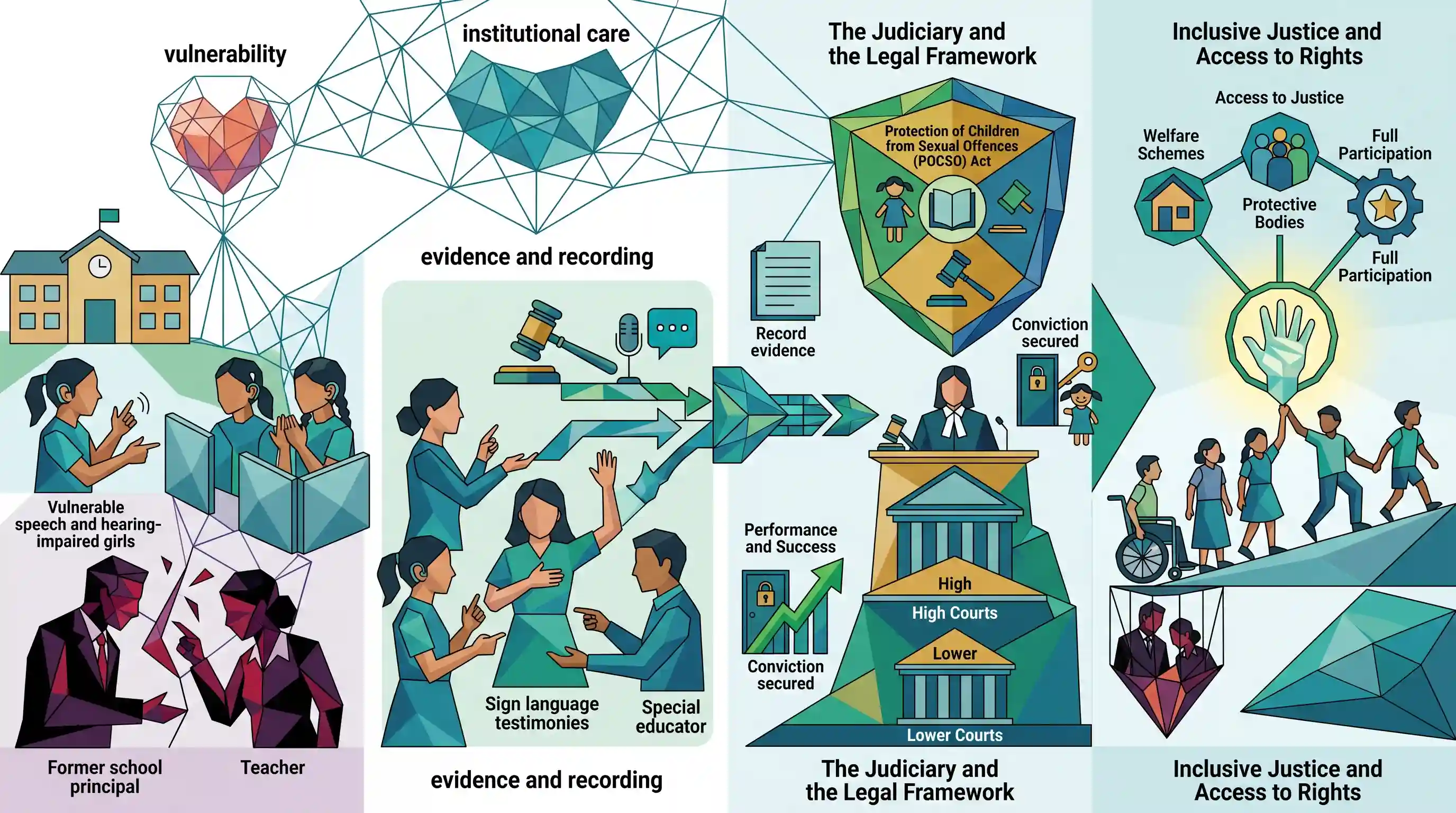
A recent judicial conviction involving the sexual assault of speech and hearing-impaired girls by a former school principal and a teacher was successfully secured through the critical use of sign language testimonies. This case highlights the heightened vulnerability of children with disabilities, especially in institutional care, and underscores the vital role of the POCSO Act. Furthermore, it demonstrates the necessity of an inclusive justice system where special educators and interpreters enable accurate evidentiary recording, ensuring that Persons with Disabilities (PwDs) are not denied their right to access justice due to communication barriers.
Key Points
- The conviction of school authorities for sexually assaulting speech and hearing-impaired girls highlights severe vulnerabilities within institutional care settings for children with disabilities.
- The successful admission and reliance on sign language testimonies demonstrate the legal system's capability to accommodate Persons with Disabilities (PwDs), ensuring their fundamental right to access justice.
- The case underscores the critical importance of special educators and certified sign language interpreters in judicial proceedings to accurately record statements of witnesses unable to communicate verbally (e.g., under Section 119 of the Indian Evidence Act).
- This serves as a precedent for intersectional justice, addressing the compounded vulnerabilities of being a female child with a disability under the POCSO Act.
Important Terms
Protection of Children from Sexual Offences (POCSO) Act

A 2012 gender-neutral law protecting minors (under 18) from sexual abuse, harassment, and pornography. It mandates child-friendly procedures, special courts, and stringent punishments for aggravated offenses.
UPSC context
GS Paper II: Social Justice; tests knowledge of welfare laws for vulnerable sections and protection of children.
Rights of Persons with Disabilities (RPwD) Act, 2016
Legislation enacted to implement the UNCRPD, expanding disability categories to 21. It mandates non-discrimination, accessibility, and equal legal rights for persons with disabilities in all spheres.
UPSC context
GS Paper II: Governance and Social Justice; relevant for mechanisms protecting vulnerable populations.
Bharatiya Sakshya Adhiniyam (BSA)
The 2023 law replacing the Indian Evidence Act, 1872. It modernizes evidence rules by incorporating electronic records and allowing remote or digitally-assisted testimonies to ensure fair trials.
UPSC context
GS Paper II: Judiciary/Legal Reforms; tests understanding of the evolving criminal justice system and evidentiary standards.
Access to Justice
A fundamental principle ensuring that all citizens, regardless of physical or communication barriers, can effectively utilize legal mechanisms to seek remedies and protect their rights.
UPSC context
GS Paper II: Constitution and Judiciary; tests concepts of legal empowerment and systemic inclusivity for marginalized groups.
Special Courts
Designated judicial bodies established under the POCSO Act to ensure speedy trials of child abuse cases while maintaining a sensitive environment for victims.
UPSC context
GS Paper II: Judiciary; focuses on the structure and functioning of specialized judicial mechanisms in India.
Prelims Trap
"Testimonies given in writing or sign language by a speech-impaired witness are legally classified as documentary evidence."
Under Section 119 of the IEA (Section 125 of Bharatiya Sakshya Adhiniyam), evidence given by a witness unable to speak via writing or signs in open court is explicitly deemed oral evidence.
Static Concepts Connected
How does the Bharatiya Sakshya Adhiniyam (BSA) treat testimony from a speech-impaired witness?
- Legal competence: A witness unable to communicate verbally is legally competent to testify in court.
- Mode of testimony: They may give evidence in any manner they can make it intelligible, such as by writing or through sign language in open court.
- Categorized as oral: Such testimonies are strictly categorized as "oral evidence" and hold the same evidentiary value as spoken testimony.
- Expert assistance: Special educators or certified interpreters can be legally mandated to assist the court in accurately recording this evidence.
What are the key provisions for PwDs in the justice system under the RPwD Act?
- Access to Justice: Section 12 mandates the State to ensure PwDs can exercise the right to access courts and judicial bodies without discrimination.
- Support measures: Requires recording testimonies in preferred formats and languages, utilizing expert assistance like sign language interpreters.
- Intersectionality recognized: Specifically acknowledges the compounded vulnerabilities faced by women and children with disabilities, requiring tailored protective measures.
Cross-Topic Patterns
Accessible Courts & Judicial Infrastructure
Connects the RPwD Act's mandate for "Access to Justice" with recent Supreme Court initiatives and e-Courts Phase III, which emphasize making physical and digital judicial infrastructure barrier-free for disabled litigants.
Intersectionality in Social Justice
Highlights the compounded vulnerabilities of gender, minor status, and disability. This intersectional framework is increasingly critical for GS-I Society and GS-II Social Justice answers regarding institutional care abuses.

Expect a Prelims question testing the Bharatiya Sakshya Adhiniyam's explicit classification of sign-language testimony as oral evidence.
Linked PYQs · 2
Linked PYQs · 2
- 2017MainsGS2
Does the Rights of Persons with Disabilities Act, 2016 ensure effective mechanism for empowerment and inclusion of the intended beneficiaries in the society? Discuss.
- 2022MainsGS4
Apart from intellectual competency and moral qualities, empathy and compassion are some of the other vital attributes that facilitate the civil servants to be more competent in tackling the crucial issues or taking critical decisions. Explain with suitable illustrations.
